Showing posts with label confirmation bias. Show all posts

Sunday, May 14, 2023

The World's Most Pressing Issue?

A couple of days ago, this intriguing prompt appeared on the FB page of one of Curmie’s former students: “What do you think is the world’s most pressing issue and why?” Curmie was tagged, but didn’t reply right away, partially because he wanted to craft an appropriate response, partially because he realized that whatever he said would almost certainly be unreasonably long for a Facebook comment, partially because his laptop charger had died, and he didn’t want to drain the battery. 

But now Curmie has a new charger and both the time and space to give this question due consideration. There are, of course, a multitude of possible answers—at the largest scale, there’s global warming (this would have to be #1 because it affects everyone and because the situation continues to get progressively worse), the possibility that the conflict between Russia and Ukraine might evolve into something even worse, the ongoing threat of sectarian terrorism, plus a hot of other issues, of course. 

The likelihood that after the 2024 elections the leader of the free world, whether it’s the current incumbent or his predecessor, will be a bumbling, mentally unstable, octogenarian (yes, Curmie knows, Donald Trump would be “only” 78 on Inauguration Day 2025; go with me here, Gentle Reader) is certainly a cause for some concern. Significantly, as Curmie suggested earlier this year, there’s literally no one in either party to vote for, only a lesser-of-two evils alternative to an even worse candidate. 

Other issues—gun violence, restrictions on 1st amendment rights from both the left and the right, wealth/income inequality, immigration policies, abortion rights, etc.—are more US-specific, but they are, or should be, on the minds of all Americans, and global implications are certainly present if not necessarily paramount. 

But Curmie ultimately decided to distinguish between the general and the specific. Finding solutions to the former is more attitudinal than policy-based. I was already heading in this direction when I read an excellent response from another of my friend’s friends, suggesting that we concentrate on what he calls “empathic thinking.” This idea is at least a first cousin if not a sibling to Curmie’s point of view, but they’re not quite the same. 

Curmie’s first musings on the subject vacillated between distinguishing between short-term and long-term thinking, and between self-serving and altruistic motives. So the temptation was to declare the #1 problem to be a concentration on short-term personal advantage. It is this attitude that leads to “gotcha” journalism, to political demagoguery, and indeed to a wide variety of deceitful practices. 

The best example of this phenomenon that comes to mind at present is the GOP’s labeling of the Affordable Care Act (Obamacare), which is virtually identical to the program instituted by Mitt Romney in Massachusetts, as some sort of extreme left-wing authoritarian plot. (Yes, the actual bill, despite being a net positive, was bloated and all but incomprehensible, but they didn’t know that yet.) But it was more important to Mitch McConnell and his minions to deny President Obama a victory than to work for the betterment of the country. 

McConnell, of course, has raised partisan hackery to dizzying new heights, but there are plenty of pols, pundits, and other self-proclaimed authorities from every point on the political spectrum who practice the same kinds of chicanery; they just aren’t as good at it… or as proud of their own duplicity. 

Ultimately, though, “short-term” and “self-interest” are two problems, not one, aren’t they, Gentle Reader? Putting them together, though useful in philosophical terms, does seem to evade the larger question of a single “pressing issue.” So how do we re-define this contemplation? 

Those who know Curmie personally, or who have read this blog (or its predecessor over on Live Journal… yes, really) for a period of time, will likely know that he is something of a Confucian. As I wrote over a dozen years ago: 
One of the central tenets of Confucian thought is the avoidance of lengthy and complicated rules structures. Every situation is different, and one can never anticipate all the possible permutations. Confucius’s solution is not to try. He advocates placing authority in the hands of a junzi (gentleman) who is sufficiently endowed with both wisdom and ethical sensibility to be able to adjudicate disputes. 
The junzi business may be a little intellectually elitist even for Curmie’s taste, but the recognition that every situation differs at least slightly from every other is of crucial importance, and is too often forgotten. Take a story that has made the news in various permutations repeatedly in recent months: a white police officer kills a black man. There are three basic responses: A). “the cop is a racist,” B). “the cop was doing his job; don’t resist and you have nothing to fear,” C). “tell me more.” Only C is an acceptable answer, but Curmie fears it would place last in the voting. 

There are bad cops, and some are violent racists who hide behind a badge. (There are also bad, violent, cops who aren’t racists.)  Moreover, in some situations killing someone is legitimate. Confucius identifies three possible scenaria, each with a different ethical response. Obviously, one possibility is murder (or manslaughter), which cannot be countenanced. But killing in self-defense is justifiable. Moreover—and here’s where it gets really interesting—Confucius argues that failure to kill in certain circumstances is unethical. He was talking specifically about protecting one’s lord, but it’s just a short step from there to thinking about protecting an innocent victim (or more than one). 

And each of these descriptions is subject to shades of meaning, especially but not exclusively in terms of motive—the cop really did think he was reaching for a taser instead of a handgun, or really did think the toy brandished by the victim was an actual weapon, for example. Perhaps he was attempting simply to disarm an assailant and slipped. There are as many different versions of the story as there are incidents. 

But too many people seek only the opportunity to exercise confirmation bias, attending to the one or two facts which fit the conclusion they’re already 80% of the way to making, and casually neglecting any contradictory or even ameliorating evidence that doesn’t fit the already-constructed paradigm. 

Tell me what you understand of the events at the Capitol on January 6, 2021 and I’ll be pretty likely to identify your politics. At one level, this is unproblematic. At another level, it’s the essence of this argument. 

So what do we call the “pressing issue”? How about “intellectual laziness”? This manifests not only in our impressions of individual stories, but also in our political decision-making, and here Curmie uses the term “political” to refer to all manner of maneuvering for personal advantage, not simply in running for mayor or Congresscritter or whatever. 

Many years ago, Curmie was recruited by the then-current holder of a position of some responsibility in a subgroup of a large professional organization. Being on a nominations committee meant that you were familiar with the goals of the group and cognizant who the rising stars were most likely to be; you’d seen their work and their participation in group activities. Committee membership was an investment of time and knowledge for the betterment of the organization. 

More recently, being on that same committee is advertised to graduate students attending their first conference as a way to more quickly move into their own leadership positions. The committee didn’t call up good people and urge them to run for office; they sat back and waited for self-nominations, effectively making self-promotion the sine qua non of opportunity. Even when no one came forward, the committee did nothing. Intellectual laziness. 

Needless to say, self-promotion is valued over actual competence (let alone excellence) in more places than just the academy. A politician without “name recognition” not only has little chance of success, but is more than likely to be ridiculed by the chattering class for the audacity of merely having good ideas instead sucking up to the right donors and hiring a first-class publicist. Intellectual laziness. 

As a longtime professor, Curmie was already seeing a decline in students’ ability to think over a decade ago. In that same blog piece linked above, Curmie wrote this: 
Needless to say, a lot of students founder a little in my freshman-level classes. They get glassy-eyed stares when I refuse to tell them whether Biff or Willy is the protagonist in Death of a Salesman, mutter about unfairness when receiving less than full credit for a plausible conclusion unsupported by argumentation, panic when I disagree with an opinion expressed by the textbook author or a high school English teacher (who got a C from me in this very class a few years ago). They can't think, in other words. The more cynical among you might suspect that I play devil’s advocate from time to time, just to see if a given student really has the stuff of scholarship. To this accusation, of course, I indignantly respond, “Moi?”. 
Curmie regrets to say that the situation has only deteriorated from there. Indeed, whereas Bob Seger’s “Against the Wind” can be inspirational, the same cannot be said for pissing into the wind, and that feeling of despair became a significant reason why Curmie is now a professor emeritus

Part of the cause for this disintegration of the educational system, and hence of the culture, can be traced to politicians’ fetishistic desire for quantification and “accountability.” You’ll note, Gentle Reader, that the latter term is in scare quotes, because the sole consideration of the determination is performance on a standardized test. 

If you’ve followed this blog at all assiduously over the years, you’ll know what Curmie thinks of that idea. If not, you might start here. Short version: as part of an evaluation, such tests are not without some merit, but they measure test-taking strategies (and freedom from testing anxiety) at least as much as they do skill. And they only measure that which can be measured: that is, only things for which there is a single, unassailably correct, answer. 

Curmie used to tell Theatre History classes that if someone tells you they know for certain what Aristotle meant by “catharsis,” you should run, not walk, away from this person. You should similarly avoid those who are unequivocally convinced that Robert Frost is or is not being ironic in closing “The Road Not Taken” with “…and that has made all the difference.” There are countless other examples, of course. 

You are also free to decide that, say, Anton Chekhov was the greatest playwright of the modern age, but you’re going to need to back up that assertion with analysis—with thought. You can’t just fill in the bubble on the Scantron sheet, because there is no “correct” answer. Why is Chekhov better than Ibsen or Lorca or Williams? Responding to that question requires analysis, recognition of alternate possibilities, and actual thought as opposed to memorization. (As an experienced theatre director, Curmie suggests that actors’ ability to learn their lines is not the only criterion by which their success ought to be measured.) 

Does the educational status quo, driven largely by non-educators, encourage intellectual laziness? Unquestionably. Does the political system do so? Of course. Does what passes for journalism do so? You know what Curmie thinks on that score from the way he phrased the question. Does business suppress thought in the name of being a “team player”? You may answer in the negative to this one only if you’ve never heard of Elon Musk. 

Anyway, that’s Curmie’s answer to the question of our most pressing issue as citizens of the world: intellectual laziness. Thanks for your patience and endurance in making it this far, Gentle Reader.

Friday, January 3, 2014

The Erin Cox Case. Again.

Option #1: Curmie was snookered.

We need this guy on the case.
(Sorry, Cumberbatch fans.)
I wrote two stories (1, 2) about the Erin Cox case in Massachusetts. She, you may recall, was the high school volleyball player who was stripped of her team captaincy and suspended for five games for what she claimed was simply picking up a drunken friend at a party at which underage drinking occurred. I even nominated Principal Carla Scuzzarella for a Curmie Award. In fact, she was leading the voting when reader Renee provided a link that suggests that all of Ms. Cox’s allegations of mistreatment were, to coin a phrase, lies.

I know, I know, I was relying on reporting from sources like the Boston Herald and WBZ-TV. I ought to be able to trust them, but I should also know better. Indeed, even when the story spun by Cox and her opportunistic and quite possibly dishonest attorney Wendy Murphy began to unravel, I distrusted school authorities in general so much that I dismissed their claims of due process with a good deal of contempt. (I still don’t believe the denial of a zero tolerance policy, by the way.)

In other words, I was guilty of confirmation bias.

Or perhaps not.

Option #2: All those initial allegations were true.

The only evidence that they weren’t is one story in a monthly local free paper which has been repeated a couple of times but never independently confirmed by a news source you’ve ever heard of. One way or the other, that’s evidence of unethical journalism: either by the big media outlets who didn’t admit their mistake or by The Valley Patriot.

Let’s see: there’s a “handwritten letter to the court” which is quoted but not shown, nor is a link provided. “The officer who charged Cox with possession of alcohol was Boxford Police Officer Brian Neeley, the same officer who wrote the email to the North Andover Schools on her behalf.” So why did he write the e-mail? Moreover, as argued on the Stately McDaniel Manor site:
If we assume this reporting and anonymous “Valley Patriot sources” in the district court and law enforcement are accurate, there remain a number of perplexing questions. If [the Valley Patriot’s Tom] Duggan’s sources for this story do indeed come from the local court and law enforcement, they are not only violating the ethics of their positions, but likely, Massachusetts privacy laws relating to juveniles. This is an inherent problem of this sort of case. Pursuing facts that are hidden behind privacy walls requires someone to breach those walls, always unethically, usually illegally. One may argue that the public has a “right to know,” but there is no such “right” in the Constitution or elsewhere. This also raises the question about whether it is ethical for journalists to entice public employees to violate the public’s trust and even the law. After all, this is hardly an issue of national security or the betrayal of a vital public trust by a high governmental official. There is not a great deal of honor in whistleblowing in such cases.
Moreover:
In any reasonable interpretation of Duggan’s prose, the local police are saying that when [school district lawyer Geoffrey] Bok wrote that Cox was arrested, he was “not correct,” or in common, everyday English, he lied. Yet Duggan says that there is no evidence that Bok lied, citing the distinction I have drawn regarding physical custody arrests and citations. Apparently the local police think that distinction important and believe that Cox was not arrested. Because even a citation is actually an arrest, this would tend to support Murphy and the police, not Duggan or Bok.
Mike McDaniel concludes:
Regular readers know I am anything but a defender of the mainstream media. Perhaps they have not retracted their stories because they do not have definitive proof they were wrong. Can we believe Duggan’s anonymous sources? Perhaps. As I wrote, it would certainly not be unusual for any teenager in a difficult situation to present them self in the best possible light, even to lie. Perhaps Erin Cox did lie about this. Duggan certainly seems to believe that, but if he does have a copy of Cox’s handwritten “confession,” he is also sufficiently savvy not to publish it or to reveal from whom he received it. That could be legally expensive. It is possible, too, that the police and courts wanted that information leaked, so the leakers had nothing to fear, but that opens another can of ethical and legal worms, and arguably a larger and more convoluted can….
I’ll continue to dig toward a resolution I can report with confidence. Until then, you have all the facts I’ve been able to discover. I recommend that you, gentle readers, don’t hold your breath.
Apart from the fact that Curmie has a special affection for those who address their audience as “gentle readers,” I think McDaniel makes a lot of sense.

The fact is that these waters are very muddy indeed. Did the national and regional (i.e., Boston) media sensationalize the story and then abandon it when things got complicated? Of course. Was Cox in possession of alcohol? Perhaps. Did the school provide an appropriate hearing? Perhaps. Were Principal Scuzzarella’s actions worthy of a Curmie Award? If, but only if, the anonymous sources and reporting of a small-town free press are on the up and up. So whereas I urge you to vote for the 3rd Annual Curmies (nominees here; ballot in the upper right corner of this page), I don’t think it’s appropriate to vote for her (and I can’t remove her from the ballot): one of the cardinal principles of our justice system, after all, is the presumption of innocence. Ms. Scuzzarella might be guilty. “Might” isn’t good enough. And if she really did administer justice appropriately, then I apologize for saying otherwise.

Oh, and whatever is or is not true, Erin Cox is a kid. If she really was drinking, well, she wouldn’t exactly be the first teenager to do that. Her mother and lawyer may be irredeemable, but she isn’t. Let’s let her grow up and see what happens.

Sunday, July 15, 2012

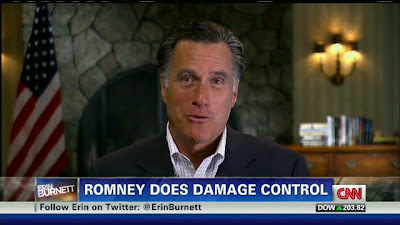
Mitt Romney's Week: Part II

And so… on to Part II of the unfolding saga of Mitt Romney’s week.

A couple of days ago, the Boston Globe published a story—not the first of its kind, but the biggest, latest, splash—suggesting that Romney hadn’t, in fact, left Bain Capital in 1999 when he said he did, but rather in 2002. [Campaign adviser Ed Gillespie is now saying that Romney “retired retroactively” in 2002. With friends like this…] Why does it matter? Well, a number of decisions in that 1999-2002 timeframe are central to the depiction of Bain as the poster child of vulture capitalism: shutting down businesses, laying off workers by the thousands, outsourcing jobs to China and elsewhere.

Romney, at least in his candidate persona, doesn’t want to be associated with that, and he has countered allegations from the Obama campaign and others by insisting that he had nothing to do with what the company did after February of 1999.

The evidence, frankly, is somewhere between contradictory and inconclusive. A few things are clear:
1. As David Corn demonstrates in an article in Mother Jones, Bain had begun its outsourcing operations at least by 1998.

2. No one seems to dispute that Romney was the sole stockholder and CEO of Bain, at least nominally, until 2002. He received a six-figure salary, independent of payments made to him in his capacity as owner, well after 1999. It is unclear—to me, at least—whether these were deferred payments. They could have been. They also might not have been. Proclamations in either direction tell us only about the predilections of the speaker, not about the truth of the situation.

3. The original intention, at least, was that Romney would continue at Bain on a part-time basis while running the 2002 Salt Lake City Olympics, and that he was merely taking a leave of absence. It didn’t work out that way, at least as far as the “leave of absence” played out: he never returned to Bain.

4. There’s a difference between being the CEO and managing the company. Whether that is a relevant distinction is less clear.

5. Romney’s denials are littered with the same weasel-words—“I don’t recall” and such—as his denial of the prep school hair-cutting incident. That doesn’t mean he isn’t telling the truth. It does mean that he doesn’t sound like he’s telling the truth… or, rather, that he’s running his rhetoric through a Clintonesque parsing program, providing an escape hatch for every declarative sentence.

6. The Obama team’s accusations are ethically unsupportable (based on what we actually know) and politically inept. You represent the President of the United States. It goes way past “unseemly” to accuse anyone, let alone a legitimate candidate for the Presidency, of a felony without a hell of a lot more evidence than you’ve got at your disposal. But I suppose expecting political campaigns to measure up to the standards of common decency is asking a bit much. Political astuteness, however, ought to come a little easier. Yes, you’ve put Romney on the defensive. In July. And you’ve done so with an accusation that 1). sounds hysterical, 2). might not conform to the facts, 3). abandons any claim, present or future, of taking the high road in the campaign, and 4). has the potential to blow up in your face, with Romney pointing out how desperate you were to change the subject from your guy’s track record.

At the very least, let the David Corns and Rachel Maddows do the heavy lifting. You stand on the sidelines and say, “There certainly seem to be some unanswered questions here. We urge Governor Romney to provide the necessary documentation to answer them.” But that would mean that Axelrod et al. couldn’t do their rabid Rottweiler imitations. Pity.
But to say that we don’t know everything we need to know to make an intelligent appraisal of the facts is to err more on the side of understatement than of hyperbole. And the coverage shows this. Fact-checkers like FactCheck.org, to my mind the best such service (although I don’t always agree with their conclusions, of course), concludes that there is no evidence that Romney did anything criminal, or indeed that he was indeed an active manager at Bain even when his signature appears on all those SEC filings. Others, like the Washington Post’s fact-checker Glenn Kessler, the Columbia Journalism Review’s Brendan Nyhan, and Fortune’s Dan Primack, agree.

Yet the 35 common-sense questions raised by TJ Walker of Forbes, hardly the bastion of frothing-at-the-mouth anti-capitalism, go unanswered. You can read the entire list, of course, but here are some highlights (obvious typos corrected):
1. Are you contending that an individual can simultaneously be the CEO, president, managing director of a company, and its sole stockholder and somehow be “disassociated” from the company or accurately classified as someone not having “any” formal involvement with a company?

2. You have stated that in “Feb. 1999 I left Bain capital and all management responsibility” and “I had no ongoing activity or involvement.” It depends on what the definition of “involvement” is, doesn’t it? Clearly you were involved with Bain to the extent that you owned it. Are you defining “involvement” in a uniquely specific way that only means “full-time, active, 60-hours-a-week, hands-on manager?” ….

5. You earned at least $100,000 as an executive from Bain in 2001 and 2002, separate from investment earnings according to filings with State of Massachusetts. Can you give an example of anyone else you personally know getting a six figure income, not dividend or investment return, but actual income, from a company they had nothing to do with?

6. What did you do for this $100,000 salary you earned from Bain in both 2000 and 2001?

7. If you did nothing to earn this salary, did the Bain managers violate their fiduciary duty by paying you a salary for no discernible reason? ….

15. Isn’t it possible that if Bain had made an investment during 1999 to 2002 that you felt was truly odious, for example ownership of a legal Nevada brothel, that you could have and would have used your authority to veto such a decision?

16. If, in fact, you did not veto any major investment decision during your 1999 though 2002 ownership, doesn’t that imply your broad consent of management’s decisions?

17. According to the Boston Globe, “In a November 2000 interview with the Globe, Romney’s wife, Ann, said he had been forced to lessen, but not end entirely, his involvement with Bain Capital.” Did your wife misspeak? ….

23. Every time a reporter asks you “why were you listed by Bain in SEC documents as the CEO in 2000-2002″ You respond that everyone knows you were no longer the active manager after Feb. 1999 and that you owned stock in Bain but did not manage anything. That may well be, but that doesn’t answer the question as to why Bain listed you as CEO, president and managing director. Why won’t you answer a simple question that involves basic facts that are undisputed?

24. Why do SEC documents claim you were Chief Executive Officer, President, and Managing Director of Bain Capital 2000 and 2001 if you were merely the sole owner?

29. When asked “did you attend board meetings for Bain after 1999″ you responded by saying “I did not manage Bain after 1999,” or that you didn’t attend any meetings involving things like firing people. This seems to suggest the possibility that you did attend Bain meetings in 2000 and 2001 that did not involve hiring or firing people or where you made the final decisions on investments. Is that possible?

30. If not, why not just give a blanket statement that you never attended a single board meeting for Bain after Feb. 1999?

31. If Obama owned slum apartments in Chicago that horribly mistreated poor people and didn’t provide them heat or running water, but Obama hired a real estate management firm to manage the building and collect rent, do you think it would be fair to criticize him for being a hypocritical slum lord who showed no compassion for poor people?

35. In general, don’t full-time hired managers often seek the “advice” of absentee owners and then do everything they can to implement that “advice?”
There may well be legitimate answers to these questions (I’ve omitted a couple from Walker’s list that I think are either over the top or already answered), but we haven’t heard them yet. When I rented out the house I inherited from my father about the same time all this stuff about Bain was going down, I hired a real estate manager to handle the details for me. They selected the tenants, collected the rent, and handled minor problems like a malfunctioning dishwasher or a mouse spotted under the sink. They had power of attorney. That doesn’t mean they didn’t have both an ethical and a legal obligation to remember whose house it was.

I was not merely consulted about whether to re-paint, cut down the big maple that was dying but not yet dead, or re-carpet the upstairs bedroom. Rather, they made a recommendation and I made the decision: because I was going to be the one paying for it. I understand that there are legal distinctions between this arrangement and the one Romney had with Bain, but I confess that I find it difficult to believe that the two situations were functionally very dissimilar. More to the point, while my involvement in decision-making was undeniable, it took about an hour a year. All this claptrap about how busy Romney was—“too busy to celebrate his anniversary” and other hogwash—is ultimately irrelevant. If I’m about to invest a few million dollars of a company’s money, and that company is owned by one person: I’m going to give him a call, even though I know “he’s busy,” just to make sure he’s on board. If the Bain people didn’t, they’re idiots… and Romney hired them, making him… well…

One more thing: FactCheck.org found a few months ago that Romney’s claim to having created 100,000 jobs is not merely “unproven” and based on the work of many people whose initials aren’t WMR, but relies on figures… wait for it… after Romney claims to have left Bain. Staples is a big corporation now. Bain helped it out a decade or more ago. That means Romney created the job of every current Staples employee. Really, that’s how his mind works.

Romney, like all politicians, wants to have it both ways. He wants credit for anything that happened on his watch, even if it happened despite him; he accepts no responsibility for anything bad, even if his fingerprints are all over the disaster. Thus, it’s Obama’s fault that the national economy isn’t doing better than it is, but Romney is blameless that Massachusetts ranked 47th in the country in job creation while he was governor. Sure, Mitt.

The best-case scenario for Romney, in political terms, at least is that he really wasn’t involved at all in Bain’s operations after February of 1999. That would mean that he entrusted a fortune to people who made no attempt to contact him (or he, them) about key decisions, even though he was the sole owner and CEO. This is the business acumen Romney would bring to the White House if elected? I’ll pass, thanks. Unlike the brouhaha over more recent uses of the Romney fortune, there’s no suggestion of a blind trust here. Nor is there any suggestion that Romney disagreed then—or now, for that matter—with any of Bain’s decisions.

He created a culture at Bain that led inevitably to the decisions that are now under attack. He hired the people who made them. He was CEO and sole owner. To expect to avoid culpability (or praise, no doubt, from some) for those decisions is the height of arrogance.

That said, the Obama campaign’s mud-slinging is as depressing as it is petulant. Somewhere in How-to-Run-a-Political-Campaign school, there must be a course called “It Isn’t Slander if We Do It.”

How this contretemps will play out, and to whose advantage, has yet to be determined. It is plausible that there’s more to the charges than we currently know, and/or that the Obama team will make the allegations stick. It’s also plausible that Romney could benefit, by getting this potentially embarrassing episode out of the way in July, and/or by making the reckless shrillness of the Obama campaign an issue: “look at what they’re willing to do to stay in power.” More likely, no one will decide whom to support based on this incident. Those on the left are ready to believe the worst of Romney; those on the right will defend him because, well, at least he isn't Obama.

This has already become a race between two versions of hubristic, two versions of ethically insupportable, two versions of ultra-partisanship devoid of even the sense to recognize that the people who are ultimately going to decide the election—those yet uncommitted—are going to be more likely to be turned off than impressed by glib histrionics. It is already an election about who deserves our vote less, not more. It’s only July. I despair.