One of my favorite lines from the late singer/songwriter Warren Zevon is “Just when you thought it was safe to be bored / Trouble waiting to happen.” That lyric came to mind when I happened across an article in the Chronicle of Higher Education titled “Hamline President Goes on the Offensive.” Well, that lyric and one of my most oft-used phrases, “Oh, bloody hell!”.
This rather lengthy article—over 3000 words—deserves to be read in its entirety, even though it may involve a (free but annoying) registration process, but I’ll try to hit the highlights here. The author is Mark Berkson, the Chair of the Religion Department at Hamline University. His was for a very long while the only voice, or at least the only audible one, on the Hamline campus to come to the defense of erstwhile adjunct art history professor Erika López Prater as she was being railroaded by the school’s administration on absurd charges of Islamophobia.
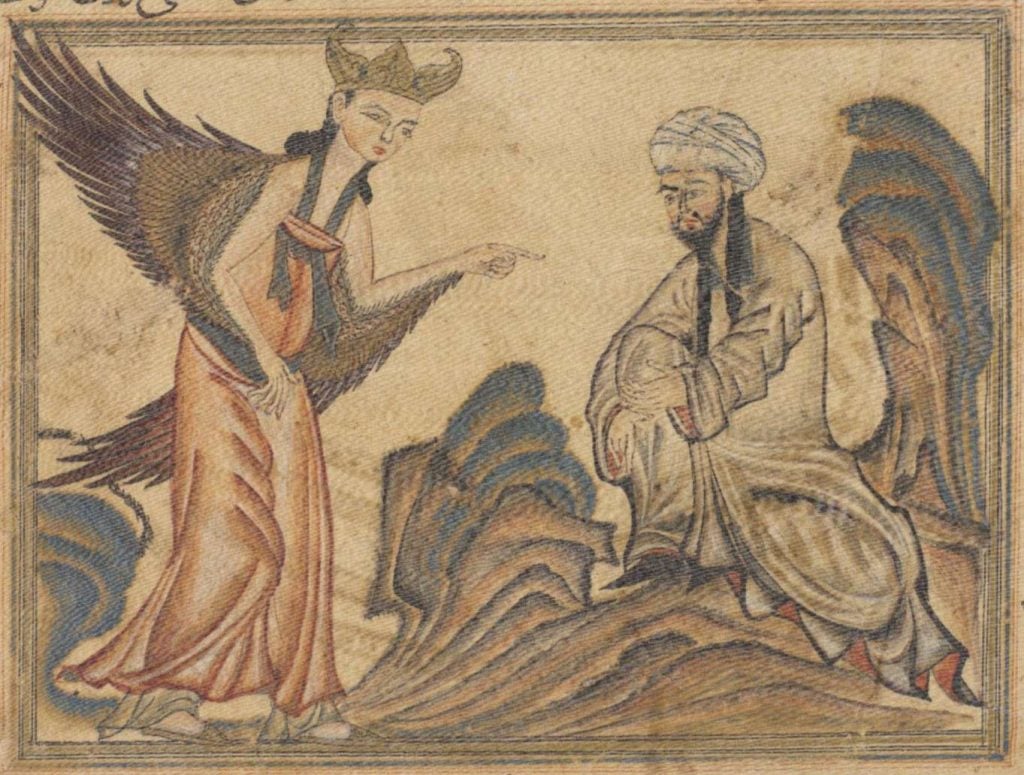
You may recall the incident, Gentle Reader. Dr. López Prater was teaching a course in global art history, in which she showed images of a couple of paintings depicting the prophet Muhammad. Recognizing that there are some strains of Islam in which viewing such images is regarded as idolatrous, she made it clear both in the course syllabus and on the day of the lecture in question that students who chose not to look at those particular photos were free not to do so, without penalty.
Ah, but that left too little room for victimhood. So student Aram Wedatalla blithely ignored those warnings and (gasp!) saw those images… or at least she says she did, which is not necessarily the same thing. Wounded to the core by her own sloth and/or recklessness, she then howled to the student newspaper and, urged on by Nur Mood, the Assistant Director of Social Justice Programs and Strategic Relations (also the advisor to the Muslim Student Association, of which Wedatalla was president), to the administration. The banner was then raised high by one David Everett, the Associate Vice President of Inclusive Excellence. (Those folks at Hamline sure do like their pretentious job titles, don’t they?)
Anyway, Everett proclaimed in an email sent to literally everyone at Hamline that López Prater had been “undeniably inconsiderate, disrespectful and Islamophobic.” To be fair, he didn’t identify her by name, but there weren’t a lot of folks teaching global art history. Everett was just getting warmed up. He subsequently co-authored, or at least jointly signed, a statement with university president Fayneese Miller that “respect for the observant Muslim students in that classroom should have superseded academic freedom.” Not at any university worthy of the name, it shouldn’t. Anyway, López Prater was de facto fired, because destroying the careers of scholars for even imaginary offenses has become a blood sport for administrators (and, in public colleges, for politicians).
There followed a not insignificant period in which the university administration was justly savaged for their disregard for facts or for due process, and for the hypocrisy of their actions, which clearly contradicted the university’s pretensions to upholding academic freedom. These denunciations came not only from other art historians, but also from such organizations as the American Association of University Professors, the National Association of Scholars, the Federation for Individual Rights and Expression, the American Freedom Alliance, PEN America, and (oh, yeah…) the Muslim Public Affairs Council. It wasn’t pretty, but it was richly deserved.
Finally, far too late and far too insincere, there was a sheepish admission that calling López Prater “Islamophobic” was “flawed.” Any with more cranial capacity than a turnip would say “freaking ridiculous,” but hey, it’s a step, right?
This torrent of negative publicity no doubt also helped to catalyze a number of other faculty to evolve from their invertebrate state and join Professor Berkson in defense of López Prater’s perfectly reasonable pedagogy. The faculty, now with the courage engendered by a very one-sided national response to events at Hamline, ultimately voted overwhelmingly to demand that President Miller resign. Also, of course, López Prater sued the university. As far as I can determine, that case is ongoing.
Like a lot of other people, I thought, despite some reservations, that it was now “safe to be bored,” to coin a phrase. The matter was now in the hands of the Trustees, and the only hope to salvage any scraps of what legitimacy Hamline may once have enjoyed would be to show Miller the door, taking Everett and Mood with her. They did not do so, of course. Instead, they behaved like Trustees (Regents, Councilors, whatever) have done at every place I ever worked in career that stretched into six decades, from the ‘70s to the ‘20s: they couldn’t admit that they were the folks who hired Miller and that they’d made a mistake. They punted, as such craven and often anti-intellectual bodies are wont to do.
So Miller is still in place until she retires “early” in June. Of course, she says, the events of the last year or so had no effect on the decision to retire. Oh, and “No one was let go for showing an image.” Also, that Nigerian prince is absolutely above-board. Just so you know. (Okay, maybe that last part is made up.)
But there was, to quote Zevon, trouble waiting to happen. A couple of weeks ago, Miller and her minions presented a forum with the heady (but, of course, misleading) title “Academic Freedom and Cultural Perspectives: Challenges for Higher Ed Today and Tomorrow.” An actual discussion offering different perspectives on how to weigh the sometimes competing values of academic freedom and respect for cultural differences would be welcome. But such things almost never happen. There’s virtually always a point of view imposed from above; in my experience, this “correct” position is seldom… well… correct.
This event, at least according to Professor Berkson, whom I tend to believe, was staged for no reason other than to excuse the inexcusable behavior of the Hamline administration. The first two people to speak: Everett and Miller. The latter declared that this was an “offensive” move. She pronounced it to contrast it with “defensive,” although stressing the second syllable would almost certainly have made her statement more accurate.
She claimed that the real threat to academic freedom was happening in places like Florida and Texas. Well, she’s right that there are threats in those places: just because some of the allegations are exaggerated doesn’t mean there isn’t legitimate cause for concern… or, indeed, for anger. But the idea that Miller and her ilk are somehow innocent because others are guilty, too? No, that argument has no merit. Dr. Berkson is kinder than I would be when he writes that “Miller fails to see that there are many ways that academic freedom can be threatened.”
Anyway, the two major culprits in the art history debacle served to introduce the keynote speaker, Michael Eric Dyson. Dyson is an intelligent, well-educated man (PhD from Princeton), and an eloquent speaker. He is best known for his ongoing rhetoric that blacks in this country continue to suffer from centuries of ongoing oppression. (Perhaps that’s why his net worth is estimated at a paltry $5 million?)
His speech, writes Berkson, made some useful points, but ultimately he contributed to what Berkson calls “essentially a full-throated defense of the administration’s actions against López Prater.” “If I got Muslim students,” Dyson said, “and I know what upsets them, I got the freedom to show what I want to show, but why would you? What’s your point? What’s your intention?” Berkson, himself an authority on Islam, responds:
It is clear that López Prater had no intent to upset anyone. She was teaching an important work of Islamic art, which is part of her job. She showed concern for her Muslim students by giving them multiple warnings, in writing and orally, to avert their eyes when she showed the image if they so wanted. This is nothing like the examples — some given more than once by many speakers at the event — of Holocaust denial, flat earth theory, fomenting an insurrection, and using the N-word in the classroom. None of these absurdly inappropriate disanalogies are remotely similar to the challenge that arose in López Prater’s art history class and that many of us regularly face — responsibly teaching relevant and suitable academic content that might be disturbing to some students.
Note to Dr. Dyson: don’t ask rhetorical questions if there’s somebody ready to answer them.
There followed a panel discussion featuring three bused-in speakers: Stacy Hawkins (her bio on the Rutgers law school website features the word “diversity” a dozen times, if that gives you an idea of her priorities), anti-racist activist Tim Wise, and Robin DiAngelo (whose books include such titles as White Fragility and Nice Racism). The sole representative of Hamline faculty was political scientist David Schultz; given the fact that Miller would rather chew on razor blades that allow Berkson a forum, Schultz is a more than reasonable representative of a professoriate more interested in developing students’ analytical skills than in inculcating them with a particular perspective.
Berkson has a lot more to say in his article—about power dynamics involving administrators, faculty (with sub-categories of tenured, tenure-track, and adjunct) and students; about the fact that none of the panelists (except Schultz) addressed the López Prater case even obliquely; about the casual assumption on the part of the guest panelists (and the Hamline administration) that faculty don’t actually care about their students’ well-being; about the distinction between freedom of speech and academic freedom; about the fact that the AAUP recognizes the delicate balance between academic freedom and respect for differing perspectives, but nonetheless describes the actions of the Hamline administration as running a “de facto campaign of vilification” against López Prater based on an “inaccurate and harmful understanding of the nature of academic freedom in the classroom.”
I do urge you to read Berkson’s entire article if this topic interests you at all. But I’ll close with this: university students are old enough to contemplate ideas that may make them uncomfortable. Perhaps these different perspectives are grounded in race, or religion, or gender, or politics—for these purposes, it doesn’t matter. Trying new things is sometimes scary, and the intellectual terrain that must be crossed can be something of a minefield, but negotiating those hazards is imperative for faculty and students alike.
Figuring out how to make that crossing successfully is not merely an admirable goal; it is a necessary one. Colloquia featuring different approaches are desperately needed. And there are any number of examples of situations in which there’s a legitimate argument for both sides of an argument (e.g., if López Prater hadn’t offered students the ability to opt out). This isn’t it. Stacking the deck with speakers eager to defend an indefensible position isn’t helpful; it’s the equivalent of defending Lauren Boebert or Jamaal Bowman for their recent headline-making misadventures.
Professor Berkson closes by
citing Professor Schultz, who said of the conversation: “Our discussion here
about diversity and academic freedom ... is probably at the most superficial
level that we can have. … At the end of the day, let’s have a real discussion.” Berkson comments simply, “Amen.”
“Amen,” indeed.
Note: as has often been the case of late, this post, or one very like it except for a couple of stylistic edits, first appeared on the Ethics Alarms page.