Showing posts with label "from the river to the sea". Show all posts

Tuesday, April 30, 2024

Greg Abbott Violates the 1st Amendment. Again.

Too fitting, alas.

When Curmie uses the term “authoritarian asshole” to describe Texas Governor Greg Abbott, he understands that the noun in question represents an opinion: an opinion shared, he suspects, by the majority of readers of this blog, but an opinion nevertheless.  The adjective, however, must be considered an objective truth.  Abbott thinks everyone should conform to his version of ethics on every possible subject, and he’ll use every resource available to punish them if they don’t.

Abbott, of course, purports to be upholding the principles articulated in the Ten Commandments, but he fares a lot better in the early ones about being Judeo-Christian than the later ones; he’s actually rather a fan of bearing false witness, for example.  Nor are we talking here about things like a restrictive abortion law or requiring age verification to visit pornsites.  The former might be (probably isn’t, but might be) grounded in an understandable belief that human life begins at the embryonic stage of development or earlier.  The latter reflects a reasonable, if logistically futile and constitutionally problematic, intention of keeping pornographic materials out of the hands of minors.

Over the past few weeks, however, Abbott has obviously and blatantly violated the 1st Amendment protections of pro-Palestinian students and others.  The first round of this debacle came in the form of an executive order in response to anti-semitism.  Problem was, it restricted the speech of a particular group of people—in this case, those supporting Palestinian autonomy—but no one else’s. 

The response from FIRE (that’s the Foundation for Individual Rights and Expression) was, as usual, right on the money.  Here’s the salient part:

Anti-Semitism on campus is a real problem. When anti-Semitic speech crosses beyond the First Amendment’s protection, Texas institutions have a moral and legal obligation to take action. But today’s executive order relies on a definition of anti-Semitism that reaches core political speech, including criticism of Israel. The order also singles out student organizations by name, suggesting these groups should draw official scrutiny on account of their views.

State-mandated campus censorship violates the First Amendment and will not effectively answer anti-Semitism. By chilling campus speech, the executive order threatens to sabotage the transformative power of debate and discussion. That’s in sharp contrast to Texas state law, which wisely recognizes “freedom of speech and assembly as central to the mission of institutions of higher education.” When speech on contentious issues is subject to punishment, minds cannot be changed.  

Curmie would explain that the definition of anti-Semitism in question is included in Texas Government Code Section 448.001; it is ultimately derived from the International Holocaust Remembrance Alliance’s “working definition.”  One might reasonably surmise that such an organization might have a rather broader definition of the term than what might be considered normative.  Even the IHRA, however, includes this proviso: “criticism of Israel similar to that leveled against any other country cannot be regarded as antisemitic.”

Monday morning Curmie watched a FIRE webinar featuring Alex Morey, that organization’s Vice President of Campus Advocacy; Will Creeley, their Legal Director; and Nico Perrino, their Executive Vice President.  There were several phrases that were repeated multiple times: “viewpoint and content neutral,” “reasonable time, place, and manner restrictions,” “true threats and intimidation,” “severe, persuasive, and objectively offensive.” 

Whatever justification there may have been for Abbott’s executive order, it most certainly was not viewpoint and content neutral: he mentions two student organizations by name, having unilaterally decided they were guilty of violating free speech policies, and insists on revising existing policies to accommodate his desire to stifle the rights of those who don’t share his views. 

Abbott is correct that “from the river to the sea, Palestine shall be free” has been used by Hamas supporters to advocate the elimination of the state of Israel or even of Jews in general, but is neither denotatively problematic (it varies little from “we shall overcome”) nor objectively offensive.  The slogan has also been used by those who simply want a Palestinian homeland out from under the proverbial thumb of Israeli control. 

Creeley, as he had in a Los Angeles Times opinion piece co-written with renowned legal scholar Eugene Volokh cited by Curmie back in December, insisted that… wait for it… context matters.  In the webinar he argued that simply chanting that slogan remains protected speech; doing so while brandishing a weapon or engaging in true threats or intimidation, however, would be a different matter.  Context!

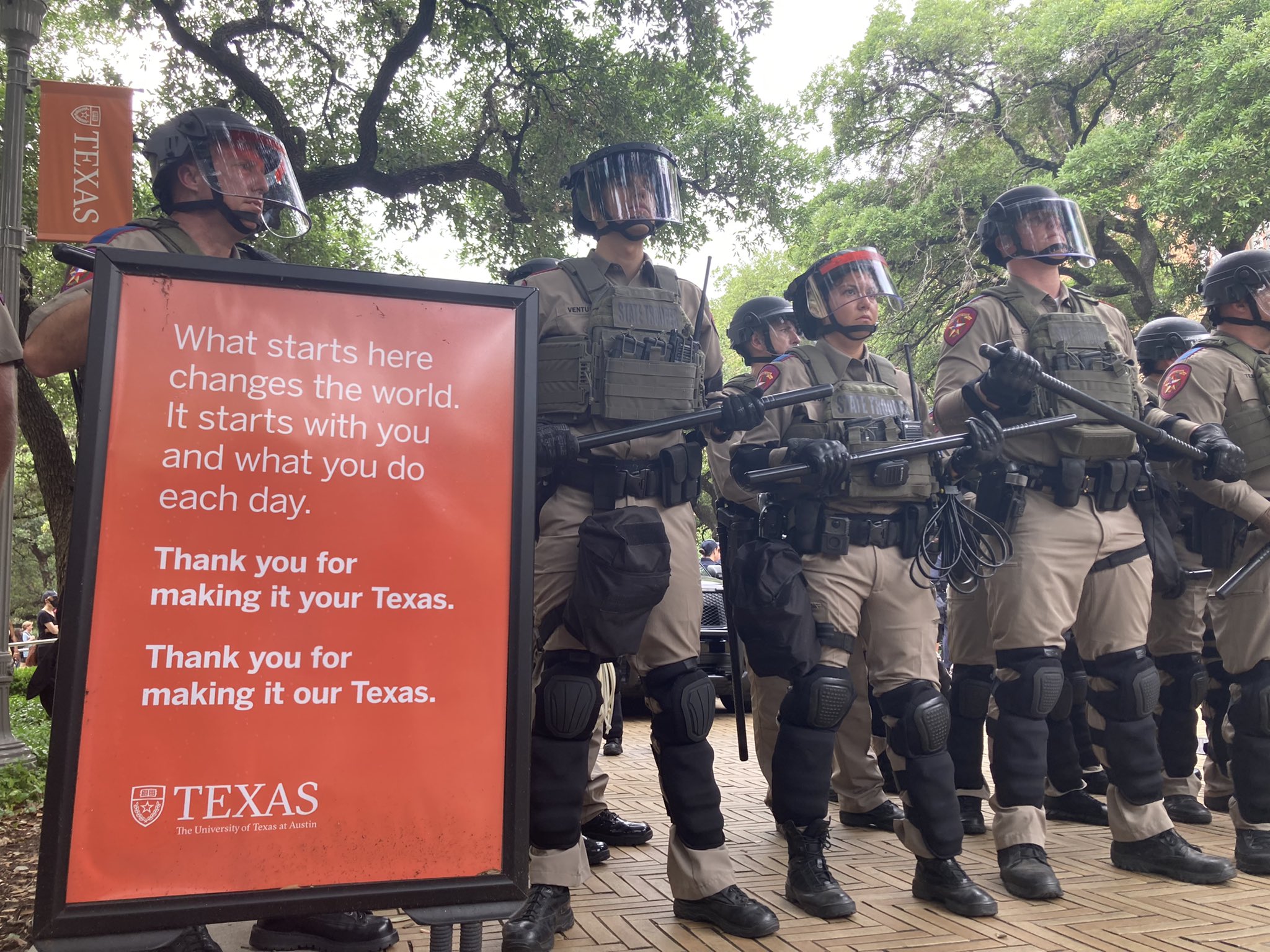
But, as they say in the late-night infomercials, Wait!  That’s not all!  If FIRE was unimpressed with the executive order, they pulled no punches in their commentary on calling in the cops to prevent a protest on April 24, simply because Governor Abbott didn’t like it… and because the University of Texas-Austin President Jay Hartzell is a spineless idiot who cravenly went along.  Dozens of arrests were made, and one photojournalist (ironically enough, from the local Fox affiliate!) was dragged to the ground from behind and detained, although video evidence shows that he was, as instructed, moving back.  In any sane society, that cop would be summarily fired and charged with first-degree assault.  Chances of that happening in Greg Abbott’s Texas: roughly those of Kristi Noem being named PETA’s Person of the Year.

Angel Eduardo’s piece on the FIRE website is headlined, “Texas tramples First Amendment rights with police crackdown of pro-Palestinian protests,” and is accompanied by the photo you see to the right.  It doesn’t get any better for Abbott and his minions later in the article.

First, there’s the re-visiting of the executive order:

Threatening expulsion for expression that some — or even many — may find offensive is a speech-chilling encroachment on students’ First Amendment rights. This is especially true when “anti-Semitism” is defined to target core political speech — such as criticism of Israel — which FIRE has warned Abbott’s order effectively does.

Then comes the link to a letter from FIRE’s Jessie Appleby to UT President Hartzell.  She gets right to the point, decrying in the first paragraph the university’s 

... outrageous and unnecessary use of riot police yesterday afternoon to forcibly disperse students and faculty engaged in a peaceful Gaza solidarity walk-out on campus, taking journalists covering the event with them.  UT Austin, at the direction of Governor Greg Abbott, appears to have preemptively banned peaceful pro-Palestinian protesters due solely to their views rather than for any actionable misconduct.

Tell us what you really think, Jessie!  She’s not done, though: 

UT Austin’s disproportionate response to a seemingly peaceful protest, on expressly viewpoint-based grounds, raises serious constitutional concerns. As a public institution, any university restriction on student expression must comport with the First Amendment’s “bedrock principle” of viewpoint neutrality…. rules must be viewpoint- and content-neutral, narrowly tailored to serve a significant government interest, leave open ample alternative channels for communication, and—perhaps most importantly—not selectively enforced based on a speaker’s viewpoint.

Moreover, 

Texas law is clear: Outdoor common areas on state university campuses are traditional public forums open for “any person to engage in expressive activities in those areas of the institution’s campus freely…. A peaceful protest in an area of a state university that is open to public expression is not unlawful “occupation”—protesters cannot unlawfully occupy a space by engaging in expressive activity they have every right to pursue in a space in which they have every right to be….

UT Austin has abdicated its constitutional and state-mandated obligations to protect expressive rights on its campus.

That pretty well sums up Appleby’s letter, but Eduardo has yet more in his article.  He includes one last jab, linking to a video from a mere six months ago, in which UT Vice President for Legal Affairs and General Counsel Amanda Cochran-McCall says “state law in Texas actually allows members of the public just like our university community to come onto campus and use our common outdoor areas for speech activity.”  Eduardo wonders “what changed?”  The answer, as he well knows, is that, like Elon Musk, Greg Abbott is profoundly interested in free speech for anyone who agrees with him; everyone else… well…

Curmie has followed FIRE for a decade or more, and has never seen a more thoroughgoing and incisive excoriation of a university’s willing capitulation to a politician more interested in shutting down opposition to his personal perspectives than in obeying the US Constitution, or indeed Texas law.

Curmie expected no better from Greg Abbott.  He’d hoped for more from UT officials, but is well aware that competent and conscientious university administrators are approximately as plentiful as honest men in Diogenes’ world.

Note: none of the foregoing is intended to take a stance in the ongoing hostilities between Israel and Hamas.  Curmie stands by his earlier commentary; that’s it.  Nor does this essay express any opinions on pro-Palestinian protests on other campuses.  Curmie is a Confucian, remember, Gentle Reader?  Every case is different.

Sunday, January 7, 2024

Further Musings on "Context"

Claudine Gay at the Congressional hearing

The recent resignations of Liz Magill and Claudine Gay as presidents at the University of Pennsylvania and Harvard University are, of course, of interest to Curmie, both as a career academic and as an observer of American society.  They tell us more about the business of higher education than, perhaps, we would like to know.

It is widely believed that their testimony before a Congressional committee last month was evasive, even mendacious and/or anti-Semitic.  Curmie, you may recall, disagreed with those conclusions, and noted that both Eugene Volokh and FIRE’s legal director, Will Creeley, agree with his assessment.  Context does matter. 

The specific circumstances surrounding a demonstration by supporters of the Palestinian cause chanting “from the river to the sea” are central to determining the appropriate response.  That phrase has been interpreted by some to mean the extermination of Israel, or even of Jews in general.  Others claim the slogan suggests merely an aspiration to be liberated from what Palestinians perceive, not altogether inaccurately, as Israeli oppression, with no inherent suggestion of violence.  

Analogously: a swastika—the word is derived from the Sanskrit for “may all be well with you”—is a positive emblem in several Eastern religions (especially, but not exclusively, Hindu), but that’s not the first association 21st-century Americans, especially Jews, will make.  Should Hindus be prevented from using a time-honored symbol of their faith because the Nazis appropriated the image?  No, but circumspection would certainly be in order.  Context!

Back in the Dark Ages of the late 20th century, Curmie taught courses in public speaking and persuasion.  Those courses required examining the relationship between the sender and the receiver of a message.  More specifically, communication theory suggests that there are innumerable ways in which the process can go wrong.  All of us have experienced more than one episode in which what one person intended to say was not what the other person heard.  These situations, though clearly unintentional, often lead to tension… or worse.

Volokh, Creeley, and Curmie agree that context matters, that whether or not demonstrators were engaging in protected (even if objectionable) speech is a matter of context.  If the chants constitute an actual threat against specific individuals or group, if there is an incitement to criminality, then First Amendment protections (and their equivalents at private universities purporting to uphold free speech values) do not apply.  Barring that threat, however, even offensive speech must be permitted, provided it does not directly violate the rights (as opposed to the sensibilities) of others.

Curmie has long believed in the “reasonable person” approach.  That is, in this particular matter, the question is not whether Jewish students at those universities felt personally threatened, but whether a reasonable person would have interpreted the actions of the protestors in that way.  And now we’re back at context.  Curmie wasn’t there.  Neither, probably, were you, Gentle Reader.  Ultimately, we’re going to have to trust the people on the ground to make the call.  That doesn’t mean they’re necessarily right, only that we have no other reasonable alternative.

The concept of context takes on another meaning, too, of course.  Here, the issue is not free speech, but consistency.  And here is where those critical of the responses by various university administrations across the country have their most persuasive point: what if it were a different group of students who were offended or felt threatened by the actions of others?

Curmie has been dismissive here and elsewhere of, for example, the black student at the University of Michigan who felt “unsafe” when a professor showed the Laurence Olivier film version of Othello in class, or the Muslim student at Hamline University who purported to feel “unwanted” and “disrespected” when she passed up clearly stated opportunities to avoid seeing an image of the prophet Muhammad in a global art history class and would have us believe she was scarred for life.

Curmie mentions these incidents not because they’re silly, although they are, but because university administrations sided with the students and their fragile sensibilities: in the former case, a Distinguished University Professor (note the capital letters: this is an official title) was humiliated and removed from teaching his course; in the latter case, an adjunct professor (with a PhD) was de facto fired.  

It is not too big a stretch to suggest that had some group other than Jewish students considered themselves threatened on the Penn or Harvard campuses, the administrations’ actions might almost certainly would have been different.  In other words, whereas allowing the pro-Palestinian protests was arguably the correct call when considered in isolation, in context (there’s that word again!) it could reasonably be considered a hypocritical violation of the university’s precedents in order to favor one side of a contentious issue.  Are these examples of anti-Semitism?  Curmie isn’t saying “yes,” but he isn’t saying “no,” either.

This critique is especially true at Harvard, where Claudine Gray’s resignation letter includes this tidbit: “it has been distressing to have doubt cast on my commitments to confronting hate and to upholding scholarly rigor – two bedrock values that are fundamental to who I am – and frightening to be subjected to personal attacks and threats fueled by racial animus.”

Yeah, right.  Curmie may agree that responses to campus demonstrations should be based on context, but she failed to make that case in her appearance before that committee, when either she knew what questions were coming or was remarkably unprepared.  If that performance was “confronting hate,” Curmie is Miss America.  Still, Curmie is reasonably convinced that Gay would have survived the brouhaha arising from the congressional testimony had she not been outed as a plagiarist. 

As for “scholarly rigor,” well, even her supporters at the Harvard Crimson admit that “Gay’s behavior constitutes plagiarism” and that “sloppiness of this kind is unbefitting of a Harvard president.”  Yes, it is true that plagiarism cases are on a continuum, and some examples are worse than others.  But whereas the lack of intention to deceive is at least a partial excuse for an undergraduate (Curmie has seen scores of such cases), such a lack of… wait for it… rigor is unacceptable in a graduate student, let alone the president of Harvard. 

If, as many folks who know the specifics of Harvard’s honor code better than I have asserted, Gay’s plagiarism was quantitatively and qualitatively significant enough that a Harvard undergrad would have been suspended for similar offenses, Gay should be fired, not simply from the presidency but also as a faculty member.  Nor should anyone else hire her.

Predictably, Gay accepts literally no responsibility for her actions, resorting instead to claims of racial victimhood.  They are bullshit.  It may not be true that Gay got the job to begin with not because she was the best available candidate, but because she was considered the best available black female candidate (Curmie doubts that even that description is likely to be true), but it’s difficult to believe otherwise.  And her self-righteous bluster about “racial animus” only weakens what little case she had.

Dr. Gay, you were de facto removed from the presidency of the nation’s oldest and most famous university because you were proven to be a fraud, even to the satisfaction of many of your supporters.  You get to remain in a cushy faculty position, and according to one report will still bring in a salary about a dozen times as high as Curmie’s was when he retired as a full professor.  You caught a break, and it’s far more likely that your demographic profile lightened your punishment than that it precipitated it.  The wise thing to do would be to STFU.  But, of course, if you were actually wise, you wouldn’t be in this position to begin with.

Wednesday, December 13, 2023

Context, and the Effort to Pretend It Doesn't Matter

Liz Magill testifying
For better or worse, the testimony of the presidents (well, one of them is now an ex-president) of Harvard, MIT, and the University of Pennsylvania before a congressional committee a little over a week ago remains a subject of considerable commentary, particularly from those who sought to denigrate the alleged evasiveness of the presidents’ responses.

Specifically, the trio wouldn’t answer “yes” or “no” to questions posed by Rep. Elise Stefanik about whether calling for the genocide of Jews violates their universities’ policies on bullying and harassment.  They gave boilerplate responses, suggesting that context would be a determining factor.  Yes, they looked sort of bad, but Curmie struggled to discern how their answers were inappropriate.  Context does matter, always; terms like “pervasive,” “severe,” and “directed” may seem legalistic, but Curmie isn’t sure how one can answer legalistic questions without responding in kind.

Moreover, Curmie can find no one who advocated for the “genocide of Jews” in those terms.  There were, apparently, chants of “intifada,” and of “from the river to the sea.”  The former refers to resistance against oppression; it suggests the possibility of violence, and that’s what Hamas means by it, but the word is apparently used not infrequently by others without that implication. 

Similarly, “from the river to the sea, Palestine shall be free” is a rallying cry for Palestinians.  But, as Laurie Kellman points out in an AP article, “what the phrase means depends on who is telling the story — and which audience is hearing it.  Many Palestinian activists say it’s a call for peace and equality after 75 years of Israeli statehood and decades-long, open-ended Israeli military rule over millions of Palestinians. Jews hear a clear demand for Israel’s destruction.”

In other words (wait for it), context matters.  When used to justify Hamas’s slaughter and kidnapping of innocent people whose only offense was to be in the wrong place at the wrong time, or as a means of intimidating specific Jewish people, it means something different than simply an declaration of general solidarity with the Palestinian cause.  Yes, it may be naïve to believe that one is expressing the latter sentiment without recognizing the distinct possibility that others, particularly but not exclusively Jews, will hear something different than what was intended.  But naïveté should not be a punishable offense, or, rather, it carries its own punishment.

Let’s be real for a second.  Congressional committee hearings are seldom intended to illuminate an issue, but rather to provide Congresscritters an opportunity to grandstand for their respective political bases.  Witnesses at such hearings are generally to be treated as piñatas to be pummeled by the smug and censorious pols who are blinded by their moment in the spotlight.  Stefanik did admirably at getting her name in the papers (be honest, Gentle Reader, had you ever heard of her before last week?), largely by asking questions that could not be reasonably answered with the “yes” or “no” responses she so petulantly demanded.  And she got a particularly high score on the smugometer.  The link included above is from her YouTube page.  She’s pretty damned proud of herself.  Curmie doesn’t think she should be.

As expected, and no doubt intended, the press was all over the hearing.  We heard lots about the presidents’ “inability” to give straight answers.  Their performance was derided by pro-Israeli pundits and parodied by Saturday Night Live (to be fair, the show pretty well skewered Stefanik, too).  Omitted from this commentary was a recognition that there’s a difference between speech which is repulsive and that which ought to be suppressed.  Nor was there any indication that the chattering class understands that criticism of the Israeli government is not intrinsically anti-Semitic, any more that criticizing the Obama administration was intrinsically racist.  Sometimes, yes.  Always?  No.

These reports also gloat about Ross Stevens, the UPenn alum who withdrew a $100 million donation because he decided the university was doing too little to suppress what he regarded as hate speech.  This, probably more than the reaction to now ex-president Liz Magill’s testimony at the committee hearing, is likely to have been the deciding factor in her no doubt forced decision to resign.  Curmie, who would prefer educational policy to be determined by other than plutocrats, is less enthusiastic about this maneuver. 

No one, certainly not Curmie, is countenancing the actual intimidation and harassment of Jewish students, which has in fact been occurring on college campuses across the country.  How widespread it is may be difficult to determine—Curmie has seen none of it first-hand—but it unquestionably exists, and needs to be aggressively addressed.  The cries from Muslim advocates that this situation is no different than what their predecessors endured post-9/11 are probably accurate but ultimately irrelevant.  Two wrongs…

But revenons à nos moutons; back to that testimony.  As you can no doubt discern from the commentary above, Gentle Reader, Curmie was not and is not particularly appalled by those university presidents’ answers.  Guarantees of free speech mean nothing if they apply only to non-objectionable speech.  Whereas it is true that as private universities the three schools in question are not bound by the 1st Amendment, as elite secular institutions of higher learning they have a responsibility to be at least as open to speech, even that which they may find abhorrent, as do their public counterparts.  Plus, of course, their respective mission statements promise that level of protected speech.

But the apparent unanimity of response, even from trusted sources, gave Curmie pause.  It’s clear that the line between protected speech and harassment, intimidation, or incitement is very thin and virtually indiscernible.  Might Curmie have found himself on the wrong side of that line?  Was his contempt for Rep. Stefanik’s self-righteous (and, indeed, harassing) posturing affecting his judgment on the larger issue?

Then, yesterday morning, he read an editorial in the Los Angeles Times penned by Eugene Volokh and Will Creeley.  The former is one of the most-respected constitutional scholars in the country; the latter is legal director at the Foundation for Individual Rights and Expression (FIRE).  When it comes to defining what is and what is not protected speech, we could do a lot worse than listening to what either of these gentlemen have to say. 

Curmie encourages you, Gentle Reader, to read the article in its entirety, but here’s their most important paragraph: “Antisemitism on campus is a real problem, and in this fraught moment, many Jewish students are understandably scared. But if freedom of expression is to survive on American campuses — and for our nation’s vitality, it must — Magill’s original answer was right. Context does matter.”

They subsequently argue that calls for intifada are protected or not according to context.  And whereas the segment quoted above is the best encapsulation of their total argument, the part that most caught Curmie’s attention comes later, in a consideration of the ethics and morality of killing civilians in order to advance a politico-military agenda or, especially, to deter other killing.  They note that the same argument could be made by both Hamas in their self-image as freedom-fighters and by the Israeli government in terms of their willingness to allow predictable and significant collateral damage in the form of civilian casualties in their attacks on Hamas.

Significantly, write Volokh and Creeley, “a broad rule against ‘calling for mass killing’ would render this discussion subject to punishment. Indeed, it would mean students could be punished for using the same argument to defend the American bombing of Hiroshima and Nagasaki.” 

Curmie notes an even more significant example: the British decision to allow Coventry to be bombed in order that the Nazis not know that the Enigma Code had been cracked.  That decision—sacrificing not merely civilians, but one’s own civilians—was a key to the Allied victory.  It literally could have changed not merely the longevity of the World War II, but its very outcome.  It had to have been a horrible decision to have to make, but it isn’t difficult to understand the reasoning.  The idea that a discussion of the propriety of that strategy would somehow be off limits undercuts the entire rationale for the existence of universities.

Here is where Curmie goes all Confucian (again) and insists upon looking at these incidents on a case by case basis.  Some of the words and actions clearly ought to be forbidden; others, however upsetting they may be, ought just as clearly be allowed.  And then there are the ones in the middle, where honorable, objective, and well-intentioned people can disagree.  It would be nice to have an actual Confucius around to make those close calls, but (alas!) he’s unlikely to appear on the scene. 

The goal is, and must be, to protect one group of students and faculty from actual harassment and true threats while protecting the freedom of expression of a different group of students and faculty.  Curmie, who lived his entire professional life subject to the often stupid decisions of university administrators, is less than entirely sanguine about turning such cases over to them, but there is no better alternative.  Distinguishing between that which is threatening and that which is merely offensive isn’t easy, but the job must be done, and done well, or we all lose.