Showing posts with label "student athletes". Show all posts

Thursday, April 18, 2024

Why There’s a Teacher Shortage: Exhibit A


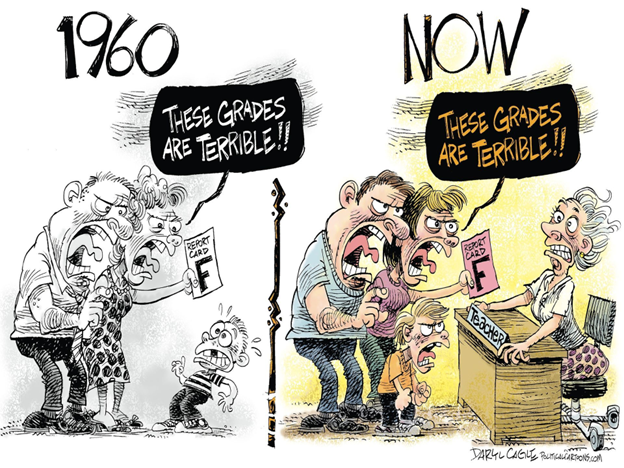
One of Curmie’s friends and former students (we’ll call him L for the purposes of this post) teaches theatre in a public school.  He recently posted on Facebook about a confrontation he’d had with the father of one of his students.  The boy had failed to do three significant assignments, and, curiously enough, his grade reflected that fact.

Ah, but you see, the lad is an athlete, and a failing grade made him academically ineligible.  So Dad screams for “about 15 minutes.”  My friend responded like this: “I want him to be able to play […], too. I understand how important it is for him to have that outlet. But if I want lights on in my house, I gotta pay bills. If I wanna drive a car, I gotta pay to put gas in the car. So, if _______ wants to play […] then he’s gonna need to stop being lazy and do what is required in this class. Not to mention the other three classes he is failing.” 

L got literally dozens of positive responses: “likes,” “loves,” and comments, including from Curmie. Indeed, although he’d done some great work as an actor for me, and had subsequently had no little success in the professional world, I’ve never been prouder of him.

What he described, of course, is a familiar situation to anyone who has taught for even a short while. Some students—especially but by no means exclusively athletes—not only want, but expect, special treatment. Their parents do, too. Sometimes their coaches get into the act. I once had a “student-athlete” bring his position coach along to whine about his grade. The latter demanded that I change the grade of his star player. Yes, demanded. Not “asked if there was anything that could be done,” demanded. I told him to get out of my office, that I wouldn’t discuss grades with anyone but the student himself. He went stomping down to the department chair’s office while I told the student that there was no way I’d change his grade.

The student had a D on one hour-exam and failed the other two. He routinely failed the reading quizzes. He didn’t write either of the two required papers. He got something like a 21 (yes, out of 100) on the final exam. Plus, we had a departmental policy that no one with seven or more absences—including excused absences—would pass the course. I can’t remember exactly how many he had… eleven, maybe? Ah, but he seized on that: one of those absences should have been excused, you see. Note that the policy doesn’t differentiate between excused and unexcused absences, that he’d still be over the limit, and that with those other scores he’d have failed even with a perfect attendance record. Oh, and the reason he missed class on that one occasion was that he was in court, being convicted of a violent crime.

The good news in this scenario was that my department chair had my back. Yes, that should be expected, but it isn’t always the case, especially if we’re talking about a star athlete, or the kid of some influential politician or wealthy donor or whatever. I don’t know if they tried to bully the dean when neither my chair nor I would give in, but if they did, he sent them packing, too.

This being a rather perspicacious readership, I suspect you know where this is heading, don’t you, Gentle Reader? I’ve been lucky enough to have spent virtually my entire career in places where I was trusted to do my job; my grading decisions were always final. But it is not always thus, as my former student discovered.

The school administration—as is too often the case, a perfect storm of cowardice (a.k.a. weeniedom), sloth, and stupidity—made my friend change the kid’s grade. Apparently, they exerted similar pressure on the other three teachers, as well, as the lad miraculously became eligible again. I’m not sure of the exact circumstances, and the Facebook post that reveals that sports (or maybe just parental bellicosity?) will always trump classwork at that particular school has been taken down. Maybe my friend capitulated to pressure; maybe the administrators just changed the grades themselves.

Anyway, I apparently saw the post in question only after it had been up for a while. I was about to tell my friend to get the hell out of that school, but then I looked at the other comments. At least a dozen other teachers, some of whom had also been my students, chimed in the they had endured similar situations at their schools, often several times. It didn’t matter where they taught, or what they taught, or how long they’d taught: same story. Students were not allowed to fail, no matter what they did…, or, more likely, didn’t do. And any attempt to apply any academic standards whatsoever must be quashed.

On the one hand, it was heartening to see my friend get support, or at least commiseration, from so many fellow travelers. On the other hand, it was chilling to see the ubiquity of the problem. It’s bad enough at the college level, where I taught. Certainly the fact that I doubted not merely the competence, but the integrity, of people up the food chain from me (different folks from the administrator(s) I mentioned earlier) was a factor in my decision to retire when I did. It’s even worse in the secondary schools.

Still, the comment that most caught my eye wasn’t one of solidarity. I can’t quote it directly, but the substance was that since my friend can’t do anything about the current situation, he should just document it and move on, because one of his students might need similar… erm… “assistance” in the future: if the administration can change grades so X can play his sport, they can change grades so Y can be in the musical.

I can certainly understand that argument as a survival tactic. It is, in some ways, equitable, but it is also an option unavailable to someone who teaches history or biology. Plus, of course, it serves to legitimize an irresponsible, anti-intellectual, and unethical process. Still, it is a metaphorical arrow in L’s quiver, whether he would ever use it or not, and he would probably be wise to let the administration know it’s there. I’m enough of a Confucian to believe that every situation is different, and it’s not difficult to imagine a scenario in which such a strategy might be at least ethically neutral.

Ultimately, all I can do is to hope that L finds a responsible way to move forward. The professions (both theatre and teaching) need people like him. He’s a good man and apparently a good teacher, too. But I couldn’t blame him if he decided that quitting would be the only ethical choice.

This is another piece originally posted on Ethics Alarms.  There are some comments there if you’re interested.  They’re also there if you’re not interested.

Tuesday, March 5, 2024

Dartmouth's Basketball Team Embarrasses This Alum, But Not as Much as the NLRB Does

The men’s basketball team at Curmie’s undergrad alma mater, Dartmouth College, is an embarrassment.  No, not because they’re terrible, although they are: they have secured last place, alone, in the not-exactly-elite (in basketball terms) Ivy League.  They didn’t win a road game all year.  As of this writing, they’re 337th (of 362) in the NET and 339th on KenPom.  They haven’t had a winning record in 15 years, and currently sport the longest active streak (dating back to 1959) of not participating in the NCAA tournament.  They weren’t very good back when Curmie was a student there; they’re worse now.

But “disappointing” isn’t the same as “embarrassing.”  Not being very good basketball players is one thing; being narcissistic little assholes is something else again.  The reason the Big Green’s hoopsters are in the news, alas, falls into the latter category.  The players voted today (as I write this on March 5) to unionize (!), thanks to a heightened sense of self-importance by some rather mediocre athletes and a remarkably inane decision by the NLRB’s Regional Director, declaring them “employees.”  All 15 players signed the initial petition to join Local 560 of the Service Employees International Union, and 13 of them voted to unionize.

The Regional Director in question is Laura A. Sacks of the Boston office.  (Curmie believes people who do remarkably stupid things in their professional capacities shouldn’t be able to hide behind an important-sounding title.  Walking lawyer jokes like Jake Krupski ought to be similarly disgraced.)  The decision itself is inane on its face, but the rationale is even worse.

Here’s the decision; let’s look at a couple of key points.  First off, there is no argument with the college’s position that financial aid is offered exclusively on the basis of financial need; indeed, four players on the team receive none, whereas one gets a full ride.  Athletes don’t get special housing or other such perks.  Again, no one claims otherwise.  A fall term message to players “encouraged” them not to schedule courses during potential practice times, particularly between 2:00 and 5:00 in the afternoon. 

Conversely, that message told players they should “[F]eel free to register for courses in the following time slots: 8S/8L, 9S/9L, 10, 10A, 11, 12.”  Here’s where Curmie’s experience becomes relevant, because he knows what that means.  About 90% of all the courses I took as an undergrad were in one of those time slots.  Afternoons, certainly after 2:00, were almost always free.  One doubts that much has changed, even given the considerable interim.

Remember, too, that since Dartmouth is on a quarter system, students take only three courses at a time, so there’s less likelihood of scheduling conflicts at all; unless a particular course necessary for a player’s degree plan was offered only in the afternoon and only during basketball season, problems are rare if not altogether absent.  It’s also unclear why the team couldn’t practice in the evening, as there are multiple places on campus with basketball courts, and much of “practice” is film study or time in the weight room.

Also worthy of notice is the fact that NCAA and Ivy League regulations prohibit teams from requiring too much practice time: “In-season, student-athletes may participate in a maximum of four hours of CARA [countable athletically related activity] daily and a maximum of twenty hours of CARA weekly….  When a sport is not in-season, student-athletes may participate in a maximum of six hours of CARA each week.”

Yet, curiously, Sacks and her minions based part of the decision on the bizarre belief that athletes should be treated differently because the demands on their time exceed those required of participants in, for example, music, theatre, or journalism.  In a word, BULLSHIT.  First off, those activities are year-round; there’s no “off season,” and certainly no time cap.  Curmie was required to spend more than four hours a day and more than 20 hours a week not infrequently (especially but not exclusively during tech weeks) when he was in school, and he's certainly expected that kind of commitment from students throughout his career as a director and technical director in college and university settings. 

The other variation on this theme was that Curmie realized early on that if he was going to be an active member of the debate team, he was going to have to spend a lot more than 20 hours a week.  He opted instead for doing research to help the team when he could, administering one of the divisions of the high school invitational tournament hosted by the Forensic Union, and occasionally brainstorming with more active team members.  But those active debaters spent dozens of hours a week working for the team.  Same with the editors (at least) of the college newspaper, the directorate of the radio station… the list goes on and on. 

It’s also frankly nuts to claim that the Ivy League is taking students out of classes willy-nilly.  Virtually all league games are played on Friday night or Saturday.  Wanna guess, Gentle Reader, how many road games Dartmouth will play this year on a Monday through Thursday while classes are in session?  The answer is… wait for it… one.  Yes, one.  Another came between the end of classes and the end of finals.  Yet somehow, we get an official NLRB ruling with nonsense like “if, for example, the team is traveling on a Monday…”  Is Sacks incapable of looking at a schedule?  Furthermore, there was no rebuttal to the coach’s testimony that players sometimes missed road trips, with his blessing, because of class responsibilities.  In the Ivy League, education matters more than sports.  It really does.

So the whole “taking them out of classes” business is nonsense.  Moving on.  OK, get this: Cade Haskins, one of the students who keeps getting quoted, says that although the college makes it clear that “it is understood by both the faculty and coaching staff that class attendance takes precedence over participation in athletics,” he often prioritized basketball.  The fact that he can’t abide by the rules is an argument in his favor?

The precedent for this action is a decision a few years back when the Northwestern football team successfully convinced the NLRB that they were employees, but because they compete in a league that includes state universities (Dartmouth doesn’t), federal law apparently makes it impossible for the NLRB to make a ruling against the university in this instance.  Of course, unlike Dartmouth or indeed any other Ivy League school, Northwestern does give athletic scholarships, so, arguably, players are indeed employees, doing a job in exchange for financial considerations.  Still, it’s ironic that it would be Northwestern, a school far more noted for its academics than its athletics, that would be the target for such a unionization effort.

There are more ironies at play, too.  It would be impossible to name an athletic conference that cares more about the importance of education relative to sports than the Ivy League does, and there are few teams in any sport in the Ivy League more inept than Dartmouth men’s basketball… well, with the possible exception of Dartmouth women’s basketball.  If these folks are “employees,” Curmie would hate to see the amateurs.

Oh, but alumni contribute to the college because of the basketball team!  (Seriously, that’s an argument!)  Luckily, Curmie had put down his mug before reading that part, or coffee would’ve come out his nose.  There’s an alumni group, you see, Gentle Reader, that contributed over $300,000 to improve the basketball facilities!  Curmie got a missive from the alumni fund the other day.  That $300k for basketball would amount to about 7/10 of 1% of the unrestricted giving to the college last year (that doesn’t count the tens of millions of dollars designated for other specific uses.) 

It goes without saying that the basketball team at Dartmouth loses a lot more money than it brings in.  Don’t expect to see games televised except on ESPN+, and whereas Curmie’s other American school (his MA is from a British university), the University of Kansas, has sold out 16,300 seat Allen Field House every game for the last 22 years, Dartmouth can’t fill 2100 seat Edward Leede Arena even half full for Senior Night. 

The fact that according to the NLRB decision, “[N]o current members of Dartmouth’s men’s basketball team participate in NIL activities” sort of tells it all.  They’re eligible to do so, but local businesses don’t care enough to pay them as spokesmen.  Why?  Because they aren’t going to attract positive attention.  Curiously enough, the “whiny loser” image isn’t one that advertisers choose to foreground.  They’ll do their own ads or hire actors who know how to read a line. 

But if NIL threatens merely the idea of collegiate sports as we know them (see Curmie’s commentary here, here, and here, for example), the prospect of having to remunerate student-athletes will—nay, should—spell the end of intercollegiate sports altogether.  Many colleges are considering cutbacks to athletic programs as it is.  Curmie wrote last year that another Ivy League school, Brown, “had to cut some varsity sports a couple of years ago: losing money on athletics was one thing; losing that much money was untenable.”  

Whereas part of Curmie says “Good!”, the fact is that cheering on the home team is, or should be, very much a part of student life.  Curmie saw dozens of athletic events—football, baseball, basketball, hockey, lacrosse, ski jumping—as a student and doesn’t want future generations of students to be denied that opportunity. 

But if pampering a cohort of mediocre narcissists will cost even more time and/or money than it already does, the tipping point draws nearer.  There are some outstanding colleges and universities that don’t have athletics teams at all, or who play only in Division III or the NAIA: Brandeis, CalTech, MIT, NYU, and the University of Chicago come to mind.  Brooklyn’s St. Francis College recently eliminated all its Division I athletics programs, citing finances.  Indeed, only a handful of athletic departments break even; most lose millions of dollars a year, the shortfall made up by increased tuition and fees borne by other students, a goodly number of whom couldn’t care less about whether the basketball team is any good.

It's also probably worth mentioning that the two players quoted in the Politico article linked above are, predictably, not among the best players of even the remarkably unsuccessful team on which they play.  They’ve totaled 153 points and 50 rebounds in 26 games (let me save you the math, Gentle Reader: that’s less than 6 PPG and 2 RPG between them); both have more turnovers than assists.  They… erm… have little hope of a career in professional basketball.  Yet they seem to be at the center of the self-glorification.  Figures.

To be fair, there will be appeals after appeals, and it’s unlikely that college officials will have to negotiate for the services of hoopsters in the near future.  That doesn’t make the initial Regional NLRB ruling any less ludicrous.  Ultimately, the argument comes down to this: are athletes are treated significantly differently from participants in other extra-curricular (or co-curricular) activities?  If the answer is no, then there’s no case.  If it’s yes, then the rationale is that because jocks have been coddled in the past, they should be even more coddled in the future.  Color me unimpressed.

Curmie is loath to quote Donald Trump with anything even bordering on approbation, but on this one, he’s got it right.  If these guys want to be considered employees, the correct response is “You’re fired.”  Laura Sacks ought to hear those words as well.

Monday, January 15, 2024

NCAA Football, Part 2: Some (Sort of) Solutions

OK, Curmie recently pointed out a handful of the manifold problems with college football as it is currently structured, especially with respect to the bowl system.  There are some issues that are insoluble, either legally (apparently) or structurally.  NIL and the transfer portal aren’t going away, but some tweaks are still possible. 

Next year’s expansion of the playoffs from four to twelve teams is stupid (it potentially adds three games to some teams’ schedules—let’s just forget about all that “student-athlete” rhetoric—but it does solve one problem and mitigate another.  There won’t be an undefeated major conference champion that isn’t given at least the opportunity to win a national title.  If you’re not clearly one of the twelve best teams in the country, STFU if you get ranked 13th. 

Plus, there will be fewer opt-outs if there’s a national title at stake instead of the rather less impressive distinction of being the champion of the Pop-Tarts Bowl.  (Yes, that’s a real bowl game.)

But these don’t begin to solve all the problems.  Let’s take the ones Curmie identified earlier and offer some possible solutions.   

NIL is becoming the principal if not sole driver of collegiate athletics.  We can’t eliminate the system altogether, but we can impose restrictions.  For example: forbid universities from marketing their players, or seeking contributions from the public (“if you want your team to keep winning, send a check”).  To give a little perspective: it is hardly a secret that Curmie is a fan of the Kansas Jayhawks; KU is the only school from which Curmie has a degree that has Division 1 football. 

Jayhawks coach Lance Leipold was heavily rumored to be a contender for the University of Washington job after their coach, Kalen DeBoer, left for Alabama.  Curmie subscribes to an email list about KU athletics.  The most recent missive manages to whine on three separate occasions about the alleged insufficiency of KU’s NIL funds as a cause for concern.  KU, by the way, is about to give Leipold a substantial raise to his meager $5.7 million salary; it appears likely he’ll soon be able to get the large Coke with his Big Mac combo if he wants it.  Collegiate sports have been mostly about money for a long time; we’re moving towards being exclusively about money.

It would be nice to impose a cap on how much a “student athlete” could make, but that’s probably not feasible.  What could certainly be done is to make all NIL contracts include a promise by the athlete to be available to play in every game, including bowl games, except when ruled medically unable to do so or there is some other reasonable excuse (death in the family, that sort of thing).  “I’m an asshole who doesn’t want to risk injury” is not such a legitimate reason.  NIL sponsors should be permitted to claw back every nickel from players who don’t adhere to this rule.

If Curmie were in a management position with an NFL team, he’d make it clear that he’s a lot more interested in players who want their team to win and do what it takes to make that happen rather than in looking out for themselves alone.  Of course, the average NFL exec is a moron who wouldn’t come to that obvious conclusion, but even curmudgeons can dream, right?

That said, players who stand to make millions as professional athletes are indeed risking their future earnings by playing in bowl games.  They will receive insurance policies based on percentage of their anticipated future income, as determined by independent authorities; the cost of these policies will be shared equally by the NCAA and the player’s university.

The transfer portal will not be open until the day after the national championship game.  Schools who contact players from other teams will be ineligible for any post-season games, including conference championships, for one year (three years for a second offense in the three year period).  Players who advertise their availability prior to that start date will be ineligible to play for anyone for one year. 

And then there are all those bowl games that nobody has ever heard of unless your team plays in it.  Here’s Curmie’s proposal: no bowl game that includes a major conference team and attracts neither 25,000 fans to the stadium nor a TV rating of 1 (i.e., 1% of television sets in the country are tuned to the game) will continue next year.  Those numbers will be halved—12,500 fans and a rating of .5—for games between Group of 5 teams. 

Games that meet only one of those criteria will be on probation: if they reach the goals next year, great.  If their numbers improve but are still below the threshold, the bowl remains on probation.  If the numbers don’t improve, they’re gone.  No new bowl game can be played within 25 miles of the venue for five years.  (A different bowl in the same city that meets the requirements would be allowed to continue.)

Using TV ratings on Sports Media Watch and attendance figures from Wikipedia, Curmie would therefore cancel the Boca Raton and Fenway Bowls immediately, and place the Birmingham, Camelia, Cure, Famous Idaho Potato, Famous Toastery, Frisco, Hawaii, Independence, Las Vegas, Mobile, Myrtle Beach, and New Mexico Bowls on probation.

Of the five current “All-Star” games, the East-West Shrine Bowl would be allowed to continue because of its charitable cause; the others would be cancelled unless they, too, adopt a recognized charity recipient of the game’s revenues.  Such a charity must not be exclusive in terms of race, sex/gender, religion, etc. 

Even if all of these ideas were to be adopted, college football will never be the same.  Curmie supposes there’s something to be said for being upfront about the corruption of the process, but that seems rather a small consolation.  “Student athletes,” especially in football, will increasingly be regarded as commodities to be bought and sold, in large part because they’re marketing themselves that way.  But until someone comes up with a better way to spend a Saturday afternoon in the fall, Curmie will probably continue to watch.  Alas.


Friday, April 2, 2010

In the Supreme Hypocrisy Sweepstakes, the NCAA Has Opened a Slight Lead on University Administrators

No fewer than four headlines about topics touching on education have caught my eye in the last 24 hours. Two of them have to do with collegiate sports, two with other issues. Sports today; other topics tomorrow (I hope).

We start with the apparent inevitability that the whores brain trust at the NCAA will, sooner rather than later, announce that the field for the men’s national basketball tournament will be expanded from 65 teams to 96. The same NCAA that crows incessantly about “student-athletes” but won’t actually require programs to take some responsibility for the academic progress of their players (my screed here) now sends forth its VP Greg Shaheen to proclaim with a disingenuousness that would make Sarah Palin proud that, in the expanded format, “the amount of time student-athletes would be out of school would be roughly the same as the current model” and there’d be “a reduction in travel time.” Yeah, right. A team that would earn a 9-seed in the current arrangement would have to play on, say, Thursday against a 24-seed (!), meaning they’d miss class for a minimum of three days (Wednesday through Friday). If they win, they play again on Saturday (against an 8-seed). But at the end of the weekend, we’re only down to 32 teams, not the current 16. So there needs to be another game, probably against a 1-seed, on Tuesday, meaning those players would miss another three days (Monday through Wednesday). And if they keep winning, they’d be expected to play again on Thursday and Saturday. Then they could go home for two whole days of classes before having to show up, by NCAA dictum, at the Final Four site by Wednesday, with games Saturday and Monday. In other words, if a 9-seed or lower made it to the national championship game, they’d miss 8 of a series of 9 classes that meet MWF. Think that can’t happen? Given the stupidity with which the exalted selection committee under-values any team that isn’t from a so-called power conference, I don’t.

Let’s leave aside the dilution of the tournament with even more mediocre teams from big conferences: if NCAA lapdog Minnesota coach Tubby Smith really “[doesn’t] see any watering down at all,” then he’s even stupider than I thought. Let’s duck, too, the thorny issue of what to do with regular-season champions from smaller conferences: include them and their conference tournament is de-valued, exclude them and the regular season is de-valued (these teams are currently guaranteed a spot in the NIT, which would presumably disappear). Let’s just concentrate on the fact that the NCAA chooses to actively disprove its own pretensions of “student-athletes.” That formulation sort of loses something if you won’t even allow these kids to go to class, don’t you think? By the way, I endorse John Feinstein’s analysis, which I read after having already come to virtually the same conclusions. This decision is about one thing only: short-term profits for the NCAA and its water-carriers the athletic departments. The fans, players, and long-term good of the game? Are you kidding?

In other sports news, it seems that some of my brethren and sistern in the academic field are getting a little disgruntled that in an era of shrinking budgets, athletics departments don’t seem to be being asked to tighten their extra-large belts even a little bit. While it is true that the football and men’s basketball programs at some universities make money, athletic departments as a whole don’t. Indeed, there are precisely two major public universities in the country—Nebraska and LSU—in which the athletics departments receive no subsidies from their respective universities. So it is, for example, that the Faculty Senate at the University of Memphis has proposed that the university eliminate its $2 million underwriting of the Athletic Department (this measure would still leave untouched the $7+ million per year the department gets from student fees). The $7.7 million subsidy by the University of California at Berkeley is similarly under fire. All told, as described in this January article from USA Today, while the rest of us have been trying to find ways of cutting back, in athletics departments at the 99 public universities in the power conferences, subsidies from the general fund grew “about 20% in four years, from $685 million in 2005 to $826 million in 2008, after adjusting for inflation. At more than a third of those schools, the percentage of athletic department revenue coming from subsidies grew during the four-year period studied.” That would be an average of over $8.3 million per school per year. That's well over 100 faculty who could have been hired or retained, or more than 300 full-ride scholarships to students who, you know, have something to offer in the classroom.

It may or may not be true that successful, big-time, athletics programs lead to alumni giving and student satisfaction: the fact that it's Conventional Wisdom doesn't make it true. All I know is that a win over Harvard in my undergrad days was as much fun as a win over Mizzou in my grad school days. As for funding, well, according to the most recent figures in the Chronicle of Higher Education, there are ten institutions with an endowment of over $1 million per student: of these, precisely one, Stanford, is in a major athletic conference. Even when we eliminate the per-student component, we’re left with the simple fact that only four of the schools with the twelve largest university endowments, and only about 46% of all universities with $1 billion endowments, have big-time athletics, and several of those that do (Northwestern, Vanderbilt, Virginia…) aren’t perennial powers in any major sport. [Note: the tables are password-protected: if you don’t have a Chronicle subscription, you’re going to have to trust me on the numbers.] So I’m thinking that there isn’t exactly a one-to-one correlation between attracting donors and going to a BCS bowl game.

On the one hand, the faculty protests at Memphis and Berkeley and wherever else are more symbolic than pragmatic. No university president has the courage to suggest that their sainted football or basketball coach isn’t worth $1 million a year, or that a bunch of functional illiterates shouldn’t take up space in classrooms, lower the level of discussion, and generally be coddled and cooed over. N.B., I am fully aware that there are a great many people about whom the term “student athlete” isn’t an oxymoron. I’ve had them in my classes. But I’ve also had the others—the ones who think they’re entitled to a good grade in my class because they can catch a football well enough to start for a team that went 4-8 in Division I-AA. No, expecting anyone in a university administration or on a Board of Trustees to care more about real student achievement than about whether the team goes to the Petunia Bowl—that would be asking far too much. But maybe some good will come of the outcry, anyway: if nothing else, I suspect at least a few more people now know that it’s the universities who subsidize athletics, not the other way around.