Showing posts with label academic freedom. Show all posts

Tuesday, May 12, 2026

The Head of a University System Should Not Be a Knuckle-Dragging Bigot

Chancellor Brandon Creighton
Curmie started a piece a couple of weeks ago about the North Carolina community college whose administration demanded changes to the set for a production of Euripides’ Bacchae only hours before the show was to open.   He thought about perhaps appending some commentary on Utah Valley University’s withdrawal of the offer to best-selling author Sharon McMahon to deliver the commencement address because, although she described herself as “gutted” by the assassination of Charlie Kirk on that campus, she said she understood why some people weren’t grieving as loudly as the some other folks wanted.  She had the audacity to quote directly Kirk’s reprehensible statements about gays, Muslims, and blacks.  That, in the world of fawning obeisance to Dear Leader and his minions, is apparently inexcusable.

Anyway, Curmie didn’t get very far with that essay that night, but he did get a start: “Sometimes Curmie thinks there are tests of intelligence, integrity, and courage for people who want to be college presidents.  You have to fail at least two to get the gig.”  Curmie expresses all due disrespect for the stupidity, over-reaching, and cowardice of Jim Morton at Cape Fear Community College and Astrid Tuminez at Utah Valley (to be fair to the latter, the rabid responses of those who regarded a smug asshole like Kirk as akin to the Second Coming might indeed have suggested the possibility of legitimate security concerns).  But the easy winner of the Censorial Asshat Tournament (post-A&M edition) goes to Texas Tech (TTU) Chancellor Brandon Creighton, whose antics Curmie read about when a friend posted a story from the Erin in the Morning page to her Facebook page, describing a litany of restrictions on, well, teaching and learning at all TTU affiliated campuses.

A little background:

There are, in fact, three different state university systems in Texas (Curmie has no idea why): the University of Texas (UT), Texas A&M (TAMU), and Texas Tech.  Curmie’s former school was independent of control from Austin, College Station, or Lubbock until a couple of years ago (when Curmie was already retired from full-time teaching), but has now been absorbed into the UT network.  UT is not without its censorial impulses (see here and here, for instance), but so far, at least, it’s the least problematic of the three systems in terms of restricting curriculum.  That’s relatively speaking good news for Curmie’s former colleagues (it could be worse!), but Curmie waits with some trepidation for the other shoe to drop.

Even apart from enacting laws any reasonable person would call 1st Amendment violations, the governor and state legislature pull all the strings.  The governor, the despicable Greg Abbott, appoints the Regents, who appoint the Chancellor and university Presidents.  Back in the Dark Ages when Curmie was a lad, such appointments were based on who could best serve the interests of the school, its people (faculty, staff, students, and alumni), and the state. 

Curmie has mentioned a few times that his father was a President in the State University of New York system.  The chair of the College Council (the equivalent of the Regents) for several of his years in office, was appointed by a Republican governor; he was the chair of the Democratic Party in an adjoining county.  Back then, both the governor and the council chair cared more about education than about pushing a political agenda (or stifling someone else’s) in the state colleges.  Curmie can’t speak for other states, but in the two he’s most familiar with, Kansas and Texas, such an attitude would now be regarded by every politician in sight as hopelessly naïve, even quaint.

Even a decade or so ago, although prospective Regents in Texas had to be active Republicans, at least some attention was paid to the ways they might benefit the institution.  Now, the only requirement is stolid sycophancy.  And it probably goes without saying that Creighton, like his compatriots at Texas A&M, has no damned business heading any educational institution, let alone a system of colleges and universities.  He has no relevant experience: he’s a lawyer and former hard-right state legislator.  He neither knows nor cares anything about education, except as a tool for propaganda. 

One more point that sort of makes this personal.  As you probably know, Gentle Reader, Curmie came out of retirement to teach two sections of Theatre History as a sabbatical replacement in the fall of 2024.  It was an intriguing return to the classroom.  Far too many students were unwilling or unable to do the level of work expected in an upper-division course, but, as Curmie noted at the end of that semester: 

...it’s extremely important to note that my best students were not only more numerous than average, but they were really outstanding.  They’d not only done the reading; they’d thought about it.  They asked pertinent questions and made intriguing comments, often analogizing (appropriately!) to other plays, novels, films, or historical events.  Most of all, and this was especially true of a couple of them, they were intellectually curious.  They’d read things that hadn’t been assigned, and then they’d ask me questions.

After a couple of decades in this business, one learns to identify students who not only excel at the undergraduate level, but show considerable potential for success in graduate school, as well.  One young woman in particular was everything you could want in a budding scholar.  I was happy to help her navigate the process, and although Texas Tech wouldn’t have been my choice for her, she was enthusiastic about her interactions with the department, and I wrote a very positive letter of recommendation for her.  I warned her about the prospect of censorship, and she took it seriously, but she was thrilled to have been offered an assistantship there.  That was all, of course, before this latest round of anti-intellectual shenanigans.  I heard from her a week or so ago; she plans to go ahead with her studies at TTU.  Curmie may wish she’d chosen a different school, but he sincerely hopes never to have the words “I told you so” form in his mind in this regard.

The white robe was at
the cleaners.

I will say this: if Creighton and his evil minions mess with her—whether by censoring professors’ ability to present the full range of information required of a course or by limiting what she could choose as a thesis topic—he’d do well to be careful out there.  Curmie makes no threats, but there just might be an angry old man (like the one at the left) with long grey hair, a beard, and a Gandalf staff, parked in Creighton’s outer office.

So… is the memo sent out by Creighton really as bad as Erin in the Morning would have us believe?  Probably not quite.  It does, for example, differentiate between course content which is “centered on,” “includes,” or contains “incidental reference” to SOGI (that’s Sexual Orientation and Gender Identity, for those of you not au courant with the latest alphabet soup).  But there’s always one sentence too many.  It’s expressly permitted, for example, to discuss “chromosomal variations” or “intersex biological conditions,” but not to make the obvious inference, that there might be more than two genders, or that “gender identity is a fluid spectrum.”

Curmie also wants to tease out the implications of some of Creighton’s definitions.  An example of an “incidental reference,” for example, is “a single sentence in a larger text.”  That hardly qualifies as a reference at all, and is most likely a side comment rather than part of a prepared lecture.  Curmie never taught a course that would qualify as “centered on” SOGI topics, but he has a number of good friends who have done so, and most if not all of Curmie’s classes are in the “includes” range.  This is especially true if we look at the “SO” part of “SOGI.”  Most of the hoopla of late has centered on trans or gender-fluid people, but if sexual orientation is also part of the equation, then anything related to homosexuality also figures into the mix.

But notice that the course need not be “centered on” one of those impermissible subjects.  It’s enough if some “course materials” do so, and Curmie can’t remember ever teaching a course that didn’t cross over that threshold.  Moreover, “in courses where course materials (inclusive of all assigned works, readings, case studies, peer-reviewed research, videos, etc.) are centered on or include sexual orientation or gender identity, alternate materials must be utilized.”  (emphasis added)  Must, mind you. 

It’s important to point out, of course, the implicit assumptions here.  Cishet relationships, because they are in the majority (and because that’s the world inhabited by the censors), are de facto not considered to be about sexual orientation, thus conflating the statistically probable with the normative.  There’s a pretty wide range of statistics concerning what percentage of the population self-identifies as LGBTQ+.  Let’s go with the Williams Institute report that puts that figure at 5.5%.  (The rate in Texas is slightly lower, at 5.1%, but that still means that well over a million Texas thus identify.)  Two things are significant here.  First, nationwide, university-age (18-24) respondents self-reported at nearly three times that figure, 15.2%.  Second, we’re going to pretend for a moment that everyone who didn’t say they were LGBT self-identified as straight, whereas a significant number of people didn’t give a yes/no answer to the question (e.g., they listed themselves as asexual, refused to answer, etc.).

Even using this probably artificially low percentage of LGBT people in the population, the chances are better than even that a class of a mere 14 Texas students includes at least one LGBT individual.  If we use the national figure for 18-24-year-olds, a class of 25 students is almost 98.5% likely to have an LGBT student, and the likelihood would be three or four.  Curmie has taught core classes of 73 (the capacity of the room) several times at a Texas public university.  Using the estimate for university-aged individuals, the chances that all 73 of those students are straight is about .0006%.  Not very damned likely, in other words.  And those LGBTQ+ students might like to see themselves treated with at least respect if not representation.

Of course, Creighton wants to leave himself some wiggle room.  This manifests in two forms: selective enforcement and prior restraint.  No matter how precise the language tries to be, it can never allow everything it wants to allow and disallow everything it wants to disallow.  There will be judgment calls every semester, and the criteria will seldom be limited to course content.  You will perhaps recall, Gentle Reader, that the two Texas A&M professors who most ran afoul of that university’s censorial dictates were the Chair of the Academic Freedom Council and the President of the A&M chapter of the American Association of University Professors, an organization that’s very close to being a faculty union if indeed it isn’t one: people most likely to think that faculty ought to have a say in university governance, in other words.  Coincidence, huh?

But Curmie is most concerned about prior restraint.  Most faculty would like to… you know… keep their jobs, and not everyone has a sufficiently high profile that they can just pack up and leave for a private university the way Martin Peterson (he of the infamous reading from Plato in a philosophy course) did.  That means looking over your shoulder a lot. 

Will I get into trouble if I talk about the piquancy of a boy playing a girl playing a boy playing a girl in As You Like It?  What about the theory that Peace in Aristophanes’ Lysistrata may have been played by a (nude) female slave, thereby not following the tradition of women being played by men?  Can I talk about John Lyly’s Gallathea at all?  (Or do I get a partial exemption because I wrote my Master’s thesis about Lyly?)  Should I not show that video about the onnagata when discussing Kabuki?  Or mention the only Chinese Opera actor most Americans have ever heard of, Mei Lanfang, who played exclusively women’s roles?

Can I, as an acting teacher, assign roles to student actors which may not conform to their sexual orientation or gender identity?  Must a production of Jean Genet’s The Maids cast all three roles as women (the play is written that way), or could a director cast the play with men, as Genet suggested he might like to do?  Is the farcical element of, say, The Breasts of Tiresias, in which the female lead grows a full beard in a matter of seconds and the male lead gives birth to 40,000 babies overnight, enough to exempt it?  Is The Children’s Hour verboten?  Is Cat on a Hot Tin Roof?  Is Rent?  Or Some Like It Hot?  Is it trans actors or trans roles I can’t use?

It’s easier to avoid that confrontation, to submit, to water everything down to accommodate the stolid and the bigoted.  But that’s not education; that’s capitulation.  Far better to suggest to Chancellor Creighton that he perform an exercise best suited to particularly limber hermaphrodites.  (Easy for Curmie to say…)

Thursday, January 8, 2026

One More Reason Curmie Is Glad He's Retired: So He Doesn't Have to Deal with Crap Like This

Regular readers of this blog will know that Curmie is a retired professor who taught for two decades at a state university in Texas.  He taught theatre, mostly the “academic” stuff like theatre history and play analysis.  As mentioned in a previous post, he taught plays and essays by a wide range of authors: some concentrated on race, others on gender, others on sexual orientation.  He showed a video of the Noble Call of Irish drag queen Panti Bliss after a performance at the Abbey Theatre. 

Some authors were communists; others were monarchists.  Their religious beliefs were Christian or Jewish or Muslim or Buddhist or Hindu or… you know, atheist.  Some wrote realism; others wrote anti-realism; others a hybrid.  Many wrote before the concept of “realism” existed except as mimesis, the “imitation of an action.”  Outside the classroom per se, Curmie directed at least three plays (As You Like It, The Breasts of Tiresias, and A Servant of Two Masters) which involved cross-dressing in one form or another, and at least three others in which a role written for a man was played by a woman.  Curmie’s job was to bring as much of the depth and breadth of theatre to his students as he could, to broaden their horizons, and ultimately to turn them loose on the world, whether they chose to pursue a career in theatre or not.

He was, and is, something of an intellectual snob: not in the sense that he believed himself to be the authority on all things theatrical, but in the confidence that he knew what material needed to be covered in a theatre history course or a topics course on Asian theatre or Non-Realism Between the Wars at least as well as, and probably better than, anyone up the food chain, certainly better than anyone more than one step up.  He was lucky enough to have deans and provosts who stayed out of his way, and department chairs who may have given the occasional piece of advice, but never commands.  And partisan political hacks would do well to steer clear.

Was Curmie further emboldened by being granted tenure and further still by reaching the point where he could retire as opposed to resign if things got too problematic?  Yeah, probably.  But he also remembers a moment in grad school when some idiot state legislator (there’s another kind?) demanded that the university submit a list of all the courses that contained any reference to homosexuality.  Curmie’s solution, articulated in a letter to the editor of the campus newspaper, was simple: send the asshole a copy of the course catalog.  You might be able to strike a math course here or there, but the chances that Pythagoras engaged in activity that would now be called homosexual conduct at some point in his life are actually pretty high.  Besides, the demand was for a list of those courses, not for only those courses, and it we wouldn’t want to inadvertently leave something out, now would we?

Anyway, yesterday was an interesting day in the world of 1st Amendment rights for university professors.  On the one hand, Darren Michael, the Austin Peay State University theatre prof who was fired for posting a link to an article about Charlie Kirk’s argument that the 2nd Amendment was worth preserving even at the cost of a few lives, settled his lawsuit with the university.  As Curmie predicted, he got his job back along with $500k and a couple other goodies.  (Curmie didn’t predict the amount, but he knew it would be substantial).  All told, it was a nice FAFO message for the Austin Peay administration.

On the other hand, we also learned of Martin Peterson, a Philosophy professor at Texas A&M being essentially told that he’d either have to stop teaching Plato in his Contemporary Moral Issues course or be re-assigned to a different course, one that meets at 8:00 a.m.  Well, that’s slightly over-stated.  He’d have to skip the parts of Plato that some idiot state legislator (or weenie dean, or whoever) believes are icky.  As usual, Gentle Reader, please excuse the redundancy of both “idiot state legislator” and “weenie dean.”

Two essential points here: First, Texas A&M is a state institution, which means that the 1st Amendment cannot be circumvented just because a university administration or state legislature wants to do so.  Second, this isn’t some grad student in charge of this course.  Dr. Peterson is not merely a Full Professor; he’s got an endowed chair.  His MA and PhD are from Swedish universities, and he taught both in Sweden and in the Netherlands before accepting his position at A&M.  Oh, and he was a Research Fellow for three years at some place called Cambridge University.  Curmie is pretty sure he’s heard of that one.  If this man says that a particular reading from Plato is essential to his course, Curmie is going to believe him.  Nor are we talking about some obscure writing of Plato’s: it’s the Symposium, which is hardly a minor work.  Of course, Peterson is also the Chair of the Academic Freedom Council at A&M, which makes him an especial target for the censorial asshat brigade.

Professor Peterson dutifully submitted his syllabus for what he called “mandatory censorship review.”  That probably didn’t win him any points with… well, with the censors, but his description is apt.  There is a new policy adopted by the Board of Regents, declaring that “No system academic course will advocate race or gender ideology, or topics related to sexual orientation or gender identity.”  Peterson is politic enough not to mention that forbidding discussion of race or gender ideology is in fact a means of advocating a position on those issues: that the social conservatives’ dogma and suppression of other viewpoints should be unquestioned.  Curmie, you will have noticed, Gentle Reader, is not similarly politic.

What Dr. Peterson does argue is that his course “does not ‘advocate’ any ideology.”  Rather, he “teach[es] students how to structure and evaluate arguments commonly raised in discussion of contemporary moral issues.”  No reasonable interpretation of the word “advocate” would suggest that Peterson should be forced to alter his course in any way.  Of course, Professor Peterson also cites a litany of legal precedents in support of his contention that the system policy in question is unconstitutional.  Needless to say, he’s right about that, too, but it probably did him more (short term) harm than good to point out that the emperor was in a state of deshabillé.

Texas, of course, has a terrible record with respect to 1st Amendment guarantees, especially during the regime of Grand Censorial Poobah Governor Greg Abbott.  There was the illegal suppression of student protests at the University of Texas in the spring of 2024; Angelo State’s banning of discussion of discussions of transgender issues and the spread of that attempt at thought control throughout the Texas Tech system; West Texas A&M’s ban on drag shows (subsequently ruled unconstitutional); the ongoing investigations of anyone deemed insufficiently hagiographic in describing Charlie Kirk; the horrific SB37, which restricts curriculum and radically reduces the faculty’s input into decision-making; and SB2972, which is downright silly, and so on.  And on.  And on.

Texas A&M itself, of course, was the site of a major contretemps last fall.  Here’s Curmie’s description (it’s the first link in this essay): “a single narcissistic and reactionary student circulated a surreptitious video of challenging a professor for including a discussion of verboten (by Trump/Abbott) topics like gender identity and transgender people.  A grandstanding pol got involved, and soon the professor was fired, the dean and department chair demoted, and the president at the very least under fire.”  This is not what universities are supposed to do.

And now there are perhaps as many as 200 Spring ’26 courses at A&M that may be subject to censorship, lest the cherubim hear something that challenges their ignorance.  Dr. Peterson’s case is the tip of the iceberg. 

The good news is that every free speech and academic organization you can think of is all over this story.  Here’s FIRE: “The board didn’t just invite censorship, they unleashed it with immediate and predictable consequences. You don’t protect students by banning 2,400-year-old philosophy.”  And PEN America: “Censoring classical texts in service of political orthodoxy is antithetical to the goals of education. Universities exist to engage students in difficult inquiry and not to suppress ideas just because they make some uncomfortable.”  And the AAUP: “A research university that censors Plato abandons its obligation to truth, inquiry, and the public trust—and should not be regarded as a serious institution of higher learning.”  You get the idea, Gentle Reader.  Curmie, of course, is honored to join the chorus.

So, you may well ask, what is going to happen to Professor Peterson’s course?  Curmie was rather hoping that the good prof would sue the university, its president, its regents, Greg Abbott, and anyone else he could think of.  After consultations with his lawyer, however, Dr. Peterson has decided to revise his syllabus.  Instead of the readings from Plato, he’s going to substitute an article from the New York Times which deals more directly with contemporary moral issues.  Its title: “Texas A&M, Under New Curriculum Limits, Warns Professor Not to Teach Plato.”  

Well played, Professor.  Well played.

Tuesday, September 23, 2025

More Censorial Hijinks in the Kirk Shooting Aftermath


Darren Michael

Regular readers of this blog will understand that Curmie is likely to take the side of theatre professors against The Man unless they’ve done something really appalling.  So it should come as no surprise that when Curmie heard about the case of Darren V. Michael, who was fired by Austin Peay State University for posts on social media, he set fingers to keyboard rather promptly.  You will, one hopes, forgive Curmie for choosing this particular manifestation of institutional censorship to highlight.

Michael had been employed by APSU since 2007, and is referred to as a “professor” in all the accounts Curmie has seen.  That may be simply a term for a faculty member at a university, but it seems to be applied as an academic rank, meaning that he almost certainly had tenure.  What he appears to have done would be protected speech even if he were a part-time adjunct, but tenure carries with it an even broader protection… or, rather, it does at institutions that aren’t run by partisan morons.  And the fact that APSU is a state school means that the First Amendment applies, irrespective of what the administration might think.

OK, so what did he do?  The university won’t say, specifically, only that he “reshared a post on social media that was insensitive, disrespectful and interpreted by many as propagating justification for unlawful death. Such actions do not align with Austin Peay’s commitment to mutual respect and human dignity. The university deems these actions unacceptable and has terminated the faculty member.”

The local news, both TV and newspaper, covered the story, but didn’t dig very far.  KZTV makes no attempt to determine what Michael said or did; ClarksvilleNow.com mentions that Michael reposted a headline from a 2023 Newsweek article: “Charlie Kirk Says Gun Deaths ‘Unfortunately’ Worth it to Keep 2nd Amendment.”  The irony that it was Kirk himself who suffered because of the nation’s infatuation with guns ought certainly to be worth noting, and no reasonable person would suggest that it’s other than protected speech.  (This is not to suggest, of course, that everyone out there is reasonable.)

Primetimer did a little better in their coverage.  First, they identified Michael’s remarks as “insensitive,” which they no doubt were, although that’s a damned low bar to clear before a right to censorship kicks in.  They also found a post on X by T.R. Sartor (@dripchud), which includes a meme of a conversation between two well-known fictional characters:  “‘Is he dead yet?’ asked Piglet.  ‘No,’ said Pooh.  ‘Fuck,’ said Piglet.” 

OK, that’s perilously close to celebratory, if it hasn’t in fact crossed the line.  But Curmie notes two things.  First, that meme has been around since the first Trump administration, and the pronoun in question has always referred to POTUS.  Indeed, Michael clearly intended that reading: Sartor’s post is on the 10th, the day of the shooting, but the meme had been posted six days earlier. It’s completely irrelevant to the Kirk assassination except as an indicator of Michael’s general political philosophy.  It’s certainly crude and more than a bit tasteless, but, importantly, it’s still protected speech.  There is no “true threat,” no “intentional incitement to immediate violence.”  Oh, and the often over-zealous Secret Service didn’t show up on Michael’s doorstep.

There’s also, of course, the matter of timing.  Michael’s post of the Newsweek headline was on Wednesday evening.  He was fired Friday morning: not a lot of time in there for due process.  [EDIT, just as Curmie was formatting: the university has changed the dismissal to a suspension, admitting they hadn’t followed due process.  Go figure, right?]  Rather, this was a typical over-reaction by a narcissistic and authoritarian university president, one Mike Licari.  He claims that APSU suffered “significant reputational damage” because of Michael’s posts.  Well, that’s utter crap.

APSU, after all, is named for the segregationist Tennessee governor who is best known nationally for signing the bill outlawing the teaching of evolution, leading to the famous Scopes “monkey trial.”  Of course, those positions were considerably more acceptable a century ago than today, but still there’s a sort of “only in Tennessee” feel to the whole business. The university accepts virtually everyone who applies, and it graduates only 27% of its students.  While Curmie is confident that there are some excellent faculty and students there, APSU is not exactly going to be confused with an elite institution.  There is not a lot of “reputational damage” to be done.

You know what does cost the school, though?  An idiot president who fires a tenured professor for posting something ironic online.  As far as Curmie can tell, there was no accompanying text to Michael’s post, no “Hate begets hate.  ZERO sympathy” like what got an assistant dean at another Tennessee state university fired.  (Hers was protected speech, too, of course.)  Unless there’s something we don’t know about, nothing Michael did was enough to spawn a raised eyebrow, let alone a dismissal without due process... or a suspension, for that matter.  (Also, of course, Curmie’s willing to bet there aren’t a lot of people in Clarksville, TN with the skillset to teach what had been Michael’s classes, either.) There is no such thing as free speech if a state employee can be fired for saying something someone in power finds distasteful.

Oh, Curmie sees that look on your face, Gentle Reader: “Curmie’s a liberal, so he’s going to side with them.”  Nope.  Curmie was a career educator and remains a passionate defender of free speech: of an Israeli guest lecturer at Michigan State most recently, of a law professor at Ohio Northern who opposed his school’s DEI policy, and of a conservative prof at North Carolina State, to name but a couple of cases.  There are plenty of examples on both sides of the political fence.  For the past couple of weeks, the oppressors have been almost exclusively on the right.  That will change in time: not because they’ll stop being censorial, but because the left will find their opportunities.  Alas.

One thing is certain: there are some university administrators out there who are about to get sued.  That brings us to the best Facebook comment Curmie has seen in a while.  The honor goes to Leslie Skrzypczak, responding to a story about l’affaire Michael posted by Cape Cod Women for Change: “They’ve tried to reach him [Michael] for comment but his lawyer’s eyes were twinkling and they laughed and laughed.”

What she said.

Sunday, April 27, 2025

Cheque Cards, Negative Connections, and Sian Leah Beilock’s Error

Dartmouth President Sian Leah Beilock

Curmie had a conversation a couple of days ago with a student who is preparing to spend a year at a British conservatory with which our university has a long-standing exchange program.  She wanted to know about things like student visas, health care, and the like.  Curmie, as regular readers of this blog know, did his MA at the University of Birmingham in England, and he was the faculty point-person on our end of his university’s exchange with that conservatory for about a decade.  He hopes he was able to help, despite the fact that some of his information may be out of date.

Anyway, that conversation conjured memories of Curmie’s own attempts to navigate the experience.  It was the first time to truly be on his own, without knowing literally anyone in a new location; having that happen in a foreign country added to both the excitement level and the stress. 

At the time, Curmie didn’t have a credit card in his own name.  He did have a one or two cards linked to his father’s account for use in emergencies, but really wanted to be as independent as possible… and didn’t necessarily want to explain purchases to the ‘rents.  Importantly, this was long ago: a lot of smaller businesses, like the convenience store across the street from Curmie’s bed-sit, didn’t accept credit cards, anyway.  Oh, and debit cards hadn’t been invented yet. 

Curmie established a checking account with the local branch of Lloyd’s Bank, and made lots of trips there to get cash.  ATMs existed, but few were located outside bank property.  So if you needed to, say, go buy a new shirt or something, you’d have to make a trip to the bank to get cash.  Or… and Curmie finally gets to his point… you’d write a check (or a cheque, to use the British spelling).

A number of banks, including Curmie’s, introduced what they called a “cheque card” as a service to their customers.  Curmie was able to get one.  Essentially, this card guaranteed that merchants would get their money on cheques up to £50 (Curmie may be misremembering the exact amount): even if there were insufficient funds in the account, the bank would make it good, and they’d be the ones to deal with their customer. 

Alas, what started out as a service that benefitted customers and merchants alike soon took a turn.  Within months if not weeks, cheque cards become a sine qua non: it was no longer a good thing to have such a card, but a bad thing not to have one.  For customers who didn’t have the account balance or sufficient reliable income to get a card, it meant that even businesses that had accepted your cheques for years would no longer do so.

Curmie was thinking about that phenomenon when reading that his undergrad alma mater, Dartmouth College, was the only Ivy League school whose president had not signed on to a “Call for Constructive Engagement” from the American Association of Colleges and Universities.  As of this writing, that open letter, dated April 22, has 509 signatories. 

Dartmouth spokesperson Kathryn Kennedy says that President Sian Leah Beilock “does not believe that signing open form letters like this one is an effective way to defend Dartmouth’s mission and values.”  With all due respect, Dr. Beilock: bullshit.  Just as the absence of a cheque card quickly became more important than the presence of one, we’re at the stage where not joining in solidarity with the leaders of hundreds of other institutions of higher learning across the country makes more of a statement than signing would.

Back in the days when Curmie taught courses in Persuasion and Public Speaking, he talked a lot about the difference between positive and negative connections.  A positive connection is when if you do X, then a good thing, Y, will be more likely to happen.  A negative connection occurs when failure to do X will make a bad thing, Y, more likely to happen.  Stop pretending that only positive connections exist.  Signing on to that manifesto almost certainly won’t make things better, but not signing will almost certainly make things worse: for Dartmouth, for higher education in general, and for the nation.

At the moment, Dartmouth is one of only two Ivy League schools not to have substantial cuts in federal funding based on little but the caprice of the most anti-intellectual administration in history.  Dartmouth’s time will come, no doubt.  Surely we’re not under the impression that craven silence is any kind of reasonable solution.  Just ask the Republican leadership in Arkansas how their embarrassing obeisance has worked out when they’re no longer a particular asset.  “No, you don’t get FEMA assistance after tornadoes.  Don’t be silly.  Bootstraps, and all that…”

By contrast, China, Canada, and the European Union refused to buckle under tariff threats and left Trump behaving as the blustering xenophobic buffoon that he is.  Or check out the international students who sued the government rather than cravenly getting on the next plane home.  Friday’s New York Times headline: “Trump Administration Reverses Course on Student Visa Cancellations.” Or look at the difference between Columbia’s cowardly capitulation which led only to more demands, as opposed to Harvard’s suggestion that 47 perform an action best suited to particularly limber hermaphrodites, which led to a declaration that the letter to Harvard was “unauthorized.”  Bullies are always cowards.

More to the point, that statement from the AAC&U is pretty inoffensive.  First off, it’s not the monodigital salute to the Trump administration that Curmie would have written.  (Curmie had most of the skills of a successful administrator… except, crucially, the ability to suck up to powerful idiots.)  The presidents seek not confrontation but “constructive engagement.”  “Let’s talk this out, in other words.

The signatories claim write that 

We are open to constructive reform and do not oppose legitimate government oversight. However, we must oppose undue government intrusion in the lives of those who learn, live, and work on our campuses. We will always seek effective and fair financial practices, but we must reject the coercive use of public research funding.

That’s clear and focused, but it’s not antagonistic.  The most important two sentences are these:

American institutions of higher learning have in common the essential freedom to determine, on academic grounds, whom to admit and what is taught, how, and by whom. Our colleges and universities share a commitment to serve as centers of open inquiry where, in their pursuit of truth, faculty, students, and staff are free to exchange ideas and opinions across a full range of viewpoints without fear of retribution, censorship, or deportation.

In other words, our colleges and universities take seriously both the First Amendment and their responsibilities to pursue truth, as opposed to claiming to have found it.  That seems a pretty straightforward articulation of both the goals and the realities of high education.  Are there sometimes breakdowns in the system that lead to unjust results?  Of course.  Educators are human. 

But does virtually every college or university care more about free inquiry than the Trump administration does?  Is that even a serious question?  Which one seeks to thwart research into contagious diseases, cancer, or climate change, and which one wants to bring together our best and brightest academics to perform that research?  And, regardless of the academic discipline, no one gets anywhere by just repeating what they’ve been told.  That’s the job of lazy undergrads… or AI (a.k.a, A-1, according to the hopelessly unqualified Secretary of Education).

Of course, not all research is conducted in scientific disciplines, but if that made research in the humanities and social sciences unworthy of pursuit, Curmie would have done a lot less of it.  All research at the level at which university faculty engage in it is about an attempt to understand the world in which we live or the way we live in it.  Importantly, studies in languages and literature, the arts, history, philosophy, sociology, and the like tend not to be those that receive big government grants (there are some, of course, from sources like the NEH and NEA), so restricting federal funding has its most serious impact on precisely the STEM fields the right seems to think are the only ones that matter... or, in Harvard’s case, on support for area hospitals.

President Beilock’s passivity is disappointing for two fundamentally different reasons.  First, Curmie was impressed by her handling of the pro-Palestinian rallies last spring: guaranteeing the protesters’ right to free expression, but placing appropriate boundaries: no interfering with others’ rights, no taking over buildings, no true threats or intimidation, etc.  Curmie is saddened by the idea that someone who could exercise such appropriate leadership then could be such a milquetoast now.

Secondly, Curmie understands why not all college and university presidents feel safe in supporting even such a moderate document as this.  Of the five schools where Curmie either received a degree or held a full-time teaching position, four are in red states, and two are state universities; we’ve certainly seen enough evidence of the vindictiveness of GOP pols to warrant a bit of extra discretion.  The two private schools are small colleges; their endowments are less than $100,000 per current student.  They aren’t necessarily in a position to take even moderate risks.  They should, but their reluctance is understandable.

By contrast, Dartmouth is a prestigious private college in a purple state.  Its endowment is about a million and a half dollars per student.  Few institutions are in as strong a position, have as loyal an alumni body, or are as well insulated from any potential downside to signing on to the AAC&U statement.  Yet President Beilock remains passive, as if that’s a safe position.

Deliberate inaction is action.  Curmie was never a great fan of the Canadian rock band Rush, but they had their moments, like this line: “If you choose not to decide, you still have made a choice.”  The name of the song?  Freewill.”

Monday, July 3, 2023

Another Case from Yale, This One with a Twist


I had a post about half-written, talking about the fact that SCOTUS justices are nominated and confirmed (or not) primarily for their adherence to certain political principles rather than for their integrity, judgment, legal expertise, or temperament. 

‘Twas not ever thus. In my lifetime, five SCOTUS Justices were confirmed by a voice vote and three others received all 100% of the votes. Another seven received at least 80% of the votes. But of the current members of SCOTUS, only Chief Justice Roberts received majority support from Senators of both parties… and that was by a single vote. Justice Thomas, who’s been around the longest, is the only currently-serving member of the Supreme Court to have been confirmed by a Senate controlled by the party not in the White House at the time. 

This, I was about to argue, makes the process depressingly predictable: liberals over here, conservatives over there, with Roberts as the closest thing to an unreliable vote for “his side.” I was getting around to talking about the allegations against Justice Alito: did he really do something wrong, or is furor mostly partisan in nature? Answer to both questions: yes. 

But then, despite the predictable split in the two Affirmative Action cases, the student loan forgiveness case, etc., we also see Gorsuch writing a scathing dissent on Arizona v. Navajo Nation and Barrett and Kavanaugh voting with the liberal bloc on Moore v. Harper.  Plus, Jack Marshall already said pretty much what I would have said about the Alito case. I may want to return to the general outline of my half-written essay at some point in the future… but the timing isn’t right, now. 

So let me go off in a different direction and talk about a faculty member dismissed from an elite university for her political statements. The headline on the FIRE article begins “Yale shreds faculty rights to rid itself of professor…” Certainly we’ve seen a fair amount of that kind of fare, mostly from left-leaning administrations seeking to silence opposing views. What’s different is what follows in that title: “…who called Trump mentally unstable.” Well, that sure goes against the whole “universities are cesspools of Woke indoctrination” mantra, doesn’t it? 

The case involves the firing—wait, no, Yale wants to be sure it’s called a “non-renewal”—of Dr. Bandy Lee, a voluntary assistant clinical psychiatry professor, for a series of statements to the House Judiciary Committee and subsequent tweets calling then-President Trump “mentally unstable” and his supporters suffering from a “shared psychosis.” 

A federal court upheld Yale’s claim that its oft-repeated purported adherence to the “Chicago Principles” wasn’t… you know… a statement of policy, much less “a set of contractual promises.” In other words, Yale believes unequivocally in freedom of expression, except when it might be inconvenient to do so. 

And, of course, they’re equal opportunity censorious asshats (H/t to Ken White, as per tradition, for the phrase), having earned FIRE’s Lifetime Censorship Award in 2022 for a variety of restrictions on free expression, most of which stemmed from a commitment to the squishy ethical values associated with Woke authoritarianism. It turns out that Yale’s self-image as Guardians of Conformity is non-partisan… or whimsical… or that the med school is run by different censorious asshats than the undergrad and law schools… or whatever. 

The court also found that Lee was not entitled to Connecticut’s statutory protection for employees against employer discipline or discharge for 1st Amendment protected activity because, being unpaid, she was not really an employee, despite their acknowledging that Lee received office space, access to library and laboratory facilities, technology, and other forms of “indirect remuneration.” 

OK. So. Yale is hypocritical in all this, and so far, at least, the courts have allowed them to be so. Fine. But there are some nuances here that make the ethical considerations a little more complicated. 

Had I been the one to say what she said in early 2020, I would have been protected not merely by the 1st Amendment, but also by academic freedom, since I was a tenured professor. It has been argued that the original intention of tenure was to allow faculty to speak and publish controversial opinions within their area of expertise (e.g., my argument that few of the “groundlings” in Shakespeare’s theatre were really from the working class). 

This is true, but it is now accepted as the norm that tenured faculty are free to express their ideas about a wide variety of issues, including the policies of their university’s administration, and, indeed, politics. But academic freedom only fully kicks in with tenure, and Lee’s position at Yale was a couple steps down the ladder from anything resembling full protection. 

Or, rather, it would have been, except that Yale so exuberantly touts its commitment to academic freedom in a way that does indeed suggest that all members of the Yale community are entitled to these protections, even though the university now argues the contrary in court. 

More centrally, I am not a psychiatrist, and don’t claim to be. If I, or indeed any of the vast majority of the people who read this blog, called President Trump (or his successor) mentally unstable, it would be regarded as essentially a figure of speech, filtered through the speaker’s own biases and political predilections. We might mean exactly what we said, but no one would think it was other than a personal opinion. 

If, hypothetically, I say “Anyone who believes in Trump’s innocence is insane,” there will be a variety of (perhaps unspoken) responses. Most would be a variation on “What Curmie really means is that he believes firmly in Trump’s guilt on this particular issue; he’s simply over-stating the case. It’s clear that his statement shouldn’t be taken literally.” Other responses would be metaphorical applause or brickbats, depending on the perspective of the reader. What that reaction would not be is a belief that I have psychoanalyzed Trump’s defenders and rendered a professional judgment. 

Dr. Lee lacks that escape path, especially when her twitter profile highlights her advanced degrees, and she certainly suggests that her opinion ought to carry more weight than other people’s because she’s a psychiatrist. There’s a real ethical question about whether she should be using professional terminology to describe, publicly, people she has never even met. There’s something called the Goldwater rule, which may or may not be a rule, per se, may or may not still be effect, etc. The idea is that no one in the profession should make public diagnoses of public figures they have not personally examined. 

I won’t claim to be an authority on the ethics standards of the psychiatric community—Lee says she adhered to existing policy; others, including several on that Twitter chain linked above, would argue that point. I’m not taking a side in that dispute except to describe her actions as probably well-meaning (the good of the nation) but definitely partisan and provocative. 

Is that enough to get fired? Under normal circumstances, probably not. But there was no little furor about her tweets, and it’s not entirely unreasonable to think that the Yale administration decided that keeping an unpaid faculty member around wasn’t worth the controversy. 

Curiously, I can find nothing to suggest that was Yale’s thinking. I find no mention of “unprofessional conduct,” for example. Rather, they seem to have relied on arguing that the promises they made and continue to make to faculty and students are so much puffery, and none of us should expect them to keep their word. 

 “O brave new world / That has such people in’t!” I’m more with Huxley than with Shakespeare’s Miranda on this one.

Like my earlier essay on Socialists as the defenders of free expression, this piece was written for a recurring column (for want of a better term), Curmie’s Conjectures, on the Ethics Alarms blog.  It has been edited slightly here, but the argument is unchanged.  Curmie reminds you, Gentle Reader, that there is far more likely to be discussion there than here.  So go there... or don’t.  Your call.

Saturday, April 8, 2023

It's Déjà Vu All Over Again. Again.

Strains of Pete Seeger’s song “Where Have All the Flowers Gone” waft through Curmie’s consciousness. Well, not the whole song, but the key line of the chorus: “When will they ever learn?” 

You will perhaps recall, Gentle Reader, the brouhaha at Hamline University a few months ago, when adjunct professor Erika López Prater was de facto fired for showing two images of the prophet Muhammad in her art history class, despite the fact that she had warned students both in the course syllabus and on the day of the class in question, giving them the option to opt out of that viewing. 

A few weeks later, Macalester College faced a similar challenge when an art exhibition by Iranian-American artist Taravat Talepasand was deemed offensive by a Muslim student. Macalester handled the situation a lot better than Hamline did, but they did take some pretty extreme short-term censorial actions. Curmie wrote about this story, too, under the headline “It’s Déjà Vu All Over Again.” 

Professor Behmooz
And now… another one, necessitating the title you see above. Like the proverbial bad penny, these incidents keep re-appearing. There are, to be sure, a few notable differences between what’s currently happening at San Francisco State University and what happened at Hamline. 

Dr. Maziar Behrooz teaches history (as opposed to art history). He’s an associate professor (presumably tenured), not an adjunct. He is Iranian-born, so his knowledge of Islamic culture is that of long-term direct contact. He did not provide an opt-out for students who objected to seeing the image. At present, there’s only an investigation as opposed to dismissal or any other sanctions. 

But the basic story is (cue Stevie Nicks: its a songfest today!) hauntingly familiar. Behrooz has been teaching the course in the history of the Islamic world from 500-1700, and using an image of Muhammad as part of that course, for years. That means that scores, probably hundreds, of students have taken the class without incident. Indeed, if there were so much as a complaint on an anonymous course evaluation form, it’s the responsibility of the department chair and/or dean to find out what happened and to pursue the matter with Professor Behrooz if that seemed appropriate. 

No such action appears to have ever been taken, but a complaint from a single (currently anonymous) student has led to an investigation by the university’s Office of Equity Programs & Compliance: definition by example of the heckler’s veto… not to mention that the investigation started in March, long after the alleged infraction in the fall semester. 

Behrooz says that he “was not prepared for somebody to be offended, in a secular university, talking about history rather than religion.” Perhaps he should have been, but remember that the incident at Hamline hadn’t yet made headlines. He also speaks from first-hand experience that the type of drawing he shows in class can be bought at markets in Tehran (where he grew up!) near holy shrines, and that many Shiite Muslims have such drawings in their homes. Clearly, the prohibition against images of the prophet are not universal in the Islamic world. Curmie thinks we can pretty much take it for granted that if it’s permissible in Tehran, it’s probably okay for a lot of Muslims. 

Predictably, FIRE (the Federation for Individual Rights and Expression) has gotten into the act, noting that “SFSU administrators haven’t learned anything from Hamline’s mistakes.” Well, duh.  Hit it, Pete: “when will they ever learn”? 

Side note: SFSU earned the dubious distinction of drawing the Ire of FIRE (great band name, yes?) twice in a single day. The other case was the shouting down of former NCAA swimmer Riley Gaines, who was invited to campus by the local chapter of Turning Point USA to speak about gender and sports, presumably concentrating on the Gaines’s opposition to allowing trans women to compete in women’s competitions. 

This is part of a particularly disturbing trend on university campuses, which ought to be a haven for the interplay of opposing ideas, but have often lapsed into sites for ideological shouting matches which actively suppress free expression. To be blunt: Curmie doesn’t give a rat’s ass if you’re “offended” by the ideas of someone whose views you find abhorrent, and he’s pretty damned certain that you weren’t “harmed.” (News flash: they’re not real thrilled with your positions, either.) No one is forcing you to agree. You’re even welcome to protest, provided you don’t disrupt the event per se. That’s not really a very difficult concept to understand. But the heckler’s veto, even if invoked by the majority in a room, has no place in a democratic society. 

Anyway, revenons à nos moutons. In a lengthy letter to SFSU President Lynn Mahoney, Sabrina Conza of FIRE writes that:
As a public institution bound by the First Amendment, SFSU’s actions and decisions—including the pursuit of disciplinary sanctions—must not violate faculty expressive freedoms, including academic freedom to determine whether and how to introduce or approach material that may be challenging, upsetting, or even deeply offensive to some students. As such, SFSU cannot take adverse action against faculty, including initiating an investigation, with the implication of potential punishment, for exercising the pedagogical autonomy to display instructionally relevant material in the classroom, regardless of whether that material offends any students.
Clearly, the 1st amendment/academic freedom argument is paramount here, but it’s important to note something else, too: that the mere fact of launching an investigation is itself a punishment. Professor Behrooz, like Dr. López Prater before him, faces unwarranted scrutiny by the academic community. Damage to his reputation has already been done. 

FIRE, by the way, received an almost immediate response from Robert King, the Director of Communications in the SFSU President’s office. First off, a Director of Communications who, in a business email, addresses a correspondent he presumably doesn’t know by her first name? Not cool, dude. 

But the claim that “once an investigation is initiated, the University has limited ability to dismiss it” is a particularly laughable exercise in circular reasoning. They shouldn’t have opened the investigation to begin with, of course—the case against Professor Bermooz is a nothingburger if ever there was one—but you can’t claim to be incapable of fixing a problem of your own creation because you yourselves created a stupid policy (note: not a law or anything like that, a university policy) that forbids you from dismissing a case that obviously has no merit. 

Perhaps, as King hints in his letter, the university is actually trying to amend their policy to prioritize the 1st amendment and academic freedom. Three responses:
1). Curmie will believe it when he sees it, and it’s already too little, too late.
2). Where the hell is the university counsel? It’s understandable, albeit problematic, that the president might not know that what she’s doing (or at least condoning) is a violation not merely of academic freedom, but of constitutional rights. But Curmie is willing to bet that the head legal beagle at SFSU is pulling down a salary several times what Curmie ever made as a professor; it’s not exactly unreasonable to expect this person to do their damned job and keep the university from making all the wrong kind of headlines.
3). It’s not like the Hamline case failed to get any traction in the national media, especially in places like the Chronicle of Higher Education and Inside Higher Education, which every college administrator in the country ought to be reading assiduously. Hamline didn’t come out unscathed; San Francisco State won’t, either.
OK, one note of advice for Professor Behmooz: Don’t just “consider” the “compromise” of telling students you’re going to show an image that may offend a small handful of them; do it. This, of course, should have been the beginning and the end of the investigation: “hey, Professor, none of us wants to go through this again, so just give a little warning next time… if you do, we’ll absolutely have your back.” 

That said, however, the university looks a lot worse in this than the professor does. When will they ever learn?

Monday, January 16, 2023

From the "It Could Have Been Me (or Anyone Competent)" Files

About the only Hamline-related image
Curmie could find that didn’t
make him want to barf
Curmie’s profession being what it was, he applied over the years for scores of academic jobs all over the country in three rounds of job searches that culminated in accepting positions in Kentucky, Iowa, and Texas. He may have once applied to Hamline University in the Twin Cities; why else would he have heard of the place prior to the last couple of weeks, after all? 

If Curmie did apply there, they showed no interest, which, it turns out, may have been one of the best things to have happened in Curmie’s professional life. Sometimes not getting what you want is the best possible outcome. 

Curmie first heard about the recent brouhaha at Hamline, in which an adjunct professor was fired without either legitimate cause or due process, from a friend’s post on her Facebook page. She and another friend both described the situation as “complex.” Loath though he was (and is) to disagree with two of the most sensible and intelligent people of his acquaintance, Curmie suggested that there is nothing complex here at all, but rather that “Stupidity, laziness, and cowardice are in a death struggle to be the administration's defining characteristic.” Curmie stands by that analysis. 

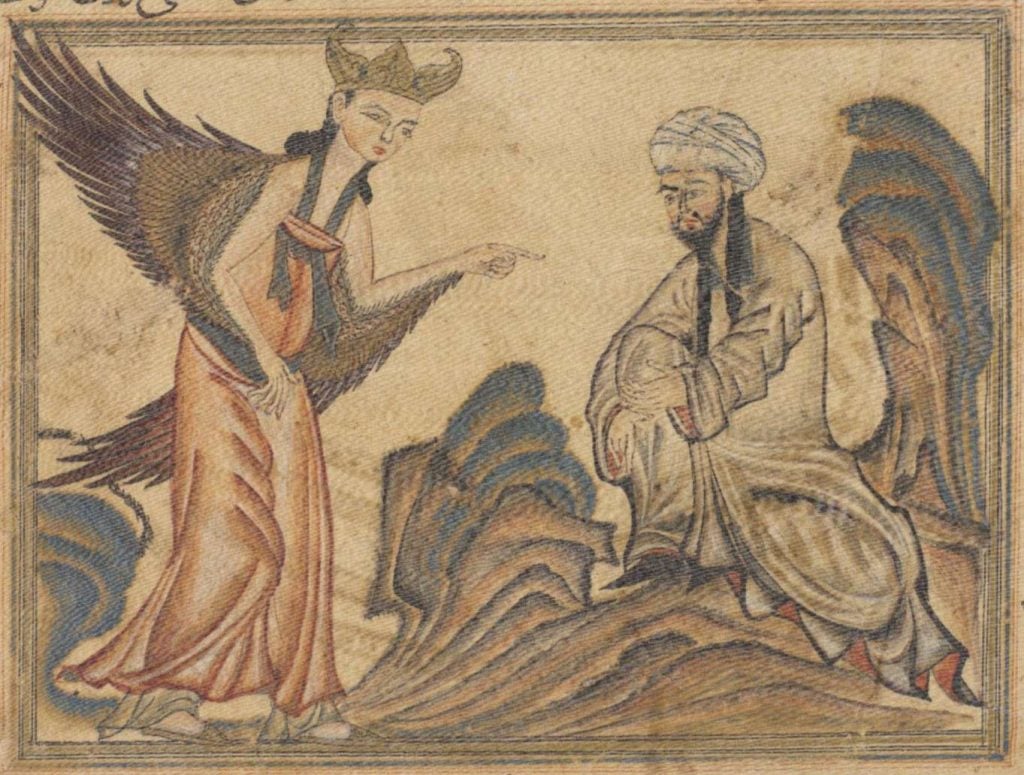
On October 6 of last fall, Erika López Prater, an adjunct professor of art history at Hamline, showed a pair of images depicting the prophet Muhammad in her course in global art history. [Note: a number of articles Curmie links here show a photo of the Rashīd al-Dīn work mentioned below. Recognizing the possibility of causing inadvertent offense, Curmie does not include this image on the blog page per se, nor will it appear on the CC Facebook page. If you do not want to see this image, do not click on the links; if you do, then click here.] 

According to an article by Sarah Cascone on the Artnet site, “One of the artworks was an illustration of the archangel Gabriel delivering his revelations to Muhammad from a 14th-century manuscript by Rashīd al-Dīn called the Compendium of Chronicles, while the other was a 16th-century work by Mustafa ibn Vali showing the prophet with a veil and halo.” 

As is fairly common knowledge, some sects of Islam regard viewing images of Muhammad as idolatrous. But three points need to be made. 

First, as López Prater herself pointed out, “there is this common thinking that Islam completely forbids, outright, any figurative depictions or any depictions of holy personages. While many Islamic cultures do strongly frown on this practice, I would like to remind you there is no one, monothetic Islamic culture.” 

Second, an art history course which does not show images such as these could reasonably be said to be lacking in the “global” element advertised by the course title. Indeed, such an omission could legitimately be regarded as Islamophobic, as it would signal a disregard for Islamic contributions to world culture. 

Finally, and by far most importantly, Prater warned students in the course syllabus (see?), urging students who chose not to view the images to contact her (no one did). She also issued a “two-minute content warning prior to the artworks’ appearance, to allow students to opt out of viewing the potentially offensive imagery should they feel it was against their faith.” What more could possibly be asked of her? Wait, let me re-phrase that: what more could a sentient adult have asked of her? They are, as shall become clear in a moment, very different questions. 

By now, you’ve long since figured out where this sordid tale is headed, haven’t you, Gentle Reader? Student Aram Wedatalla, the president of the university’s Muslim Student Association (MSA), was a student in the class. Of course, she did nothing to avoid seeing the images in question, because that would have been the mature and intelligent thing to do. Rather, she claims to have been “blindsided.” (Pay no attention to the aroma of cow pasture here, Gentle Reader; it will pass. Eventually.) 

Naturally, she went whining to The Oracle, the student newspaper: “As a Muslim, and a Black person, I don’t feel like I belong, and I don’t think I’ll ever belong in a community where they don’t value me as a member, and they don’t show the same respect that I show them.” Oh, no. Trust me, you narcissistic little brat, you don’t want to be treated with the same level of disrespect with which you regard anyone who might be sacrificed on the altar of your quest for victimhood. It really doesn’t matter if it was your petulance or just your laziness that is foregrounded here; the point is that if you want to see the culprit in this incident, look in a damned mirror. 

Of course, the student newspaper is complicit in all this, but at least the editorial staff there has a three-fold excuse: they’re post-adolescents, there are no longer many examples of journalistic integrity to be used as role models, and, alas, they’re being “educated” at Hamline. “Hamline teaches us it doesn’t matter the intent, the impact is what matters,” quoth one student. The real problem is that she’s probably right. 

Youthful impetuosity cannot be used as an excuse for the utter incompetence of the university administration’s handling of all this, however. The major players should never be allowed on a university campus again without a ticket to the basketball game or the orchestra concert. Nur Mood, the MSA advisor and Assistant Director of Social Justice Programs and Strategic Relations (is that title sufficiently pretentious?), blathered that “the harm’s done,” blithely ignoring the fact that his paranoid fantasies are far more responsible for “the harm” than Professor Prater will ever be. 

Oh, and speaking of ridiculous job titles, how about “Associate Vice President of Inclusive Excellence”? That would be one David Everett, whose email to everyone at the university declared Prater’s actions (he doesn’t identify her by name, but how many people at Hamline teach a course in global art history?) as “undeniably inconsiderate, disrespectful and Islamophobic.” Two responses: 1). Bullshit. 2). Do your damned homework and provide a little due process before you slander a faculty member, Davy. (Curmie sincerely hopes López Prater will sue the snot out of this preening twatwaffle.) 

This is also the same guy who was later to write that “In lieu of this incident, it was decided it was best that this faculty member was no longer part of the Hamline community.” (The school later lied about dismissing Prater.)  Erm… Davy… “in lieu of” means “instead of,” not “in view of.” It always does Curmie’s heart good to realize that illiteracy is no impediment to a career in university administration. (Wonder why Curmie is retired?) 

Most remarkable, however, was the outrageous statement over the names of both Everett and university president Fayneese Miller that “respect for the observant Muslim students in that classroom should have superseded academic freedom.” First off, there is no legitimate education without academic freedom (Ron DeSantis, please take note!). It would hold on any university campus worthy of the name, even if there really were something to get upset about, and even if it were intentional

To be fair, academic freedom doesn’t completely kick in until tenure, but Hamline (of course), purports to guarantee it. The university’s website includes this intriguing sentence: “The University embraces the examination of all ideas, some of which will potentially be unpopular and unsettling, as an integral and robust component of intellectual inquiry.” Wouldn’t it be fun if they actually believed that? 

Oh, Curmie nearly forgot. A Hamline faculty member who actually knows what he’s talking about, Religion Department chair Mark Berkson, wrote a letter to the student newspaper, too, pointing out that “in the context of an art history classroom, showing an Islamic representation of the Prophet Muhammad, a painting that was done to honor Muhammad and depict an important historical moment, is not an example of Islamophobia. Labeling it this way is not only inaccurate but also takes our attention off of real examples of bigotry and hate.” 

He also points out that, contrary to what Hamline seems to try to instill in its students, that intentions are irrelevant, “the Prophet Muhammad himself said that people will receive consequences for actions depending on their intentions.” Professor Berkson’s letter was removed from The Oracle’s website two days later; whether this was by an editorial staff longer on zealotry than on competence or at the insistence of the Stalinistic administration is impossible to determine. 

The hypocrisy, lack of due process, cowardice, and outright stupidity are the subject of a lot, and Curmie does mean a lot, of commentary. Yes, there are a few indignant whimpers from those whose lives have no meaning unless they can perceive themselves as oppressed, but—Allah be praised—everyone else is of a single mind. 


Curmie isn’t a Muslim, but Aman Khalid, author of an article titled “Most of All, I Am Offended as a Muslim: On Hamline University’s shocking imposition of narrow religious orthodoxy in the classroom,” is. [This one may be behind a paywall. If so, trust me on this…] Khalid writes: “Barring a professor of art history from showing this painting, lest it harm observant Muslims in class, is just as absurd as asking a biology professor not to teach evolution because it may offend evangelical Protestants in the course.” 

Curmie is not a lawyer, but the folks at FIRE (the Foundation for Individual Rights and Expression) are. And they’ve been busy: check it out here and here and here and here and here and here and here

The American Freedom Alliance describes Hamline’s actions as “an egregious violation of academic freedom,” and argues that they “severely damaged the intellectual climate at Hamline University and told every scholar who sets foot on your campus that free and open inquiry is circumscribed by the sensibilities and sensitivities of the students.” 

The article on the National Association of Scholars site is titled The Death of Academic Freedom at Hamline University

PEN America’s article argues that “Hamline University has committed one of the most egregious violations of academic freedom in recent memory,” and that “Non-renewing a professor’s contract under these circumstances is academic malpractice of a type that chills speech among all faculty, particularly contingent faculty who cannot rely on the status of tenure to protect their academic freedom.” 

Hamline is getting hammered across a wide spectrum of outlets—Curmie hasn’t even cited them all. Good. Perhaps, just perhaps, the principles of academic inquiry and free expression will be upheld, at least at other institutions which would rather not have this kind of publicity. The Hamline administration, however, has proven to be not merely craven and ridiculous, but mendacious, as well. They need to be gone. All of them. 

Now, the Trustees have gotten into the act. Curmie has a distrust of such people, born of over four decades in the trenches. But they couldn’t be any worse than the administration. We can hope for the best, but admitting they’ve put the wrong people in charge isn’t what Trustees are best at.  Alas.

EDIT: For what is perhaps the best statement of support for Professor López Prater, check out what the Muslim Public Affairs Council has to say.