Showing posts with label Greg Abbott. Show all posts

Friday, January 16, 2026

There's No 3-D Chess Here

Nope.
It had probably been months since Curmie had heard the term “3-D Chess” to describe someone so strategically brilliant as to leave the rest of us in the dust.  Then he encountered the metaphor twice on Wednesday of this week.  In both cases, Curmie’s response was, shall we say, skeptical.

The first occurrence was during the FIRE members-only webcast.  One of the viewers asked if it was possible that the administration at Texas A&M was in fact sympathetic with faculty who just want to teach their courses based on their professional expertise.  The argument, you see, was that censoring Plato in a Philosophy course was so remarkably stupid that it invites a lawsuit, which would, hypothetically, free the university from the grotesquerie that is SB37.  In other words, university policy-makers—the Regents and the administration—were hoping for a 1st Amendment challenge to an obviously unconstitutional law.  It would succeed, and control of the curriculum would thereby be wrested from idiot pols and returned to its rightful place, the university itself.

It was not an outrageous question, but FIRE’s General Counsel Ronnie London doubted that university officials were indeed “playing 3-D chess.”  He granted the possibility, but made it clear that such a scenario was unlikely.  Curmie agrees, not merely because he doubts that anyone would employ such a strategy, but because the Regents are appointed by ultra-right wing Governor Greg Abbott, whose fingerprints are all over the legislation in question… and they, in turn appoint the President.  The principal qualifications to be a Regent for a state university in Texas are simple: you must be a rich Republican who neither knows nor cares anything about higher education except as a means of advancing a political agenda.  Abbott certainly found his flock at A&M.

Remember, too, that last fall a young woman described by Curmie as “a single narcissistic and reactionary student” objected to a discussion topic because it violated an Executive Order from Dear Leader, and the professor, department chair, dean, and president all lost their jobs. 

By the way, it’s been reported that the reason that the department chair (and presumably those up the food chain) got in trouble was that they allowed the prof to teach something that wasn’t in the course description.  As a side note: when Curmie came to the university from which he is now retired, the catalog description for the second half of the Theatre History sequence said the course stopped chronologically at World War II.  Curmie said he was going to extend the timeline to the present, thereby including absurdism, the Angry Young Men, Off- and Off-Off Broadway, playwrights like Tennessee Williams and Arthur Miller, feminist dramaturgy, deconstruction… well, you get the idea, Gentle Reader.  

And get this: Curmie’s boss agreed to it without any hesitation!  Such insubordination from a department chair!  We did, by the way, change the course description, but it took a couple of years to get the revisions through the system.  In the meantime, it would appear that Curmie and his boss were both very naughty, indeed.  Luckily, the statute of limitations has run out.

But revenons à nos moutons.  The powers-that-be had their chance to challenge or even circumvent the state’s censorial policy and passed on the opportunity.  If the Regents actually wanted to halt this unconstitutional idiocy, they would have done so.  Nope.  They’re absolutely complicit.

So now we turn to the other contender for “3-D chess” designation: 47’s stated intention of annexing Greenland through whatever means necessary.  Actually, the CNN story Curmie read references MAGA-dom’s belief that Dear Leader is playing 4-D chess, and similar inanities have apparently been uttered not infrequently for some time, especially with respect to events in Venezuela.  Curmie either just didn’t see them or succeeded in ignoring them.

Last Friday, Chris Cillizza’s YouTube post (which Curmie didn’t see until today) opened with some pretty open mockery of the idea that “Donald Trump is always playing 3- or maybe 4- or maybe 5-dimensional chess, while the Democrats, the reporters covering him, everyone else, is sort of playing checkers at best.  The essence of the argument is that Trump is so strategically smart that he’s always multiple moves ahead of everyone else.”  Cillizza proceeds to talk about the strategic stupidity involved in describing Susan Collins, the most vulnerable Republican Senator seeking re-election, as a “disaster” who “should never be elected to office again.”  Collins, of course, only votes against GOP directives when it won’t make any difference (a point Cillizza doesn’t raise), and of course her vote on a procedural matter that will lead to nothing substantive fits that description nicely.

So Cillizza has a point.  But the true coup de grâce came a couple days after Cillizza’s piece, when Greenland became the topic of conversation on Sunday and then again on Wednesday.  The apologists’ argument is that only by threatening to invade an ally could Trump get Western Europe to send troops to protect Greenland, even if the perceived enemy is… well… us.  Pursuing this policy is far stupider than attacking Susan Collins. 

Sure, Greenland has some strategic importance, and we’d rather not have it taken over by Russia or China.  But first of all, that isn’t going to happen, and secondly, the downside of 47’s bluster is enormous.  His recklessness on the international stage has already cost this country more than can be regained in a decade or more of actual diplomacy and ethical leadership.  What ally would possibly trust the US now?  The idea that there would actually be a US military operation against Greenland would be laughable if we had a sane President.  As it is, the possibility looms. 

And if such an invasion were to take place, the situation would change from bad to cataclysmic.  There’s commentary out there that has been attributed to Brent Molnar (although why it doesn’t appear on his Facebook or Bluesky pages is a mystery).  Regardless of who wrote it, it’s pretty scary.  Curmie suspects it may be a little alarmist (“the world as we know it ends” may be a bit much), but virtually everything mentioned in the piece is at least a possibility if not a probability: the destruction of NATO is virtually assured; closure of American military bases in Europe, economic retaliation from the EU resulting in staggering inflation, the expulsion of US corporations from European countries, cessation of trans-Atlantic travel: all well within the realm of possibility…  It’s not a pretty picture.  

More to the point, not only would the loss of status, economic stability, and the moral high ground be devastating, there would be no upside.  The only country to gain from this ill-begotten fever dream is Russia, since European powers would be distracted away from supporting Ukraine.  Curmie judiciously refrains from wondering if that was the whole point.

Curmie would like to think that military leaders would either talk Dear Leader out of doing something so suicidal to American interests, or that they would listen to Senator Kelly and refuse an illegal order.  But when the Generals and Admirals are our last line of defense against a sociopathic POTUS with the maturity of a pampered toddler, we are neck deep in the shit and sinking fast.  Suddenly, “Doctor Strangelove” doesn’t seem so funny anymore.

So, no.  Neither the folks at Texas A&M nor in the White House inner circle are playing 3-D chess.  They’d be lucky to handle the complexities of Go Fish.

Thursday, January 8, 2026

One More Reason Curmie Is Glad He's Retired: So He Doesn't Have to Deal with Crap Like This

Regular readers of this blog will know that Curmie is a retired professor who taught for two decades at a state university in Texas.  He taught theatre, mostly the “academic” stuff like theatre history and play analysis.  As mentioned in a previous post, he taught plays and essays by a wide range of authors: some concentrated on race, others on gender, others on sexual orientation.  He showed a video of the Noble Call of Irish drag queen Panti Bliss after a performance at the Abbey Theatre. 

Some authors were communists; others were monarchists.  Their religious beliefs were Christian or Jewish or Muslim or Buddhist or Hindu or… you know, atheist.  Some wrote realism; others wrote anti-realism; others a hybrid.  Many wrote before the concept of “realism” existed except as mimesis, the “imitation of an action.”  Outside the classroom per se, Curmie directed at least three plays (As You Like It, The Breasts of Tiresias, and A Servant of Two Masters) which involved cross-dressing in one form or another, and at least three others in which a role written for a man was played by a woman.  Curmie’s job was to bring as much of the depth and breadth of theatre to his students as he could, to broaden their horizons, and ultimately to turn them loose on the world, whether they chose to pursue a career in theatre or not.

He was, and is, something of an intellectual snob: not in the sense that he believed himself to be the authority on all things theatrical, but in the confidence that he knew what material needed to be covered in a theatre history course or a topics course on Asian theatre or Non-Realism Between the Wars at least as well as, and probably better than, anyone up the food chain, certainly better than anyone more than one step up.  He was lucky enough to have deans and provosts who stayed out of his way, and department chairs who may have given the occasional piece of advice, but never commands.  And partisan political hacks would do well to steer clear.

Was Curmie further emboldened by being granted tenure and further still by reaching the point where he could retire as opposed to resign if things got too problematic?  Yeah, probably.  But he also remembers a moment in grad school when some idiot state legislator (there’s another kind?) demanded that the university submit a list of all the courses that contained any reference to homosexuality.  Curmie’s solution, articulated in a letter to the editor of the campus newspaper, was simple: send the asshole a copy of the course catalog.  You might be able to strike a math course here or there, but the chances that Pythagoras engaged in activity that would now be called homosexual conduct at some point in his life are actually pretty high.  Besides, the demand was for a list of those courses, not for only those courses, and it we wouldn’t want to inadvertently leave something out, now would we?

Anyway, yesterday was an interesting day in the world of 1st Amendment rights for university professors.  On the one hand, Darren Michael, the Austin Peay State University theatre prof who was fired for posting a link to an article about Charlie Kirk’s argument that the 2nd Amendment was worth preserving even at the cost of a few lives, settled his lawsuit with the university.  As Curmie predicted, he got his job back along with $500k and a couple other goodies.  (Curmie didn’t predict the amount, but he knew it would be substantial).  All told, it was a nice FAFO message for the Austin Peay administration.

On the other hand, we also learned of Martin Peterson, a Philosophy professor at Texas A&M being essentially told that he’d either have to stop teaching Plato in his Contemporary Moral Issues course or be re-assigned to a different course, one that meets at 8:00 a.m.  Well, that’s slightly over-stated.  He’d have to skip the parts of Plato that some idiot state legislator (or weenie dean, or whoever) believes are icky.  As usual, Gentle Reader, please excuse the redundancy of both “idiot state legislator” and “weenie dean.”

Two essential points here: First, Texas A&M is a state institution, which means that the 1st Amendment cannot be circumvented just because a university administration or state legislature wants to do so.  Second, this isn’t some grad student in charge of this course.  Dr. Peterson is not merely a Full Professor; he’s got an endowed chair.  His MA and PhD are from Swedish universities, and he taught both in Sweden and in the Netherlands before accepting his position at A&M.  Oh, and he was a Research Fellow for three years at some place called Cambridge University.  Curmie is pretty sure he’s heard of that one.  If this man says that a particular reading from Plato is essential to his course, Curmie is going to believe him.  Nor are we talking about some obscure writing of Plato’s: it’s the Symposium, which is hardly a minor work.  Of course, Peterson is also the Chair of the Academic Freedom Council at A&M, which makes him an especial target for the censorial asshat brigade.

Professor Peterson dutifully submitted his syllabus for what he called “mandatory censorship review.”  That probably didn’t win him any points with… well, with the censors, but his description is apt.  There is a new policy adopted by the Board of Regents, declaring that “No system academic course will advocate race or gender ideology, or topics related to sexual orientation or gender identity.”  Peterson is politic enough not to mention that forbidding discussion of race or gender ideology is in fact a means of advocating a position on those issues: that the social conservatives’ dogma and suppression of other viewpoints should be unquestioned.  Curmie, you will have noticed, Gentle Reader, is not similarly politic.

What Dr. Peterson does argue is that his course “does not ‘advocate’ any ideology.”  Rather, he “teach[es] students how to structure and evaluate arguments commonly raised in discussion of contemporary moral issues.”  No reasonable interpretation of the word “advocate” would suggest that Peterson should be forced to alter his course in any way.  Of course, Professor Peterson also cites a litany of legal precedents in support of his contention that the system policy in question is unconstitutional.  Needless to say, he’s right about that, too, but it probably did him more (short term) harm than good to point out that the emperor was in a state of deshabillé.

Texas, of course, has a terrible record with respect to 1st Amendment guarantees, especially during the regime of Grand Censorial Poobah Governor Greg Abbott.  There was the illegal suppression of student protests at the University of Texas in the spring of 2024; Angelo State’s banning of discussion of discussions of transgender issues and the spread of that attempt at thought control throughout the Texas Tech system; West Texas A&M’s ban on drag shows (subsequently ruled unconstitutional); the ongoing investigations of anyone deemed insufficiently hagiographic in describing Charlie Kirk; the horrific SB37, which restricts curriculum and radically reduces the faculty’s input into decision-making; and SB2972, which is downright silly, and so on.  And on.  And on.

Texas A&M itself, of course, was the site of a major contretemps last fall.  Here’s Curmie’s description (it’s the first link in this essay): “a single narcissistic and reactionary student circulated a surreptitious video of challenging a professor for including a discussion of verboten (by Trump/Abbott) topics like gender identity and transgender people.  A grandstanding pol got involved, and soon the professor was fired, the dean and department chair demoted, and the president at the very least under fire.”  This is not what universities are supposed to do.

And now there are perhaps as many as 200 Spring ’26 courses at A&M that may be subject to censorship, lest the cherubim hear something that challenges their ignorance.  Dr. Peterson’s case is the tip of the iceberg. 

The good news is that every free speech and academic organization you can think of is all over this story.  Here’s FIRE: “The board didn’t just invite censorship, they unleashed it with immediate and predictable consequences. You don’t protect students by banning 2,400-year-old philosophy.”  And PEN America: “Censoring classical texts in service of political orthodoxy is antithetical to the goals of education. Universities exist to engage students in difficult inquiry and not to suppress ideas just because they make some uncomfortable.”  And the AAUP: “A research university that censors Plato abandons its obligation to truth, inquiry, and the public trust—and should not be regarded as a serious institution of higher learning.”  You get the idea, Gentle Reader.  Curmie, of course, is honored to join the chorus.

So, you may well ask, what is going to happen to Professor Peterson’s course?  Curmie was rather hoping that the good prof would sue the university, its president, its regents, Greg Abbott, and anyone else he could think of.  After consultations with his lawyer, however, Dr. Peterson has decided to revise his syllabus.  Instead of the readings from Plato, he’s going to substitute an article from the New York Times which deals more directly with contemporary moral issues.  Its title: “Texas A&M, Under New Curriculum Limits, Warns Professor Not to Teach Plato.”  

Well played, Professor.  Well played.

Thursday, September 11, 2025

FIRE's Failure and Curmie's Happiness in Retirement

 
One of the more troubling survey results.  Probably.
If FIRE, the Federation for Individual Rights and Expression is known for anything by the general public, it’s for their annual Free Speech Rankings of colleges and universities.  The new (2026: apparently they’re like model years for cars in this regard) list dropped this week, and it reveals some troubling information.

Nearly 2/3 of the 257 colleges and universities studied received a failing grade from FIRE, and none got better than a B-.  Of course, if what you want to do is to show the need for your organization, you’re likely to paint a rather gloomy picture of the status quo, so perhaps a grain of salt is called for.  Still, it’s chilling that FIRE President Greg Lukianoff’s could comment that, 

Rather than hearing out and then responding to an ideological opponent, both liberal and conservative college students are retreating from the encounter entirely. This will only harm students’ ability to think critically and create rifts between them. We must champion free speech on campus as a remedy to our culture's deep polarization.

A third of college students surveyed agreed that violence is acceptable, at least “rarely,” to stop speech.  A majority said they would oppose their school’s inviting any of six controversial speakers (three from the left and three from the right) to campus.  Note: these are not specific individuals, apparently, but hypothetical people who are quoted as saying something controversial, e.g., “children should be allowed to transition without parental consent” or “transgender people have a mental disorder.”  You get the picture, Gentle Reader. 

Of course, some of this gets into areas of fungible definitions.  Is grabbing and restraining someone who is inciting violence (i.e., engaging in non-protected speech) perpetrating violence against that person?  Or is the term limited to punching out someone you disagree with?  Does “rarely” mean “only in extremely rare circumstances” (such as just described) or just “not very often”?  And what is meant by “invite”?  Is that my tuition money that’s being spent on bringing in this person whose views I abhor, or is it the Young Republicans/Democrats/whatever footing the bill?

Similarly, it’s also difficult for a university to legitimately be blamed for students’ reluctance to discuss controversial issues in entirely social atmospheres outside the classroom.  If, for example, a student hears another student advocating a position on abortion or the conflict in Gaza which is radically different from their own, choosing not to express a contrary view may be appropriate if that decision comes not from fear but from simply not wanting to be bothered. 

Similarly, Curmie has three different responses to those who disagree with his posts, both here on the blog and, considerably more frequently, on the Facebook page.  (No one has really taken issue with anything he’s posted on BlueSky; that bridge will be crossed if/when reached.)  Usually, the comment simply remains with no counter-argument.  Curmie isn’t afraid of detractors, but sometimes they’re just not worth the trouble.  Sometimes, Curmie responds with a clarification or further argument.  Rarely (there’s that word, again), he’ll ban someone.  (He hasn’t done that in several years.)

For all this, FIRE’s work, whether arguing against speech codes, protecting research from government interference, or working to eliminate loyalty oaths (including towards DEI advocacy), is unquestionably a net positive, and the free speech rankings contribute towards this utility.

FIRE is, to be sure, enormously and not infrequently smugly proud of their work, and Wednesday’s webinar to hype the new rankings showed that off.  Curmie does not begin to profess to any expertise in surveying, data collection and analysis, and the like, but he does come by his soubriquet honestly, and there was more than one instance in which his eyebrow raised in skepticism. 

A couple examples, paraphrased to what Curmie was hearing (perhaps not what the speaker thought he was saying).  “Well, we have this totally subjective green/yellow/red light analysis, and we’ll give you points if you’re green and take them away if you’re not…. We don’t really pay any attention to the good things you’ve done unless you pro-actively tell us about them before the rankings come out….  If you sign on to the Chicago principles, you get points for that; actually following them is (apparently) of less importance….”

The whole process seems to be an attempt to make a fundamentally subjective analysis seem objective.  Curmie has been guilty of the same; he’s not pretending otherwise, but he at least tries to let the audience in on the extent to which the evidence is or is not trustworthy.  And he’d definitely be interested in how self-selecting respondents were.  He knows how course evaluations work, after all.  As soon as they became optional, they lost pretty much all credibility.  If there are 20 students in a class—5 loved it, 3 hated it, and a dozen thought it was OK, you’ll get two positive responses, three negative responses, and two “meh” responses.  How FIRE’s methodology addresses this problem would be worth knowing.

More problematic was the avoidance of the proverbial elephant in the room.  That’s a particularly apt expression, since the elephant is the symbol of the Republican Party, which, at least in states like Florida and Texas (there are others, no doubt), is the greatest threat to free speech on university campuses. 

As many readers of this blog know and others will have surmised, Curmie is a retired professor at a state university in Texas.  That makes him both a little more knowledgeable and, admittedly, a little more biased in his interpretation of what is transpiring.  But he finds it difficult to understand how a student’s willingness or unwillingness to discuss controversial subjects in a purely social setting is more relevant to free speech concerns than is a professor’s ability to determine what should and should not be taught in a course in their area of expertise.

This summer, Greg Abbott and his simpering acolytes in the Texas legislature passed SB37, which is as anti-intellectual, authoritarian, and generally reprehensible a piece of legislation as Curmie can recall, anywhere, ever.  Curmie hopes to write a longer essay on this, but let’s just say that articles like the ones linked here and here pretty well reflect Curmie’s thinking. 

The bill strips faculty of the right to elect their own representatives, de facto grants state government the right to overturn any decision made at a state university, and gives whatever local authority remains exclusively to the president.  The president is appointed, often unilaterally, by the regents, who are appointed by the governor.  In the over two decades that Curmie has been affiliated with the university from which he is now retired, not a single regent has not been a hard-core Republican.  Indeed, their political affiliations have often been trotted out as if they were credentials for the job.

But, as they say in the late-night infomercials, “Wait!  That’s not all!”  SB37 is, more than anything, an assault on academic freedom and, by extension, of freedom of speech.  Political hacks are scouring every syllabus, looking for anything that might challenge right-wing ideology or even suggest that different points of view might not only exist, but reasonably exist.

And now we circle back to that webinar, in which viewers were encouraged to submit questions.  So Curmie did so.  He can’t reproduce his question verbatim, but it was something like this: “In an environment in which state legislatures are exercising what amounts to absolute control over curriculum, why are you surveying only students and not faculty about free speech issues?”  His question was ignored, while the moderator cheerfully moved on a softball questions from someone she identified as her friend.  OK, there were probably more questions than could have been accommodated in the time frame, and the answer to my question, pretty much “it’s hard to do that,” was sort of hinted at in response to a different question.

But it wasn’t the avoidance of Curmie’s question that really stood out.  Someone asked about the news out of Texas A&M, where a single narcissistic and reactionary student circulated a surreptitious video of challenging a professor for including a discussion of verboten (by Trump/Abbott) topics like gender identity and transgender people.  A grandstanding pol got involved, and soon the professor was fired, the dean and department chair demoted, and the president at the very least under fire.

Edicts about what can and cannot be taught in a university classroom are clear violations of academic freedom and evidence of authoritarianism. Firing a professor without even the pretense of due process is illegal, or at least would be in any state with a governor or state legislatures that weren’t so proudly anti-intellectual.  Curmie is loath to use terms that exaggerate the gravity of a situation, but if this isn’t fascism, the footwear sure does seem to be the correct size.

Anyway, whoever asked the question didn’t go into any details, just that a professor at A&M had been fired.  Someone from FIRE acknowledged the situation in about a half a sentence, didn’t explain the context to listeners who might not have heard about the incident, and then proclaimed in the Q&A link that the question had been answered.  NO, IT FUCKING WASN’T!

FIRE still, as of this writing, hasn’t addressed the situation at A&M, just as they never addressed the question of religious charter schools in Oklahoma, but they did get out a brief statement about the shooting of Charlie Kirk, leaping to the conclusion that it was politically motivated.  (It might very well have been, but they certainly didn’t know that when the statement was released.)

PEN America, however, responded swiftly and surely.  Here’s Jonathan Friedman, Sy Syms Managing Director of U.S. Free Expression Programs: 

We are witnessing the death of academic freedom in Texas, the remaking of universities as tools of authoritarianism that suppress free thought.  The decision to remove these academic leaders to satisfy politicians’ demands is an excessive punishment for the alleged violation of transparency requirements. When university presidents have little choice but to dismiss faculty members’ expertise and enforce ideological edicts, the space for free speech and open inquiry on our campuses is undeniably being suffocated.

As he writes this, Curmie is a member of FIRE but not of PEN America.  Both those situations are likely to change in the relatively near future.

Back when he was teaching, Curmie assigned texts by the likes of Marguerite Duras, Jean Genet, Imamu Amiri Baraka, Augusto Boal, and Irish drag queen Panti Bliss (Curmie encourages you to look up any of these folks who are new to you, Gentle Reader): not to get students to agree with their ideologies, but because you can’t understand the entirety of the way theatre and the larger culture interact without acknowledging the voices that may be on the periphery in one way or another.

If he were still teaching, Curmie wouldn’t change his syllabus or his teaching style one iota to accommodate the dictates of petty tyrants like Abbott or Trump.  It’s a good thing he’s retired, then.  This way, they won’t have to fire him.

Thursday, May 23, 2024

On Greg Abbott’s Outrageous Pardon of Daniel Perry


Curmie won’t make anyone look at a photo of Greg Abbott

Curmie had intended to write about this story since it came to light, but other topics and life in general interfered.  But then came a wonderful piece on the Bulwark site by Jonathan V. Last.  On the one hand, Curmie can’t improve on Last’s commentary, but he nonetheless feels compelled to comment, in part because he’s reminded of just how outrageous the actions of Texas’s petty despot governor, Greg Abbott, have become of late.

There were the twin debacles concerning pro-Palestinian demonstrations at the campus of the University of Texas at Austin, and Curmie has another piece in the works in which Abbott’s knee-jerk petulance is foregrounded.  (Watch this space!)  And now he’s pardoned a convicted murderer just because he didn’t like the victim’s politics.

As Last points out, Garrett Foster was something of a right-wing pol’s wet dream (Curmie’s term, not Last’s).  Young, attractive, a military veteran, a strong enough supporter of the 2nd Amendment that he took at AK-47 to a Black Lives Matter protest.  Oh, and white.  Mustn’t forget that part. 

Trouble was, he wasn’t there to interfere with the demonstration; he was a participant.  So a self-proclaimed racist and likely perv named Daniel Perry shot and killed Foster on the night of July 25, 2020.

It appears that Perry researched the various levels of murder and manslaughter charges and apparently sought to create a situation in which he could claim to have been in fear for his life so he could shoot somebody.  What a noble lad!

On the night in question, Perry finished his shift as an Uber driver (remind Curmie to use Lyft if he’s in Austin), rounded the corner and came upon the protest.  He could easily have driven around it, but instead, he ran a red light and rammed into the crowd, hitting a number of people, including Foster’s wheelchair-bound fiancée.  Curiously (OK, not actually curiously at all), the “exhaustive review” conducted by the Texas Board of Pardons and Paroles (all of them appointed by Abbott, of course) didn’t bother to mention this part of the story.  Or perhaps it did, and Greg Abbott just didn’t care.  It matters little if that little detail was omitted by Abbott himself or by his appointed minions.

Anyway, according to literally every witness, Foster stayed calm and did what he could to alleviate the pressure.  He tried to wave Perry on.  Yes, he was carrying an assault rifle.  Why these things are legal to open-carry in Texas is beyond Curmie’s ken, but Greg Abbott seems to think it’s a good idea… unless, of course, the guy doing so doesn’t own a MAGA hat or answer to “Jim-Bob” or “Bubba.”

Again, according to literally every witness, Foster did not raise his weapon and indeed did not have a finger on the trigger.  To be fair, all of those witnesses were protesters themselves, so they might be a little biased against the guy who killed their comrade.  But <insert late-night informercial voice here> that’s not all!  You know who else says Foster didn’t raise his weapon?  Daniel Perry.  You read that correctly, Gentle Reader.  The guy who’s claiming self-defense initially admitted that he wasn’t actually being threatened: “I believe he was going to aim at me. I didn’t want to give him a chance to aim at me” (emphasis added).

By this logic, and that of some “expert” defense witness Perry’s lawyer dredged up out of the “Testimony for Sale” database, if Curmie now sees someone, anyone, walking down the street carrying a gun, I’m within my rights to shoot to kill, not just if he does anything to actually threaten me, but even if I’m a paranoid coward like Daniel Perry and just sorta kinda think he might.

Oh, and unless Curmie’s been led astray by all those cop and lawyer shows he’s watched over the last half century or more, self-defense is an affirmative defense, meaning the burden of proof shifts.  The prosecution must prove that the defendant committed the act; the defendant doesn’t need to prove that he didn’t, only that the case hasn’t been proved beyond reasonable doubt.  When self-defense is presented as an argument, however, the presumption is that the claim is untrue, and the defendant must prove, at the very least, that it is more likely than not that he was indeed acting in self-defense.

And guess what?  The jury didn’t buy the argument.  Let me put it a different way: twelve out of twelve jurors were convinced that Perry was lying.  Not a single juror had even reasonable doubt of Perry’s legal and ethical guilt.  It may be a little problematic that all of the witnesses were participating in a demonstration that Foster joined and Perry sought to disrupt.  But it’s a hell of a lot more problematic that the only person claiming self-defense is the defendant, on trial for murder, and that he himself acknowledged, at least initially, that there was no immediate threat.

Of course, the day after the obvious verdict was announced, before Perry was even sentenced (!), Greg Abbott proclaimed that he’d grant a pardon if his hand-picked minions the Board of Pardons and Paroles recommended it.  Was he acquiescing to the demands of the despicable Tucker Carlson, or did he come to this remarkably moronic conclusion on his own?  We’ll probably never know.

What is clear is that it is that Abbott could not possibly have studied the evidence presented at the trial and done his actual job at the same time.  Not in order to issue a reasonable statement a day after the verdict.  Life is easier, of course, if you form a conclusion based on your prejudices and then grab hold of any excuse, however spurious, to ignore the actual facts.  Those of us who care about actual justice have more struggles.

It is obvious that Greg Abbott is a grand-standing fraud, a hypocritical ideologue, and an authoritarian asshole.  Whether he’s also a racist idiot, or just likes pandering to his base, a sizable proportion of whom are racist idiots, is unclear.

It’s also crystal clear that the pardon, which the Houston Chronicle’s Cayla Harris and Neena Satija describe as “the first time in at least decades that a Texas governor has pardoned someone for a serious violent crime, let alone murder,” was an act of raw political power, a show of force, with no concern for the reality of the events described.  There is literally (and, Gentle Reader, you know that Curmie is enough of a Grammar Nazi that when he writes “literally,” he means literally) no evidence to support a claim of self-defense except Perry’s (ahem…) “amended” memory of what happened. 

Oh, and by the way, there seems to be no disputing that Perry did indeed run a red light and drive into the crowd, thereby surrendering any claim to self-defense.  The best the defense had to offer was the the claim that Perry inadvertently ran that red light and plowed into the protesters while texting.  Oh, well if he was only reckless when he obviously broke the law, that’s all right, then, right?  Even if Perry’s claim is true, which is about as likely as Curmie’s undergrad alma mater winning next year’s NCAA basketball tournament (they were dead last in a pretty weak league this year), there would be no way the demonstrators could have known that he had no ill intent, but was rather a reckless jackass who still shouldn’t be driving for Uber.  It would be reasonable for them to believe that they were being threatened.  Had Foster shot Perry, in other words, there might have been a legitimate self-defense argument.  Not the other way around, though.

Witness, too, Abbott’s cheap shot at prosecutor, Travis County District Attorney José Garza, who had the audacity to prosecute a murderer whose politics aligned with the governor’s.  It’s difficult to argue with Garza’s assertion that the pardon places “politics over justice and made a mockery of our legal system.” 

Side note: if Greg Abbott wants to say nasty things about José Garza as a personal opinion, he’s absolutely entitled to do so, just as Curmie can offer a personal opinion about Greg Abbott.  But to use the power of the governor’s office to say nasty things about Garza as fact in an official document is pretty close to libel, if indeed it hasn’t crossed that line.

A couple days after announcing the pardon, Abbott slithered off to the annual fellation (we can hope that it was only metaphoric) of the NRA.  Of course, he’d just pardoned a murderer who had killed a man for the sole reason that the victim was openly carrying a weapon; one might imagine that the NRA wouldn’t take kindly to that, but of course they’re just as ideological and almost as hypocritical as Abbott.  And one suspects that the average melanin count of attendees was rather low.

Gentle Reader, if you want to say that there is no clear evidence of a racial motive in the killing of George Floyd, you’ll get no argument here.  If you want to suggest that the death of a single petty criminal in Minnesota shouldn’t incite massive protests around the country, Curmie’s willing to listen, at the very least.  If you want to claim that some BLM protests became violent, and that some of that violence was initiated by the demonstrators themselves, Curmie nods in agreement.

But this particular episode at this particular protest at this particular time in this particular place needs to be looked at individually.  (Curmie goes Confucian again.  Who’da thunk it?)  This incident is clear-cut.  Daniel Perry is a racist, a liar, a coward, and… oh, yeah, a murderer.  He should be in prison because he’s an obvious danger to society.  Not as big a danger as Greg Abbott, though.

Tuesday, April 30, 2024

Greg Abbott Violates the 1st Amendment. Again.

Too fitting, alas.

When Curmie uses the term “authoritarian asshole” to describe Texas Governor Greg Abbott, he understands that the noun in question represents an opinion: an opinion shared, he suspects, by the majority of readers of this blog, but an opinion nevertheless.  The adjective, however, must be considered an objective truth.  Abbott thinks everyone should conform to his version of ethics on every possible subject, and he’ll use every resource available to punish them if they don’t.

Abbott, of course, purports to be upholding the principles articulated in the Ten Commandments, but he fares a lot better in the early ones about being Judeo-Christian than the later ones; he’s actually rather a fan of bearing false witness, for example.  Nor are we talking here about things like a restrictive abortion law or requiring age verification to visit pornsites.  The former might be (probably isn’t, but might be) grounded in an understandable belief that human life begins at the embryonic stage of development or earlier.  The latter reflects a reasonable, if logistically futile and constitutionally problematic, intention of keeping pornographic materials out of the hands of minors.

Over the past few weeks, however, Abbott has obviously and blatantly violated the 1st Amendment protections of pro-Palestinian students and others.  The first round of this debacle came in the form of an executive order in response to anti-semitism.  Problem was, it restricted the speech of a particular group of people—in this case, those supporting Palestinian autonomy—but no one else’s. 

The response from FIRE (that’s the Foundation for Individual Rights and Expression) was, as usual, right on the money.  Here’s the salient part:

Anti-Semitism on campus is a real problem. When anti-Semitic speech crosses beyond the First Amendment’s protection, Texas institutions have a moral and legal obligation to take action. But today’s executive order relies on a definition of anti-Semitism that reaches core political speech, including criticism of Israel. The order also singles out student organizations by name, suggesting these groups should draw official scrutiny on account of their views.

State-mandated campus censorship violates the First Amendment and will not effectively answer anti-Semitism. By chilling campus speech, the executive order threatens to sabotage the transformative power of debate and discussion. That’s in sharp contrast to Texas state law, which wisely recognizes “freedom of speech and assembly as central to the mission of institutions of higher education.” When speech on contentious issues is subject to punishment, minds cannot be changed.  

Curmie would explain that the definition of anti-Semitism in question is included in Texas Government Code Section 448.001; it is ultimately derived from the International Holocaust Remembrance Alliance’s “working definition.”  One might reasonably surmise that such an organization might have a rather broader definition of the term than what might be considered normative.  Even the IHRA, however, includes this proviso: “criticism of Israel similar to that leveled against any other country cannot be regarded as antisemitic.”

Monday morning Curmie watched a FIRE webinar featuring Alex Morey, that organization’s Vice President of Campus Advocacy; Will Creeley, their Legal Director; and Nico Perrino, their Executive Vice President.  There were several phrases that were repeated multiple times: “viewpoint and content neutral,” “reasonable time, place, and manner restrictions,” “true threats and intimidation,” “severe, persuasive, and objectively offensive.” 

Whatever justification there may have been for Abbott’s executive order, it most certainly was not viewpoint and content neutral: he mentions two student organizations by name, having unilaterally decided they were guilty of violating free speech policies, and insists on revising existing policies to accommodate his desire to stifle the rights of those who don’t share his views. 

Abbott is correct that “from the river to the sea, Palestine shall be free” has been used by Hamas supporters to advocate the elimination of the state of Israel or even of Jews in general, but is neither denotatively problematic (it varies little from “we shall overcome”) nor objectively offensive.  The slogan has also been used by those who simply want a Palestinian homeland out from under the proverbial thumb of Israeli control. 

Creeley, as he had in a Los Angeles Times opinion piece co-written with renowned legal scholar Eugene Volokh cited by Curmie back in December, insisted that… wait for it… context matters.  In the webinar he argued that simply chanting that slogan remains protected speech; doing so while brandishing a weapon or engaging in true threats or intimidation, however, would be a different matter.  Context!

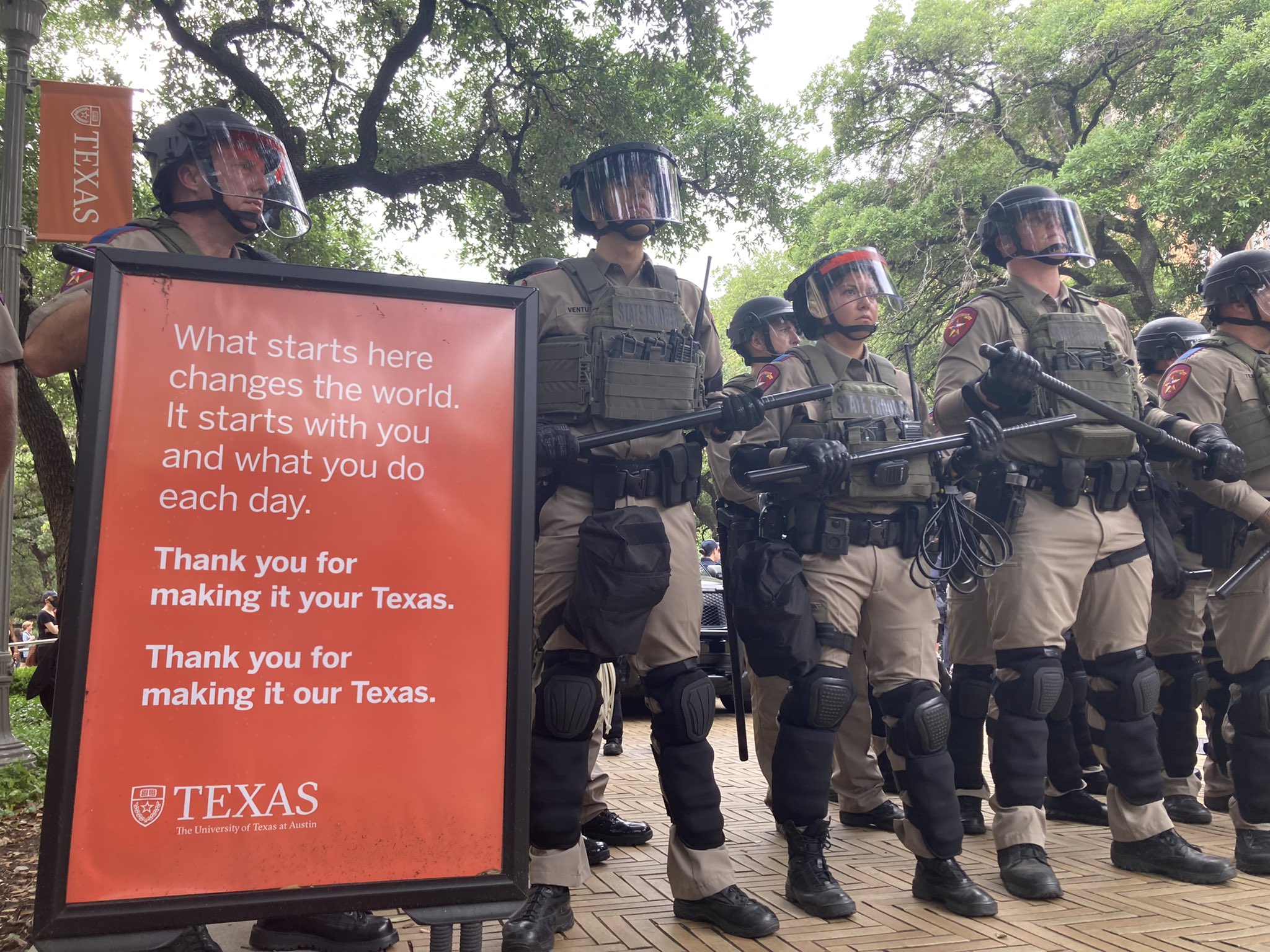
But, as they say in the late-night infomercials, Wait!  That’s not all!  If FIRE was unimpressed with the executive order, they pulled no punches in their commentary on calling in the cops to prevent a protest on April 24, simply because Governor Abbott didn’t like it… and because the University of Texas-Austin President Jay Hartzell is a spineless idiot who cravenly went along.  Dozens of arrests were made, and one photojournalist (ironically enough, from the local Fox affiliate!) was dragged to the ground from behind and detained, although video evidence shows that he was, as instructed, moving back.  In any sane society, that cop would be summarily fired and charged with first-degree assault.  Chances of that happening in Greg Abbott’s Texas: roughly those of Kristi Noem being named PETA’s Person of the Year.

Angel Eduardo’s piece on the FIRE website is headlined, “Texas tramples First Amendment rights with police crackdown of pro-Palestinian protests,” and is accompanied by the photo you see to the right.  It doesn’t get any better for Abbott and his minions later in the article.

First, there’s the re-visiting of the executive order:

Threatening expulsion for expression that some — or even many — may find offensive is a speech-chilling encroachment on students’ First Amendment rights. This is especially true when “anti-Semitism” is defined to target core political speech — such as criticism of Israel — which FIRE has warned Abbott’s order effectively does.

Then comes the link to a letter from FIRE’s Jessie Appleby to UT President Hartzell.  She gets right to the point, decrying in the first paragraph the university’s 

... outrageous and unnecessary use of riot police yesterday afternoon to forcibly disperse students and faculty engaged in a peaceful Gaza solidarity walk-out on campus, taking journalists covering the event with them.  UT Austin, at the direction of Governor Greg Abbott, appears to have preemptively banned peaceful pro-Palestinian protesters due solely to their views rather than for any actionable misconduct.

Tell us what you really think, Jessie!  She’s not done, though: 

UT Austin’s disproportionate response to a seemingly peaceful protest, on expressly viewpoint-based grounds, raises serious constitutional concerns. As a public institution, any university restriction on student expression must comport with the First Amendment’s “bedrock principle” of viewpoint neutrality…. rules must be viewpoint- and content-neutral, narrowly tailored to serve a significant government interest, leave open ample alternative channels for communication, and—perhaps most importantly—not selectively enforced based on a speaker’s viewpoint.

Moreover, 

Texas law is clear: Outdoor common areas on state university campuses are traditional public forums open for “any person to engage in expressive activities in those areas of the institution’s campus freely…. A peaceful protest in an area of a state university that is open to public expression is not unlawful “occupation”—protesters cannot unlawfully occupy a space by engaging in expressive activity they have every right to pursue in a space in which they have every right to be….

UT Austin has abdicated its constitutional and state-mandated obligations to protect expressive rights on its campus.

That pretty well sums up Appleby’s letter, but Eduardo has yet more in his article.  He includes one last jab, linking to a video from a mere six months ago, in which UT Vice President for Legal Affairs and General Counsel Amanda Cochran-McCall says “state law in Texas actually allows members of the public just like our university community to come onto campus and use our common outdoor areas for speech activity.”  Eduardo wonders “what changed?”  The answer, as he well knows, is that, like Elon Musk, Greg Abbott is profoundly interested in free speech for anyone who agrees with him; everyone else… well…

Curmie has followed FIRE for a decade or more, and has never seen a more thoroughgoing and incisive excoriation of a university’s willing capitulation to a politician more interested in shutting down opposition to his personal perspectives than in obeying the US Constitution, or indeed Texas law.

Curmie expected no better from Greg Abbott.  He’d hoped for more from UT officials, but is well aware that competent and conscientious university administrators are approximately as plentiful as honest men in Diogenes’ world.

Note: none of the foregoing is intended to take a stance in the ongoing hostilities between Israel and Hamas.  Curmie stands by his earlier commentary; that’s it.  Nor does this essay express any opinions on pro-Palestinian protests on other campuses.  Curmie is a Confucian, remember, Gentle Reader?  Every case is different.

Monday, June 19, 2023

Musings on the Elimination of DEI Offices in Texas State Universities

Curmie had coffee with a friend and former colleague last week. We talked about many things, including that our former employer’s website had been cyber-attacked over the weekend, leading to the very real possibility that email and other such services will be down for an extended period of time.
 

But he also asked me what I thought of the move by Governor Greg Abbott and his legislative majority to eliminate DEI (Diversity, Equity, and Inclusion) offices from all state colleges and universities, effective as January of 2024. I replied that I was ambivalent, thereby placing myself, no doubt, well to the political right of the majority of my friends in academe. 

Wait ‘til they find out that I don’t think the state’s new restrictions on tenure are particularly onerous, either! And yes, Curmie is well aware that Abbott and his acolytes (and future governors of either party and their minions) are more than likely to do everything in their power to abuse the new, (intentionally?) vague, rules; that doesn’t mean that habitually failing to show up for class or being convicted of a serious crime are insufficient reasons for having tenure revoked. Expressing a view contrary to those of the university president, regents, or state governor (or even calling them wanker bastards) had damned well better be protected by tenure, however. We shall see. 

There is no question in my mind that there is a purpose to be served by inclusivity, and not simply for reasons of political philosophy. Broadening horizons has direct benefits: by learning about others, you also learn about yourself, and exposure to different cultures and perspectives can only result in more mature analysis. Maybe that comes in the form of an argument that alters your view; maybe it’s something you consider but ultimately reject, secure in the knowledge that you’ve considered a different solution to a problem. 

One of Curmie’s first publications in a scholarly journal was an analysis of what plays are included in dramatic literature anthologies. It came as no surprise that the works thus canonized were overwhelmingly written by white males. What was a little more eye-opening was the fact that the disproportionality was greater when I was writing the article in the early 1990s than would have been true two or three generations earlier. 

This was a problem, not only in the classroom, but also because the implicit understanding that these were the superior works also led them to be produced more often, thereby exacerbating the imbalance. I don’t want to bother to look up the exact numbers, but I’d guess that of the first 75 shows my department produced after my arrival at the university from which I recently retired, only only four or five specifically required any non-white actors. I directed two of them, Master Harold… and the boys and Trojan Barbie. Another one, the musical Hair, actually had one of the “black boys” of the song played by a white guy in a wig and dark makeup. Ew. 

There were, of course, plenty of roles that could beand indeed were, played by non-white actors. But I do not reject outright the argument that a BIPOC actor faces a different challenge to play a character written as white, even if there’s nothing specific about race in either the character’s description or action. There may not be a significant difference, but that doesn’t mean it doesn’t exist. 

As I told my friend, if you’re teaching a course in the history of the modern theatre (as I did for a couple dozen times overall) and you don’t talk about William Henry Brown, Ira Aldridge, Lorraine Hansberry, Douglas Turner Ward, et al., you’re not doing your job. But you’re also not doing your job if, all things being equal, you spend an entire class period on Suzan-Lori Parks and five minutes on Tennessee Williams. 

And here’s where my commentary veers rightward. That article about anthologies I mentioned earlier came as a follow-up to a conference paper for a panel I organized on theatre textbooks. One of the panelists I recruited for that panel was an editor at Random House. A year or so later, I got a letter (these were the Olden Times, pre-email) from a different editor at Random House asking me to comment on the prospective contents for a dramatic literature anthology they were considering publishing. 

These were the days when “diversity” was based more on gender than on race, so publishers were scurrying to find plays by women to include in their anthologies. So far, so good, right? This book was to include a play by Susanna Centlivre (if, Gentle Reader, you’re asking “Who?,” you have plenty of company) but to omit Molière. The problem here is not the inclusion of Centlivre (although Aphra Behn would have been a better choice, imho), but rather doing so while excluding arguably the greatest comic playwright in history. 

This collection was, in other words, a good idea—recognizing the fact that women like Hrotsvitha, Sophie Treadwell, Rachel Crothers, Lillian Hellman, Lorraine Hansberry, Caryl Churchill, and many others deserve to have their work read and appreciated. But that admirable intention gets lost in the silliness of Molière’s absence. 

Similarly, it is difficult if not impossible to argue that there is no place in a university curriculum for, say, Critical Race Theory. Just as you can’t claim to understand theatre history if you can’t string together a couple of sentences about Ira Aldridge or Amiri Baraka, you can’t claim to understand the political history of the nation without at least encountering the work of Ibram X. Kendi or (before there was something called CRT) James Baldwin. 

But here’s the thing: You shouldn’t have to agree with them. The idea that faculty should have to conform to the credo that not being racist is insufficient (you have to be actively anti-racist, and prove it) is no different from the loyalty oaths of past decades, except the authoritarian impulse now comes from the left instead of the right. Similarly, I don’t want someone (administrator, politician, whoever) who doesn’t know an onnagata from a verfremdungseffekt telling me, even indirectly, what is and is not important to cover in a theatre history course. 

I can’t decide which is worse, though: telling people like me, who actively sought out diverse perspectives on the theories, literature, and production of theatre long before it became de rigeur to do so, that we aren’t doing enough because we think Molière is vastly more important than Centlivre, or to insist that someone teaching, say, math or physics, which have literally nothing to do with sociocultural perspectives, prove their anti-racist bona fides or risk not getting the job or tenure or whatever. 

It is indeed possible that someone in my discipline really does exclude the study of people or ideas that should be there, but that should lead to a discussion with a department chair, not a sweeping indictment of a professor’s presumed prejudices. The Modern Drama course I took as an undergrad centered exclusively on white male playwrights. But it stopped chronologically around 1950, so Lorraine Hansberry was excluded on that basis. Caryl Churchill’s first really significant play was first produced literally as I was taking that course; August Wilson’s wasn’t even written yet. Maria Irene Fornes wasn’t unknown, but she hadn’t yet written any of the works that now come most immediately to mind. (And so on.) 

Also, we studied only Western dramatists who had written multiple significant works, so that took Sophie Treadwell out of the picture. Yes, one could make a case for Lillian Hellman, but probably the most important playwright we didn’t read was George Bernard Shaw… because the prof didn’t like his stuff.  Curmie isn’t a huge fan, either, although he didn’t know that at the time.

Should the domain have been different, to include a broader demographic spread of playwrights? Maybe. But not inherently so. The fact is that it wasn’t until about the time I started work on my PhD that the Western theatre world wasn’t in fact completely dominated by white men. That’s simply a statement of fact. Were there women or BIPOC authors, actors, directors, etc., who would have been at least as successful as the white guys in a fairer society? Almost certainly. But that more equitable world did not exist, and the dominant Western theatrical artists were who they were. Cultural literacy in the E.D. Hirsch sense may be a problematic configuration, but it’s not unreasonable to expect functioning adults to have a basic understanding of canonical figures and their works. 

The only consolation in all this is that the art itself survives. We are indeed finding out more about wonderful artists, scientists, and other professionals who didn’t (or don’t) fit the White Guy paradigm. That’s a good thing, and the same impulse to search for information about these often unfairly overlooked individuals that drives those new discoveries is also behind the establishment of DEI offices. 

Curmie has a friend, a former student, who has gone into the Student Affairs side of university life. He’s now a director of residence life or some such title at a small university. He recently wrote on his Facebook page that DEI offices “… can help first-generation students navigate college life, or help nontraditional students integrate into the campus culture, or even advocate for improved handicapped accommodations…. While they mainly support students from marginalized backgrounds, I've never known a DEI office that is purely exclusionary. As one professional I know said, ‘white students are part of diversity, too.’” 

Yeah, maybe, except for the part about not being exclusionary. But whereas all of those functions—working with first gen students, nontraditional students, handicapped students—are indeed valuable, they can be handled by other offices. How does Curmie know? Because they were before DEI offices existed, still are to a large degree, and thus will certainly be in the future if there’s no DEI office. 

But with the exception of being another layer of high-salaried administrators gobbling up salaries two or three times those of tenured faculty, the problem isn’t DEI offices per se. Besides, most of those people will be transformed into associate deans or something and do pretty much the same thing they’re doing now, only a little more under the radar. Greg Abbott knows that, so he’s doing little more than playing to his base. It’s an exercise in cynicism all around. What it isn’t is “forward-thinking legislation,” whatever State Senator Brandon Creighton, the bill’s sponsor, might think (or pretend to think). 

The problem, I hope obviously, is not that some people prioritize the promotion of the ideas of folks from a particular demographic or political perspective. Indeed, to the extent that such views challenge dominant paradigms, they generate conversations that are the very essence of what educational institutions ought to be about. It’s the expectation that literally everyone—faculty and students alike—must conform (or at least pretend to conform) to a particular philosophy. 

The gap between the left and the right has widened in recent years. We live, to coin a phrase, in a house divided against itself. I need hardly mention here that I find myself far more often on one side of the political schism than on the other, but the dominant forces on my side of the fissure demand absolute and unequivocal adherence to 100% of their ideology. (So do those on the other side, or I might be tempted to cross over.) 

A couple of years ago, when I was still teaching full-time, my department floated a proposal that would have demanded that all students and faculty in the program read a particular set of “anti-racist” books, in order (!). Curmie noted that it’s hard enough to get students to read the plays or textbooks we assign. Oh, and I called the proposal “Stalinistic.” I stand by that analysis. 

It was then, not when the university proposed a buy-out, that I first contemplated retirement. Actually retiring may have been a cowardly response, but I have no regrets. I’m note sure that academia is (yet) hopelessly corrupted, but in this place at this time, I’m happy to be emeritus

Side note: my friend told me that an editorial in the Dallas Morning News made essentially the same points I did, that DEI should be revised rather than eliminated. But it’s behind a paywall, so I’m just taking my friend’s word for it.