
And so… on to Part II of the unfolding saga of Mitt Romney’s week.
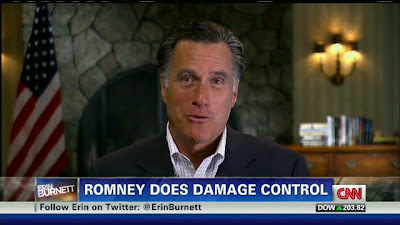
A couple of days ago, the Boston Globe published a story—not the first of its kind, but the biggest, latest, splash—suggesting that Romney hadn’t, in fact, left Bain Capital in 1999 when he said he did, but rather in 2002. [Campaign adviser Ed Gillespie is now saying that Romney “retired retroactively” in 2002. With friends like this…] Why does it matter? Well, a number of decisions in that 1999-2002 timeframe are central to the depiction of Bain as the poster child of vulture capitalism: shutting down businesses, laying off workers by the thousands, outsourcing jobs to China and elsewhere.
Romney, at least in his candidate persona, doesn’t want to be associated with that, and he has countered allegations from the Obama campaign and others by insisting that he had nothing to do with what the company did after February of 1999.
The evidence, frankly, is somewhere between contradictory and inconclusive. A few things are clear:
1. As David Corn demonstrates in an article in Mother Jones, Bain had begun its outsourcing operations at least by 1998.2. No one seems to dispute that Romney was the sole stockholder and CEO of Bain, at least nominally, until 2002. He received a six-figure salary, independent of payments made to him in his capacity as owner, well after 1999. It is unclear—to me, at least—whether these were deferred payments. They could have been. They also might not have been. Proclamations in either direction tell us only about the predilections of the speaker, not about the truth of the situation.3. The original intention, at least, was that Romney would continue at Bain on a part-time basis while running the 2002 Salt Lake City Olympics, and that he was merely taking a leave of absence. It didn’t work out that way, at least as far as the “leave of absence” played out: he never returned to Bain.4. There’s a difference between being the CEO and managing the company. Whether that is a relevant distinction is less clear.5. Romney’s denials are littered with the same weasel-words—“I don’t recall” and such—as his denial of the prep school hair-cutting incident. That doesn’t mean he isn’t telling the truth. It does mean that he doesn’t sound like he’s telling the truth… or, rather, that he’s running his rhetoric through a Clintonesque parsing program, providing an escape hatch for every declarative sentence.6. The Obama team’s accusations are ethically unsupportable (based on what we actually know) and politically inept. You represent the President of the United States. It goes way past “unseemly” to accuse anyone, let alone a legitimate candidate for the Presidency, of a felony without a hell of a lot more evidence than you’ve got at your disposal. But I suppose expecting political campaigns to measure up to the standards of common decency is asking a bit much. Political astuteness, however, ought to come a little easier. Yes, you’ve put Romney on the defensive. In July. And you’ve done so with an accusation that 1). sounds hysterical, 2). might not conform to the facts, 3). abandons any claim, present or future, of taking the high road in the campaign, and 4). has the potential to blow up in your face, with Romney pointing out how desperate you were to change the subject from your guy’s track record.At the very least, let the David Corns and Rachel Maddows do the heavy lifting. You stand on the sidelines and say, “There certainly seem to be some unanswered questions here. We urge Governor Romney to provide the necessary documentation to answer them.” But that would mean that Axelrod et al. couldn’t do their rabid Rottweiler imitations. Pity.
But to say that we don’t know everything we need to know to make an intelligent appraisal of the facts is to err more on the side of understatement than of hyperbole. And the coverage shows this. Fact-checkers like FactCheck.org, to my mind the best such service (although I don’t always agree with their conclusions, of course), concludes that there is no evidence that Romney did anything criminal, or indeed that he was indeed an active manager at Bain even when his signature appears on all those SEC filings. Others, like the Washington Post’s fact-checker Glenn Kessler, the Columbia Journalism Review’s Brendan Nyhan, and Fortune’s Dan Primack, agree.
Yet the 35 common-sense questions raised by TJ Walker of Forbes, hardly the bastion of frothing-at-the-mouth anti-capitalism, go unanswered. You can read the entire list, of course, but here are some highlights (obvious typos corrected):
1. Are you contending that an individual can simultaneously be the CEO, president, managing director of a company, and its sole stockholder and somehow be “disassociated” from the company or accurately classified as someone not having “any” formal involvement with a company?2. You have stated that in “Feb. 1999 I left Bain capital and all management responsibility” and “I had no ongoing activity or involvement.” It depends on what the definition of “involvement” is, doesn’t it? Clearly you were involved with Bain to the extent that you owned it. Are you defining “involvement” in a uniquely specific way that only means “full-time, active, 60-hours-a-week, hands-on manager?” ….5. You earned at least $100,000 as an executive from Bain in 2001 and 2002, separate from investment earnings according to filings with State of Massachusetts. Can you give an example of anyone else you personally know getting a six figure income, not dividend or investment return, but actual income, from a company they had nothing to do with?6. What did you do for this $100,000 salary you earned from Bain in both 2000 and 2001?7. If you did nothing to earn this salary, did the Bain managers violate their fiduciary duty by paying you a salary for no discernible reason? ….15. Isn’t it possible that if Bain had made an investment during 1999 to 2002 that you felt was truly odious, for example ownership of a legal Nevada brothel, that you could have and would have used your authority to veto such a decision?16. If, in fact, you did not veto any major investment decision during your 1999 though 2002 ownership, doesn’t that imply your broad consent of management’s decisions?17. According to the Boston Globe, “In a November 2000 interview with the Globe, Romney’s wife, Ann, said he had been forced to lessen, but not end entirely, his involvement with Bain Capital.” Did your wife misspeak? ….23. Every time a reporter asks you “why were you listed by Bain in SEC documents as the CEO in 2000-2002″ You respond that everyone knows you were no longer the active manager after Feb. 1999 and that you owned stock in Bain but did not manage anything. That may well be, but that doesn’t answer the question as to why Bain listed you as CEO, president and managing director. Why won’t you answer a simple question that involves basic facts that are undisputed?24. Why do SEC documents claim you were Chief Executive Officer, President, and Managing Director of Bain Capital 2000 and 2001 if you were merely the sole owner?29. When asked “did you attend board meetings for Bain after 1999″ you responded by saying “I did not manage Bain after 1999,” or that you didn’t attend any meetings involving things like firing people. This seems to suggest the possibility that you did attend Bain meetings in 2000 and 2001 that did not involve hiring or firing people or where you made the final decisions on investments. Is that possible?30. If not, why not just give a blanket statement that you never attended a single board meeting for Bain after Feb. 1999?31. If Obama owned slum apartments in Chicago that horribly mistreated poor people and didn’t provide them heat or running water, but Obama hired a real estate management firm to manage the building and collect rent, do you think it would be fair to criticize him for being a hypocritical slum lord who showed no compassion for poor people?35. In general, don’t full-time hired managers often seek the “advice” of absentee owners and then do everything they can to implement that “advice?”
There may well be legitimate answers to these questions (I’ve omitted a couple from Walker’s list that I think are either over the top or already answered), but we haven’t heard them yet. When I rented out the house I inherited from my father about the same time all this stuff about Bain was going down, I hired a real estate manager to handle the details for me. They selected the tenants, collected the rent, and handled minor problems like a malfunctioning dishwasher or a mouse spotted under the sink. They had power of attorney. That doesn’t mean they didn’t have both an ethical and a legal obligation to remember whose house it was.
I was not merely consulted about whether to re-paint, cut down the big maple that was dying but not yet dead, or re-carpet the upstairs bedroom. Rather, they made a recommendation and I made the decision: because I was going to be the one paying for it. I understand that there are legal distinctions between this arrangement and the one Romney had with Bain, but I confess that I find it difficult to believe that the two situations were functionally very dissimilar. More to the point, while my involvement in decision-making was undeniable, it took about an hour a year. All this claptrap about how busy Romney was—“too busy to celebrate his anniversary” and other hogwash—is ultimately irrelevant. If I’m about to invest a few million dollars of a company’s money, and that company is owned by one person: I’m going to give him a call, even though I know “he’s busy,” just to make sure he’s on board. If the Bain people didn’t, they’re idiots… and Romney hired them, making him… well…
One more thing: FactCheck.org found a few months ago that Romney’s claim to having created 100,000 jobs is not merely “unproven” and based on the work of many people whose initials aren’t WMR, but relies on figures… wait for it… after Romney claims to have left Bain. Staples is a big corporation now. Bain helped it out a decade or more ago. That means Romney created the job of every current Staples employee. Really, that’s how his mind works.
Romney, like all politicians, wants to have it both ways. He wants credit for anything that happened on his watch, even if it happened despite him; he accepts no responsibility for anything bad, even if his fingerprints are all over the disaster. Thus, it’s Obama’s fault that the national economy isn’t doing better than it is, but Romney is blameless that Massachusetts ranked 47th in the country in job creation while he was governor. Sure, Mitt.
The best-case scenario for Romney, in political terms, at least is that he really wasn’t involved at all in Bain’s operations after February of 1999. That would mean that he entrusted a fortune to people who made no attempt to contact him (or he, them) about key decisions, even though he was the sole owner and CEO. This is the business acumen Romney would bring to the White House if elected? I’ll pass, thanks. Unlike the brouhaha over more recent uses of the Romney fortune, there’s no suggestion of a blind trust here. Nor is there any suggestion that Romney disagreed then—or now, for that matter—with any of Bain’s decisions.
He created a culture at Bain that led inevitably to the decisions that are now under attack. He hired the people who made them. He was CEO and sole owner. To expect to avoid culpability (or praise, no doubt, from some) for those decisions is the height of arrogance.
That said, the Obama campaign’s mud-slinging is as depressing as it is petulant. Somewhere in How-to-Run-a-Political-Campaign school, there must be a course called “It Isn’t Slander if We Do It.”
How this contretemps will play out, and to whose advantage, has yet to be determined. It is plausible that there’s more to the charges than we currently know, and/or that the Obama team will make the allegations stick. It’s also plausible that Romney could benefit, by getting this potentially embarrassing episode out of the way in July, and/or by making the reckless shrillness of the Obama campaign an issue: “look at what they’re willing to do to stay in power.” More likely, no one will decide whom to support based on this incident. Those on the left are ready to believe the worst of Romney; those on the right will defend him because, well, at least he isn't Obama.
This has already become a race between two versions of hubristic, two versions of ethically insupportable, two versions of ultra-partisanship devoid of even the sense to recognize that the people who are ultimately going to decide the election—those yet uncommitted—are going to be more likely to be turned off than impressed by glib histrionics. It is already an election about who deserves our vote less, not more. It’s only July. I despair.


