Showing posts with label Pro-Palestinian protests. Show all posts

Sunday, July 27, 2025

Three Stories about Opera and Opera Houses

Curmie has seen a couple dozen operas, mostly presented by the music program at a place he was teaching.  He helped on a few, and even appeared in one.  (Fear not, Gentle Reader, it was as a narrator, as literally no one wants to hear him sing.)  But to say he’s an aficionado would slide beyond the boundaries of exaggeration and into falsehood.

That said, there are three opera or opera house stories that caught his attention in the past couple of weeks.  They are presented here in chronological order. 

We start, then, with a story Curmie first learned about from a post on Chris Peterson’s OnStage Blog.  The Thomaston (CT) Opera House has recently undergone a $3.5 million renovation, apparently funded by the state.  The space is home to the local community theatre and shares a building with the town hall.  About $700,000 of that grant was spent on restoring the original ceiling… and that’s where things start getting complicated. 

You see, that photo at the top of this entry is of part of the newly restored ceiling.  It duplicates that original design from when the opera house was built in 1884.  According to an article by Tracey O’Shaughnessy for ctinsider.com, the ceiling was designed “to get visitors to look up, forget their troubles and just get happy.”  There are four panels representing architecture, literature, music and the performing arts.  The ceiling and the rest of the building served to enhance civic pride.  State Historic Preservation Officer Jonathan Kinney says that the opera house “was a sign of a municipality achieving a level of status that they had evolved to a point that they could provide that for their residents.”

Ah, Gentle Reader, but you’ll have noticed that some of that decoration looks rather like swastikas.  The original ceiling included them as symbols evoking good fortune or well-being.  Remember, the building was constructed decades before the Nazis destroyed the possibility of a positive meaning to those images.  Well, actually, they only sorta did so.  By this Curmie is not suggesting that swastikas in the sense we generally think of them are anything but a symbol of hatred, but the ones on that Connecticut ceiling are pointing in a different direction than the one associated with Nazism: that is, the lines coming out from the center of the symbol turn left/counterclockwise, opposite of the Nazi version.

Does that matter?  Well, the term swastika comes from the Sanskrit, so it seems appropriate to respond as Curmie so often did in his Asian Theatre classes: yes and no.  First off, the term “swastika” applies to both the left-facing version seen on that ceiling and the right-facing version hijacked by the Nazis.  In other words, yes, those symbols are technically swastikas, but they aren’t what we generally think of when we use the term.  That does indeed mean that the people who are upset about the decision to repaint the ceiling are reacting to a stimulus that doesn’t really exist.  What Curmie finds interesting is that there doesn’t seem to be any attempt by those who approved the design to point out the difference between the two symbols.

So, is it over-reaction?  Or misplaced anger?  Perhaps.  But even if so, are those who argue that restoring the ceiling to its original look was an “obvious mistake” just snowflakes who need to sign on to the “historical” restoration?  Curmie thinks not.  Going ahead with a project you know is going to offend people is generally bad form, even if you’re “right.”

There is the whole authenticity argument, though… or is there?  First off, the ceiling had been painted over in the 1930s precisely because of the presence of those swastikas, so returning to what things looked like nearly a century ago doesn’t seem out of line. 

More significantly, Curmie remembers touring Shakespeare’s Globe in London twenty or so years ago.  The new (1997) theatre was built to be as accurate to the original as possible: there was no structural steel, the tools used were those available to carpenters in the late 16th century, and so on.  But, for instance, whereas the thatch for the roof was authentic, it was treated with a fire retardant chemical, and sprinklers were installed (the original Globe burned down in 1613, and repeating that particular bit of history seemed contra-indicated). 

Similarly, no one today really wants to see a show in an authentic 19th century theatre: we prefer modern electricity, plumbing, etc.  So there’s not going to be absolute authenticity.

Curmie is enough of a literalist theatre historian to call the ethical cases on both sides of the dispute to be roughly equally persuasive.  If you’re going to re-create the original ceiling, which is both inoffensive and decorative, then do it.  Except… well, you see where this debate leads to, Gentle Reader.

But there’s one other factor: the publicity.  You don’t get extra credit for scrupulous detail in a renovated building; you do catch flak for even approximating one of the most divisive and offensive symbols in human history.  This is, after all, a permanent fixture now, not a piece of set dressing in a production of The Producers.  If Jewish patrons (in particular) are made to feel uncomfortable and will avoid the space in the future, maybe there’s a problem.  In sum, then, yeah, bad idea, although Curmie does not condemn those who disagree with that assessment.

The other two stories are less ambiguous in terms of right and wrong.  So, let’s go to London for the final moments—the curtain call, in fact—for the run of Verdi’s Il Trovatore at the Royal Opera House in Covent Garden.  Daniel Perry, a self-described “queer dance artist” (spare me!), unfurled a Palestinian flag in the middle of the bows.  Perry, who appears to have been in the chorus, successfully got the flag onstage despite the attempts of some backstage crew member to thwart them [they/them pronouns, not plural].

OK, this one is simple: Perry is an idiot and an asshole.  Curmie doesn’t care whether Perry’s empathy for the Palestinian cause is appropriate or not (in fact, Curmie rather agrees with them… up to a point, at least): this is not the time or place for such self-indulgent displays.  The opera’s administrators were absolutely correct to distance themselves from the puerile display and to ban them from further productions in the space.  One hopes that Mx. Perry will find that such grandstanding has some serious career consequences.

Meanwhile, there’s the kind of boorishness displayed by Amin Hashwami’s post on X in which he suggests that the opera administration is “more disturbed [by the incident] than the killing of 58000 civilians in Gaze.”  Oh, FFS, give it a rest.  It is not the responsibility of the administration, the audience, or the leading performers who had no idea of the silliness going on behind them to support your cause 24/7/365.  When you’re on stage at Covent Garden, you adhere to the company’s apolitical credo.  And if Curmie is in that audience, he’s going to label you an asshole and be less likely to support your cause.

Oh, there’s one more thing: our Daniel speaks from a place of considerable privilege.  He was trained at the hoity-toity Tring Park School for the Performing Arts, where annual tuition is a cool £48,000.  For context, that’s about five times as high as at the very reputable conservatory with which Curmie’s university has had a relationship for a quarter century or so.  This is of little relevance to the main story, but it elicited a snort from Curmie, and it might from you, as well, Gentle Reader.

But, intentionally or otherwise, Curmie saved the most horrifically hilarious of the stories for last.  Yes, it’s true that House Republicans are threatening withhold funding from the Kennedy Center if the opera house is not named for… wait for it… Melania Trump, presumably because, to quote a vulgar but not inaccurate meme, Trumps balls won’t lick themselves.  You can’t make this stuff up.

GOP pols have proven themselves the perfect storm of malevolence, cowardice, and hypocrisy.  They’ve done more harm in a variety of ways than even passing this nonsense would be, but even confirming the likes of Baby Bobby, Dr. Oz, and Pete Hegseth wasn’t as profoundly, awe-inspiringly, stupid as this.

Melania Trump has done literally nothing for the performing arts in general or for opera in particular.  She has less right to have an opera house named for her than Curmie does—he’s worked on a couple of amateur productions, after all.  The only upside here is that there has never been a clearer demonstration of the GOP legislators abrogating their responsibilities as a co-equal branch of government.  Not even passing that Big Ugly Bill or shutting down so they can avoid dealing with the absolute certainty that Dear Leader’s name is all over the Epstein files can compete.  Naming literally anything after a vulgar trophy wife known primarily for posing for some soft-core porn is beyond laughable.  Remember, this is the couple who broke tradition by not attending the Kennedy Center Awards during 45’s term.  “Appreciation of the arts,” my ass.  Curmie cannot improve on the line of comedian Andy BorowitzKaroline Leavitt defended the decision to rename the Kennedy Center after Melania: Since President Trump took it over, the Kennedy Center has been like our nation’s First Lady: renovated and vacant.

Oh, and <insert late-night infomercial voice here> that’s not all!  JFK’s grandson, Jack Schlossberg, hammered the amendment and, as the kids say, brought receipts… like the federal law that prohibits this kind of grandstanding: “after December 2, 1983 no additional memorials or plaques in the nature of memorials shall be designated or installed in the public areas of the John F. Kennedy Center for the Performing Arts.”  There are some exceptions noted; this bill doesn’t qualify.

It’s not clear whether Schlossberg would be as adamant had the proposal been to honor someone worthy of the recognition—Jessye Norman or Leontyne Price, for example—but the fact is, we’ll never know: because no one is going to try to do that.  This is nothing but sycophancy and delusion… oh, and, as one commenter put it, the Epsteinth attempt to distract from the issue that has, for better or worse, captured the public’s attention.

So there you have it: three stories about opera and opera houses.  Curmie may not write about either subject ever again.  But… never say never.


If you’re reading this on your phone, Curmie apologizes if some of the formatting is weird.  It looks fine on Curmie’s laptop, but not on his phone, and he doesn’t know how to fix it.

Monday, May 13, 2024

Today in Alliteration: Pyrrhus and Pro-Palestinian Protests

Pyrrhus in happier times
Curmie struggled to find a hook for this piece.  He first toyed with a baseball analogy—trying to stretch a single into a double and getting thrown out at second base.  But that didn’t quite work.  Maybe something from playing cards—overplaying a hand?  No, that isn’t exactly right, either.  “First, do no harm,” the famous line (probably inaccurately) attributed to the Classical Greek physician Hippocrates?  Again, close… but no cigar.

Ultimately, we’re going to go with the notion of a Pyrrhic victory.  The term comes from the Greek king Pyrrhus of Epirus, who ruled in the early 3rd century BCE.  He is best known today not for his apparent brilliance as a general, but for winning consecutive battles against Roman armies, only to have his forces so depleted in the process that he could not continue his campaign.  Given that this is yet another post about demonstrations on university campuses concerning the situation in Gaza and Israel, the military terminology makes some sense.  And there are parallels between the actual conflict and the unrest on American campuses. 

The events of last October 7 were certainly a win for Hamas in the short term.  They inflicted far more casualties and far more damage than they incurred.  But they, and especially the everyday Palestinian people they purport to represent, have not seen a lot of wins since then.  Tens of thousands of Palestinians, including an estimated 14,000 children, have been killed by the Israeli military, and that figure does not include the imminent deaths from starvation or the displacement of over a million Palestinians.  There have been deaths and displacements on the Israeli side, too, but the numbers are significantly smaller.

On the “winning the hearts and minds” front, the process has been quite different.  There, the initial reaction across this country to the barbarity of the events of October 7 was predictably anti-Hamas.  There were pockets of dissent to that consensus, however, especially among student groups at major universities like Harvard, Columbia, UCLA, and the University of Pennsylvania. 

Things get complicated from there.  Curmie has made a number of points in the past, arguing that whereas the Hamas attacks in Israel cannot be excused, the frustration of the Palestinian people is readily comprehensible, and Israel’s response to the attack was disproportionate to say the least.  Yeah, yeah, it’s war, and there will inevitably be collateral damage.  It’s funny, though, how that’s unavoidable when it’s our side inflicting it and an offense against God and the universe if we’re on the receiving end. 

The life circumstances of the average Palestinian weren’t unknown a year ago, but, like apartheid in the ‘80s, they had long since ceased to be news, and a good number of people were shocked, not into reality, but into a consciousness of it.  The protests both helped and hurt the pro-Palestinian cause.

On the plus side, we were reminded that such events—the storming of the Bastille, the attack on Fort Sumter, the Easter Rising, and on and on—never happen in a vacuum; there’s always a rationale.  Not everyone, certainly not those in power, regard that rationale as compelling or even reality-based, but it’s there. 

But the downside is demonstrable and significant.  First, the initial rhetoric about Israel being the sole cause of the attack is sufficiently daft that it alienates potential allies.  And whereas Curmie has argued repeatedly that in the absence of aggravating factors (e.g., “true threats”), chanting slogans like “from the river to sea…” is protected speech, that doesn’t mean it’s a good idea.  Using phrases that even could be interpreted as a threat not merely to Israeli dominance in its occupied territories but to the lives of Jews worldwide is unlikely to win friends and influence people.

It opens the door for those—especially but not exclusively right-wing pols and pundits—to conflate Palestinians with Hamas and the Likud government of Israel with Jews in general.  This is, of course, a lazy and anti-intellectual construct, which is why it appeals so much to some of the dimmer bulbs in the GOP.  But it is also the stuff of headlines, largely because “lazy and anti-intellectual” is also a rather apt descriptor of the majority of so-called journalists. 

Still, there have been victories for the pro-Palestinian side, and they haven’t always come in the form of sympathy for the protesters in the wake of over-reaction from politicians, university officials, or law enforcement.  Deals—often including amnesty for protesters, consideration of divestment proceedings, creating cultural centers and Middle East Studies departments, etc.—have been struck on a number of campuses, including Northwestern, Rutgers, and Brown.  (Curmie won’t bother to link to all these stories, Gentle Reader, as he is well aware of your ability to operate the Google machine.)

But these triumphs, such as they are, have come at a price.  Negotiated settlements involving immunity for having violated either the law or at least university policy suggest a weak administration rather than a legitimate argument on the part of the protesters.  It is not unreasonable to suggest that breaking the law is breaking the law, and there is no question that some of the demonstrators did so.  Blocking access to campus, holding university workers de facto hostage, even violating reasonable time, place, and manner restrictions cannot be countenanced.  The fact that the demonstrators “got away with it” engenders resentment from those not already on their side.

More to the point, the cancellation of commencement ceremonies at the University of Southern California and the elimination of a university-wide exercise at Columbia are not going to sit well with the general public, which is already much more likely to be Islamophobic than antisemitic.  Why else would Republican pols who saw nothing wrong with a gang of neo-Nazis chanting “Jews will not replace us” in Charlottesville a couple of years ago be eager to claim that criticisms of the Israeli government are now inherently antisemitic?  And those cancellations will be blamed on the protesters, whether they’re actually at fault or not.

Curmie is reminded of standing in the May 4 Museum at Kent State University, watching tapes of the TV coverage of the 1970 shootings on that campus.  Particularly memorable was a local woman, perhaps in her 60s, who proclaimed that the events of the day had been unfortunate, “but if that’s what it takes to restore law and order…”  Student protesters are always going to be the bad guys in the public’s eyes precisely because they are suggesting that all is not right in the status quo, and those who benefit from the current system like it just fine.  Sometimes the protesters are “right,” sometimes not.  Sometimes they are the perpetrators, sometimes the victims.  But they will always, always, be blamed.

It is also a fact of life that those who oppose Group X, whoever Group X might be, will take the stupidest member of that group as representative of the entire organization.  Just as not all Republicans are as vulgarly hypocritical as Lauren Boebert, as dishonest as George Santos, or as Machiavellian as Mitch McConnell, not all campus protesters are as self-entitled as Malak Afaneh. 

She’s the woman who barged into a private event on the property of Cal-Berkeley Law School Dean Erwin Chemerinsky and his wife, law professor Catherine Fisk, a month or so ago.  She then proceeded to use a microphone to interrupt the proceedings to yammer about Ramadan (she was stopped before she could get to what one presumes would have been the real content of her screed), claiming that the National Lawyers Guild says that such an intrusion is protected by the 1st Amendment.  The National Lawyers Guild needs, as Popehat’s Ken White might say, to stop recruiting its membership out of the back room of a bait shop. 

Professor Fisk, not unreasonably, demanded that Afaneh leave her home, and attempted to wrestle the microphone from her.  Now the university is initiating a civil rights investigation against Fisk, whom Afaneh claims was trying to silence her because of her pro-Palestinian views.  No, she was “silenced” because she’s an entitled brat (Curmie refrains from using a different monosyllable beginning with the same letter).  The intrusion was, of course, planned and choreographed in advance—hence the video documentation that begins right on cue.

But a prospective lawyer, of all people, ought to know the basic principles of persuasion—things Curmie taught in a freshman-level speech course back in the day: realize that the audience might be hostile to your views and structure your message accordingly; understand, also, that the more sophisticated your audience, the more you need to acknowledge the legitimacy of at least part of their position; and for God’s sake, stay on message!

If you’re trying to convince a Trump supporter to vote for Biden, you don’t go screaming about how their guy says outrageous things.  Rather, you say “look, I know my guy makes his share of verbal gaffes, but have you really listened to the word salads your guy spews out?”  And you don’t do anything at all if they’re just trying to finish their breakfast at the local diner.

Malak Afaneh will no doubt be cheered by the true believers.  She got what she wanted: national attention.  But she unquestionably did her cause more harm than good by intruding into a private space, using a microphone to disrupt a gathering that had nothing to do with her speech, and generally being condescending to a pretty intelligent group of people.  Anyone not already firmly on her side of the controversy just moved further away from her cause because of her antics.  A small win is not worth a larger loss.

Curmie understands that.  Curmie’s students from 40 years ago understood that.  Pyrrhus definitely understood that.  Ms. Afaneh, for better or worse, does not.

Saturday, May 4, 2024

On Campus Protests, With a Stroll through Curmie's Memories

UCLA, this week

Can it really be almost nine years ago when Curmie wrote about his experience at the May 4 Museum at Kent State University, and the memories that visit engendered?  Apparently so.  The murders (yes, Gentle Reader, murders) by National Guardsmen of four students on that campus 54 years ago today was only the beginning of the process by which teenaged Curmie came to be wary of anyone with a uniform and a gun. 

The subsequent revelations of what actually happened and therefore of the prevarications of the politicians and news media alike were the confirmation that Curmie’s worst suspicions were accurate, but that voyage into (self-)awareness was triggered—if you’ll pardon the expression—by those shootings.  Two more deaths at Jackson State eleven days later, this time perpetrated by police instead of the National Guard in an even more outrageous display of recklessness, made it clear that those First Amendment rights we’d all heard about in school weren’t all that absolute. 

Kent State, 54 years ago today

It’s all too easy to forget that non-participants were among the casualties at Kent State.  One of the students who died was ignoring the protest and simply walking to class.  Another was watching from a distance; he was enrolled in ROTC.  I think we can take it on faith that he posed no threat to the Guardsmen.  The nearest of those killed was 85 yards from the shooters.  Eleven of the thirteen students who were killed or injured were shot from behind.  The list of things that aggravate the atrocities committed by the National Guard goes on and on.

But something else I wrote about from my dorm room on the Kent State campus sticks in my mind: “I fear there couldn’t be a Kent State today. Yes, I fear that, because such a declaration betrays a profound and disturbing apathy among today’s post-adolescents.”  That observation, referring to the protest, not the shootings, of course, may have been true then, but as literally scores of rallies, walk-outs, and encampments around the country in recent weeks have made clear, today’s youth isn’t as passively disengaged as we might have thought.  Several professors, Curmie’s Facebook friends, have posted of late about the anger of their students. 

Curmie confesses himself shocked that there have as yet been no deaths and few if any serious injuries linked to pro-Palestinian protests; we’ve come pretty close, though: witness the treatment of a journalist covering events at the University of Texas at Austin.  We’re about a half step away from increased police violence.  If the terms of that “man or bear” meme that’s making the rounds of late were changed to “cop or civilian,” Curmie confesses he’d need a moment to consider his options.

Anyway… you can see Curmie’s musings on Kent State in the piece linked above, or in this one from two years ago today.  But I thought today I might take a stroll through other memories.

Curmie was just a little too young to have participated in (or chosen not to participate, as the case may be) protests concerning the Vietnam War.  He had a draft card and a random number (4… ouch!), but he was in the first year in which no one was drafted. 

I did, however, experience a college campus in many ways before becoming a student.  My father was president of one of the SUNY colleges, and we lived on campus; the view out my bedroom window was of two dormitories and a dining hall.  I also attended the campus school associated with the college. 

I don’t remember the exact circumstances by which I found myself sitting on the lawn in front of one of the main campus buildings on the first Earth Day, twelve days before the events at Kent State.  What I do remember was listening to some student ramble on about how no one in the college administration, least of all the president, cared about the environment.  I finally had enough, and responded that I was confident that he did indeed care.  “How would you know?” smirked the student to this long-haired junior high kid.  “Because I’m his son.  He’s been a conservationist all my life, and he has a PhD in Botany.  I think his credentials are probably as good as yours.”  (Curmie was a snarky SOB even then.)

There was also a time when my mom asked me to take a letter or something up to someone (not my dad) in an office in the administration building.  Unbeknownst to either of us, students had taken over the building.  They barred my way to the elevator and to the stairs.  I shrugged and went back to apologize to my mom for the non-delivery.  She was very happy that no one knew who I was; in retrospect, I think her fears were probably misplaced, but there’s a difference between “probably” and “certainly.”

My other memory of being the president’s son came a little later (I think… timelines from a half century ago get a little blurry sometimes).  I was sitting in the kitchen with my mom when someone threw a rock through the dining room window.  As it happened, a campus policeman saw it happen and apprehended the perpetrator almost immediately.  He brought kid to the door to ask what my dad wanted to do. 

They asked this young man why he’d vandalized the house.  Turns out, he was demanding 24-hour visitation (there had been a curfew for men to be out of women’s dorms and vice versa).  My dad asked, simply, how he was supposed to know that from a baseball-sized rock amidst the glass shards on our dining room floor.  The look on that guy’s face when he realized that he had no answer to that question!

There weren’t any significant protests, at least that I can recall, in my own college days.  There was a smallish anti-National Front (a far-right party in the UK) rally at the University of Birmingham when I was doing my MA there, but it was literally nothing to write home about. 

We move on to a different event and to responses that weren’t centered on a college campus but certainly affected students both here and abroad.  When Iranian students seized the American embassy in Tehran, holding dozens of people hostage, Curmie was teaching at a small church-related college in Kentucky.  One of the school’s star soccer players was beaten up rather severely by a gang of local yahoos, simply because he “looked Arab.” 

In fact, he had a close family member (Curmie thinks it was his father, but he may be misremembering) who was part of the Shah’s inner circle.  If there was anyone in the state who was disinclined to support the Ayatollah Khomeini and his minions, this was the guy.  That, of course, would have meant nothing to his subhuman attackers.  Similar scenaria played out across the country in the wake of the 9/11 attacks, too, of course.  Bigots do tend to be stupid in other ways, as well.

Cornell, 1985

The other incident involving large numbers of students that Curmie witnessed first-hand was the “shantytown” erected on the Arts Quad of Cornell University in 1985.  Curmie was working on his PhD there at the time.  The encampment was located between the theatre building and the library, so I walked past it a lot, and the window in my carrel in the library looked out over it.

The idea was to force the university to divest from companies doing business with a particular foreign country.  Today, that nation is Israel.  In 1985, it was South Africa, which was still operating under the apartheid system of radical racial discrimination.

Whatever we think of the students’ intentions, the protest itself was silly: a bunch of privileged kids “roughing it” for a few hours at a time.  The joke on campus was that after doing their shift, the protesters would drive the BMW daddy gave them for their 18th birthday back to their apartment for a hot shower and a change of clothes before heading to the Moosewood (an iconic vegetarian restaurant, apparently still in business now) for lunch.

Predictably, the Cornell trustees did not divest in 1985, but there is some chance that the short-term rejection of student demands was the result of not seeming to give in to the strategy; considerable but not complete divestment did indeed take place in subsequent years before the gradual but inexorable disintegration of apartheid in the early ‘90s.

So now there are protests and demands for divestment happening on college campuses across the country.  There have been hundreds if not thousands of arrests but, as noted above, mercifully few injuries and no deaths… so far.  The issues at play—that is to say, the issues motivating the protests—are complex, and no one, certainly neither Hamas nor the Israeli government, looks good in all this. 

As Curmie noted months ago, neither side gives a proverbial shit about the Palestinian people, whose plight is worsened by the belligerence and bellicosity of both combatants.  Like the upcoming presidential election in this country, it’s not a question of who’s better, but who’s worse.

Moreover, some of the protests cross the line into illegality; others are being illegally suppressed.  Curmie keeps coming back to “context,” a term which has become anathema to the pro-Israel faction of American society.  If demonstrations do indeed threaten a part of the student population—not their belief system, their sensibilities, or the continued existence of a foreign country or its government, but them—then shutting down that protest or even arresting the participants is absolutely in order.  The same is true for violations of reasonable campus-specific time, place, and manner policies.

But 1st Amendment rights to freedom of speech mean less than nothing if they apply only to non-objectionable speech.  If that speech does not represent a true threat, if it is not “severe, pervasive, and objectively offensive,” it’s protected speech.  (Both “and” and “objectively,” as opposed to “or” and “subjectively” are significant terms here.)  True, private institutions can set their own rules—as Alex Morey of FIRE said on a webinar this week, you don’t go to BYU expecting the same freedoms you would be guaranteed at a public university.  But if your mission statement offers essentially the same commitment to intellectual freedom as the 1st Amendment does, you damned well ought to live up to your promises.

Anti-semitism is abhorrent.  Islamophobia, which to be honest Curmie has seen considerably more of on college campuses, is, too.  But mere expressions of hatefulness are protected.  Curmie thinks the benefits of such a policy outweigh the disadvantages.

So, what is the analogy to what we’re seeing today?  The demonstrations against the escalation of the Vietnam War into Cambodia?  Well, they were pervasive and fervent, but what was being protested affected American college-aged men (in particular) directly.  That’s not happening now.

The Civil Rights movement?  Sort of, to the extent that violating the law was seen by participants as ethically unproblematic.  Willingness to risk arrest for one’s beliefs is simultaneously admirable and naïve.  Those who have only the law on their side are not heroes, but they do have some moral authority.  Still, we tend to prefer Martin Luther King, Jr. to Bull Connor.

The divestment protests of the ‘80s?  Well, that seems to be the goal of many if not most of today’s protesters.  They can hardly expect to influence the actions of the Israeli government, and the US response has been sufficiently irresolute that it’s difficult to criticize except for that wishy-washiness.  We’ll also see whether the energy of the demonstrations can be upheld when campuses are, relatively speaking, empty over the summer.  More relevantly, no serious person could argue that apartheid was anything but deplorable.  Israel may not be without fault in all this, but they’re not the embodiment of evil, either.

Or is this a return of those students from Curmie’s youth, smug in their fervency and their ignorance, and committed to a strategy that not only won’t change anything but literally cannot do so?  Yes, there are those who are protesting for the sake of doing so, or for virtue signaling, or to meet boys/girls.  Or, perhaps, as the Prophet Mick Jagger suggested, “to get [their] fair share of abuse.”  That song?  You Can’t Always Get What You Want.”

Yes, there are elements of all of these.  But this round of protests seems very much to be its own phenomenon.  Here’s hoping that there are no casualties, including the Constitution.


Tuesday, April 30, 2024

Greg Abbott Violates the 1st Amendment. Again.

Too fitting, alas.

When Curmie uses the term “authoritarian asshole” to describe Texas Governor Greg Abbott, he understands that the noun in question represents an opinion: an opinion shared, he suspects, by the majority of readers of this blog, but an opinion nevertheless.  The adjective, however, must be considered an objective truth.  Abbott thinks everyone should conform to his version of ethics on every possible subject, and he’ll use every resource available to punish them if they don’t.

Abbott, of course, purports to be upholding the principles articulated in the Ten Commandments, but he fares a lot better in the early ones about being Judeo-Christian than the later ones; he’s actually rather a fan of bearing false witness, for example.  Nor are we talking here about things like a restrictive abortion law or requiring age verification to visit pornsites.  The former might be (probably isn’t, but might be) grounded in an understandable belief that human life begins at the embryonic stage of development or earlier.  The latter reflects a reasonable, if logistically futile and constitutionally problematic, intention of keeping pornographic materials out of the hands of minors.

Over the past few weeks, however, Abbott has obviously and blatantly violated the 1st Amendment protections of pro-Palestinian students and others.  The first round of this debacle came in the form of an executive order in response to anti-semitism.  Problem was, it restricted the speech of a particular group of people—in this case, those supporting Palestinian autonomy—but no one else’s. 

The response from FIRE (that’s the Foundation for Individual Rights and Expression) was, as usual, right on the money.  Here’s the salient part:

Anti-Semitism on campus is a real problem. When anti-Semitic speech crosses beyond the First Amendment’s protection, Texas institutions have a moral and legal obligation to take action. But today’s executive order relies on a definition of anti-Semitism that reaches core political speech, including criticism of Israel. The order also singles out student organizations by name, suggesting these groups should draw official scrutiny on account of their views.

State-mandated campus censorship violates the First Amendment and will not effectively answer anti-Semitism. By chilling campus speech, the executive order threatens to sabotage the transformative power of debate and discussion. That’s in sharp contrast to Texas state law, which wisely recognizes “freedom of speech and assembly as central to the mission of institutions of higher education.” When speech on contentious issues is subject to punishment, minds cannot be changed.  

Curmie would explain that the definition of anti-Semitism in question is included in Texas Government Code Section 448.001; it is ultimately derived from the International Holocaust Remembrance Alliance’s “working definition.”  One might reasonably surmise that such an organization might have a rather broader definition of the term than what might be considered normative.  Even the IHRA, however, includes this proviso: “criticism of Israel similar to that leveled against any other country cannot be regarded as antisemitic.”

Monday morning Curmie watched a FIRE webinar featuring Alex Morey, that organization’s Vice President of Campus Advocacy; Will Creeley, their Legal Director; and Nico Perrino, their Executive Vice President.  There were several phrases that were repeated multiple times: “viewpoint and content neutral,” “reasonable time, place, and manner restrictions,” “true threats and intimidation,” “severe, persuasive, and objectively offensive.” 

Whatever justification there may have been for Abbott’s executive order, it most certainly was not viewpoint and content neutral: he mentions two student organizations by name, having unilaterally decided they were guilty of violating free speech policies, and insists on revising existing policies to accommodate his desire to stifle the rights of those who don’t share his views. 

Abbott is correct that “from the river to the sea, Palestine shall be free” has been used by Hamas supporters to advocate the elimination of the state of Israel or even of Jews in general, but is neither denotatively problematic (it varies little from “we shall overcome”) nor objectively offensive.  The slogan has also been used by those who simply want a Palestinian homeland out from under the proverbial thumb of Israeli control. 

Creeley, as he had in a Los Angeles Times opinion piece co-written with renowned legal scholar Eugene Volokh cited by Curmie back in December, insisted that… wait for it… context matters.  In the webinar he argued that simply chanting that slogan remains protected speech; doing so while brandishing a weapon or engaging in true threats or intimidation, however, would be a different matter.  Context!

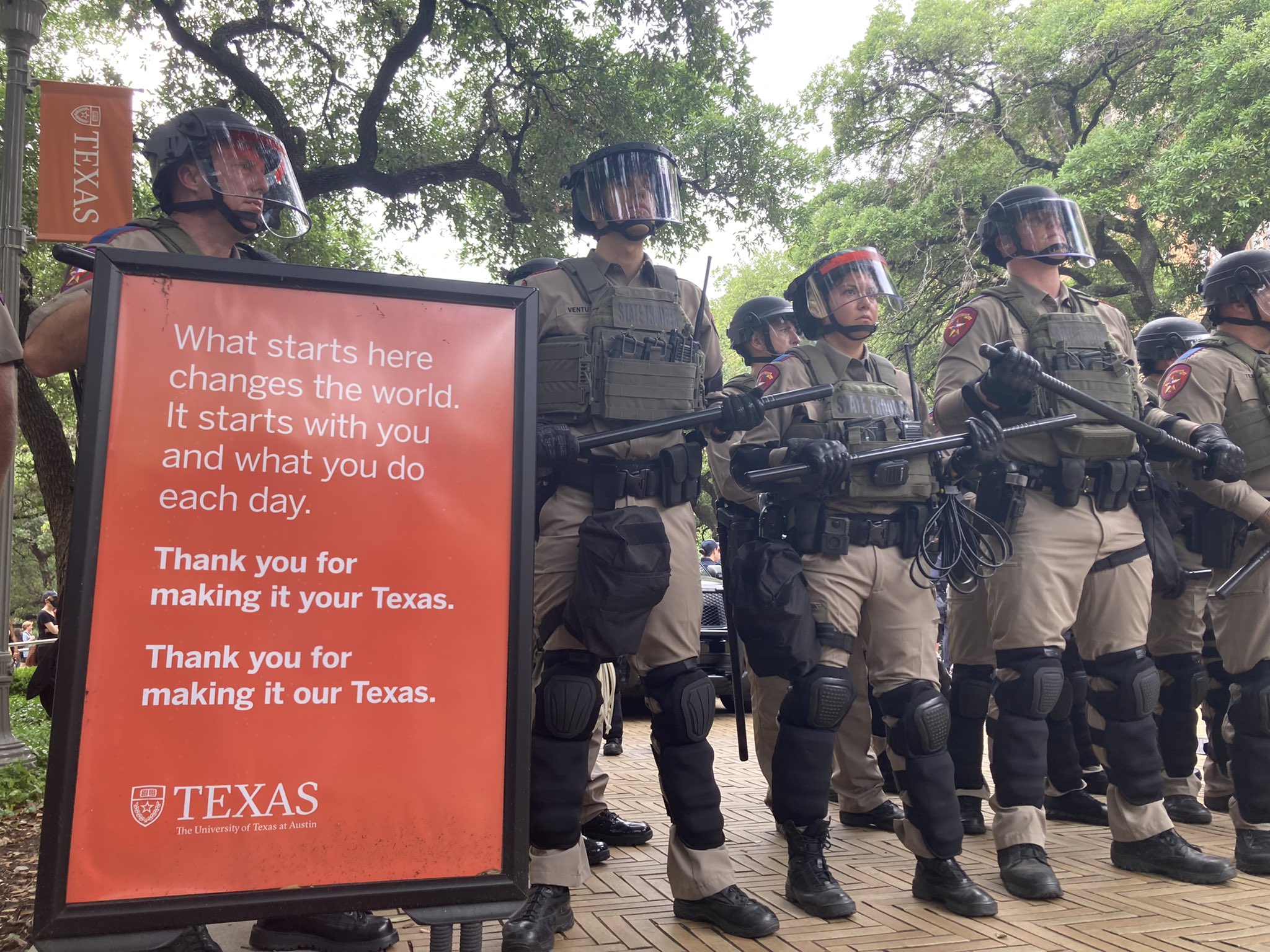
But, as they say in the late-night infomercials, Wait!  That’s not all!  If FIRE was unimpressed with the executive order, they pulled no punches in their commentary on calling in the cops to prevent a protest on April 24, simply because Governor Abbott didn’t like it… and because the University of Texas-Austin President Jay Hartzell is a spineless idiot who cravenly went along.  Dozens of arrests were made, and one photojournalist (ironically enough, from the local Fox affiliate!) was dragged to the ground from behind and detained, although video evidence shows that he was, as instructed, moving back.  In any sane society, that cop would be summarily fired and charged with first-degree assault.  Chances of that happening in Greg Abbott’s Texas: roughly those of Kristi Noem being named PETA’s Person of the Year.

Angel Eduardo’s piece on the FIRE website is headlined, “Texas tramples First Amendment rights with police crackdown of pro-Palestinian protests,” and is accompanied by the photo you see to the right.  It doesn’t get any better for Abbott and his minions later in the article.

First, there’s the re-visiting of the executive order:

Threatening expulsion for expression that some — or even many — may find offensive is a speech-chilling encroachment on students’ First Amendment rights. This is especially true when “anti-Semitism” is defined to target core political speech — such as criticism of Israel — which FIRE has warned Abbott’s order effectively does.

Then comes the link to a letter from FIRE’s Jessie Appleby to UT President Hartzell.  She gets right to the point, decrying in the first paragraph the university’s 

... outrageous and unnecessary use of riot police yesterday afternoon to forcibly disperse students and faculty engaged in a peaceful Gaza solidarity walk-out on campus, taking journalists covering the event with them.  UT Austin, at the direction of Governor Greg Abbott, appears to have preemptively banned peaceful pro-Palestinian protesters due solely to their views rather than for any actionable misconduct.

Tell us what you really think, Jessie!  She’s not done, though: 

UT Austin’s disproportionate response to a seemingly peaceful protest, on expressly viewpoint-based grounds, raises serious constitutional concerns. As a public institution, any university restriction on student expression must comport with the First Amendment’s “bedrock principle” of viewpoint neutrality…. rules must be viewpoint- and content-neutral, narrowly tailored to serve a significant government interest, leave open ample alternative channels for communication, and—perhaps most importantly—not selectively enforced based on a speaker’s viewpoint.

Moreover, 

Texas law is clear: Outdoor common areas on state university campuses are traditional public forums open for “any person to engage in expressive activities in those areas of the institution’s campus freely…. A peaceful protest in an area of a state university that is open to public expression is not unlawful “occupation”—protesters cannot unlawfully occupy a space by engaging in expressive activity they have every right to pursue in a space in which they have every right to be….

UT Austin has abdicated its constitutional and state-mandated obligations to protect expressive rights on its campus.

That pretty well sums up Appleby’s letter, but Eduardo has yet more in his article.  He includes one last jab, linking to a video from a mere six months ago, in which UT Vice President for Legal Affairs and General Counsel Amanda Cochran-McCall says “state law in Texas actually allows members of the public just like our university community to come onto campus and use our common outdoor areas for speech activity.”  Eduardo wonders “what changed?”  The answer, as he well knows, is that, like Elon Musk, Greg Abbott is profoundly interested in free speech for anyone who agrees with him; everyone else… well…

Curmie has followed FIRE for a decade or more, and has never seen a more thoroughgoing and incisive excoriation of a university’s willing capitulation to a politician more interested in shutting down opposition to his personal perspectives than in obeying the US Constitution, or indeed Texas law.

Curmie expected no better from Greg Abbott.  He’d hoped for more from UT officials, but is well aware that competent and conscientious university administrators are approximately as plentiful as honest men in Diogenes’ world.

Note: none of the foregoing is intended to take a stance in the ongoing hostilities between Israel and Hamas.  Curmie stands by his earlier commentary; that’s it.  Nor does this essay express any opinions on pro-Palestinian protests on other campuses.  Curmie is a Confucian, remember, Gentle Reader?  Every case is different.

Sunday, January 7, 2024

Further Musings on "Context"

Claudine Gay at the Congressional hearing

The recent resignations of Liz Magill and Claudine Gay as presidents at the University of Pennsylvania and Harvard University are, of course, of interest to Curmie, both as a career academic and as an observer of American society.  They tell us more about the business of higher education than, perhaps, we would like to know.

It is widely believed that their testimony before a Congressional committee last month was evasive, even mendacious and/or anti-Semitic.  Curmie, you may recall, disagreed with those conclusions, and noted that both Eugene Volokh and FIRE’s legal director, Will Creeley, agree with his assessment.  Context does matter. 

The specific circumstances surrounding a demonstration by supporters of the Palestinian cause chanting “from the river to the sea” are central to determining the appropriate response.  That phrase has been interpreted by some to mean the extermination of Israel, or even of Jews in general.  Others claim the slogan suggests merely an aspiration to be liberated from what Palestinians perceive, not altogether inaccurately, as Israeli oppression, with no inherent suggestion of violence.  

Analogously: a swastika—the word is derived from the Sanskrit for “may all be well with you”—is a positive emblem in several Eastern religions (especially, but not exclusively, Hindu), but that’s not the first association 21st-century Americans, especially Jews, will make.  Should Hindus be prevented from using a time-honored symbol of their faith because the Nazis appropriated the image?  No, but circumspection would certainly be in order.  Context!

Back in the Dark Ages of the late 20th century, Curmie taught courses in public speaking and persuasion.  Those courses required examining the relationship between the sender and the receiver of a message.  More specifically, communication theory suggests that there are innumerable ways in which the process can go wrong.  All of us have experienced more than one episode in which what one person intended to say was not what the other person heard.  These situations, though clearly unintentional, often lead to tension… or worse.

Volokh, Creeley, and Curmie agree that context matters, that whether or not demonstrators were engaging in protected (even if objectionable) speech is a matter of context.  If the chants constitute an actual threat against specific individuals or group, if there is an incitement to criminality, then First Amendment protections (and their equivalents at private universities purporting to uphold free speech values) do not apply.  Barring that threat, however, even offensive speech must be permitted, provided it does not directly violate the rights (as opposed to the sensibilities) of others.

Curmie has long believed in the “reasonable person” approach.  That is, in this particular matter, the question is not whether Jewish students at those universities felt personally threatened, but whether a reasonable person would have interpreted the actions of the protestors in that way.  And now we’re back at context.  Curmie wasn’t there.  Neither, probably, were you, Gentle Reader.  Ultimately, we’re going to have to trust the people on the ground to make the call.  That doesn’t mean they’re necessarily right, only that we have no other reasonable alternative.

The concept of context takes on another meaning, too, of course.  Here, the issue is not free speech, but consistency.  And here is where those critical of the responses by various university administrations across the country have their most persuasive point: what if it were a different group of students who were offended or felt threatened by the actions of others?

Curmie has been dismissive here and elsewhere of, for example, the black student at the University of Michigan who felt “unsafe” when a professor showed the Laurence Olivier film version of Othello in class, or the Muslim student at Hamline University who purported to feel “unwanted” and “disrespected” when she passed up clearly stated opportunities to avoid seeing an image of the prophet Muhammad in a global art history class and would have us believe she was scarred for life.

Curmie mentions these incidents not because they’re silly, although they are, but because university administrations sided with the students and their fragile sensibilities: in the former case, a Distinguished University Professor (note the capital letters: this is an official title) was humiliated and removed from teaching his course; in the latter case, an adjunct professor (with a PhD) was de facto fired.  

It is not too big a stretch to suggest that had some group other than Jewish students considered themselves threatened on the Penn or Harvard campuses, the administrations’ actions might almost certainly would have been different.  In other words, whereas allowing the pro-Palestinian protests was arguably the correct call when considered in isolation, in context (there’s that word again!) it could reasonably be considered a hypocritical violation of the university’s precedents in order to favor one side of a contentious issue.  Are these examples of anti-Semitism?  Curmie isn’t saying “yes,” but he isn’t saying “no,” either.

This critique is especially true at Harvard, where Claudine Gray’s resignation letter includes this tidbit: “it has been distressing to have doubt cast on my commitments to confronting hate and to upholding scholarly rigor – two bedrock values that are fundamental to who I am – and frightening to be subjected to personal attacks and threats fueled by racial animus.”

Yeah, right.  Curmie may agree that responses to campus demonstrations should be based on context, but she failed to make that case in her appearance before that committee, when either she knew what questions were coming or was remarkably unprepared.  If that performance was “confronting hate,” Curmie is Miss America.  Still, Curmie is reasonably convinced that Gay would have survived the brouhaha arising from the congressional testimony had she not been outed as a plagiarist. 

As for “scholarly rigor,” well, even her supporters at the Harvard Crimson admit that “Gay’s behavior constitutes plagiarism” and that “sloppiness of this kind is unbefitting of a Harvard president.”  Yes, it is true that plagiarism cases are on a continuum, and some examples are worse than others.  But whereas the lack of intention to deceive is at least a partial excuse for an undergraduate (Curmie has seen scores of such cases), such a lack of… wait for it… rigor is unacceptable in a graduate student, let alone the president of Harvard. 

If, as many folks who know the specifics of Harvard’s honor code better than I have asserted, Gay’s plagiarism was quantitatively and qualitatively significant enough that a Harvard undergrad would have been suspended for similar offenses, Gay should be fired, not simply from the presidency but also as a faculty member.  Nor should anyone else hire her.

Predictably, Gay accepts literally no responsibility for her actions, resorting instead to claims of racial victimhood.  They are bullshit.  It may not be true that Gay got the job to begin with not because she was the best available candidate, but because she was considered the best available black female candidate (Curmie doubts that even that description is likely to be true), but it’s difficult to believe otherwise.  And her self-righteous bluster about “racial animus” only weakens what little case she had.

Dr. Gay, you were de facto removed from the presidency of the nation’s oldest and most famous university because you were proven to be a fraud, even to the satisfaction of many of your supporters.  You get to remain in a cushy faculty position, and according to one report will still bring in a salary about a dozen times as high as Curmie’s was when he retired as a full professor.  You caught a break, and it’s far more likely that your demographic profile lightened your punishment than that it precipitated it.  The wise thing to do would be to STFU.  But, of course, if you were actually wise, you wouldn’t be in this position to begin with.

Wednesday, December 13, 2023

Context, and the Effort to Pretend It Doesn't Matter

Liz Magill testifying
For better or worse, the testimony of the presidents (well, one of them is now an ex-president) of Harvard, MIT, and the University of Pennsylvania before a congressional committee a little over a week ago remains a subject of considerable commentary, particularly from those who sought to denigrate the alleged evasiveness of the presidents’ responses.

Specifically, the trio wouldn’t answer “yes” or “no” to questions posed by Rep. Elise Stefanik about whether calling for the genocide of Jews violates their universities’ policies on bullying and harassment.  They gave boilerplate responses, suggesting that context would be a determining factor.  Yes, they looked sort of bad, but Curmie struggled to discern how their answers were inappropriate.  Context does matter, always; terms like “pervasive,” “severe,” and “directed” may seem legalistic, but Curmie isn’t sure how one can answer legalistic questions without responding in kind.

Moreover, Curmie can find no one who advocated for the “genocide of Jews” in those terms.  There were, apparently, chants of “intifada,” and of “from the river to the sea.”  The former refers to resistance against oppression; it suggests the possibility of violence, and that’s what Hamas means by it, but the word is apparently used not infrequently by others without that implication. 

Similarly, “from the river to the sea, Palestine shall be free” is a rallying cry for Palestinians.  But, as Laurie Kellman points out in an AP article, “what the phrase means depends on who is telling the story — and which audience is hearing it.  Many Palestinian activists say it’s a call for peace and equality after 75 years of Israeli statehood and decades-long, open-ended Israeli military rule over millions of Palestinians. Jews hear a clear demand for Israel’s destruction.”

In other words (wait for it), context matters.  When used to justify Hamas’s slaughter and kidnapping of innocent people whose only offense was to be in the wrong place at the wrong time, or as a means of intimidating specific Jewish people, it means something different than simply an declaration of general solidarity with the Palestinian cause.  Yes, it may be naïve to believe that one is expressing the latter sentiment without recognizing the distinct possibility that others, particularly but not exclusively Jews, will hear something different than what was intended.  But naïveté should not be a punishable offense, or, rather, it carries its own punishment.

Let’s be real for a second.  Congressional committee hearings are seldom intended to illuminate an issue, but rather to provide Congresscritters an opportunity to grandstand for their respective political bases.  Witnesses at such hearings are generally to be treated as piñatas to be pummeled by the smug and censorious pols who are blinded by their moment in the spotlight.  Stefanik did admirably at getting her name in the papers (be honest, Gentle Reader, had you ever heard of her before last week?), largely by asking questions that could not be reasonably answered with the “yes” or “no” responses she so petulantly demanded.  And she got a particularly high score on the smugometer.  The link included above is from her YouTube page.  She’s pretty damned proud of herself.  Curmie doesn’t think she should be.

As expected, and no doubt intended, the press was all over the hearing.  We heard lots about the presidents’ “inability” to give straight answers.  Their performance was derided by pro-Israeli pundits and parodied by Saturday Night Live (to be fair, the show pretty well skewered Stefanik, too).  Omitted from this commentary was a recognition that there’s a difference between speech which is repulsive and that which ought to be suppressed.  Nor was there any indication that the chattering class understands that criticism of the Israeli government is not intrinsically anti-Semitic, any more that criticizing the Obama administration was intrinsically racist.  Sometimes, yes.  Always?  No.

These reports also gloat about Ross Stevens, the UPenn alum who withdrew a $100 million donation because he decided the university was doing too little to suppress what he regarded as hate speech.  This, probably more than the reaction to now ex-president Liz Magill’s testimony at the committee hearing, is likely to have been the deciding factor in her no doubt forced decision to resign.  Curmie, who would prefer educational policy to be determined by other than plutocrats, is less enthusiastic about this maneuver. 

No one, certainly not Curmie, is countenancing the actual intimidation and harassment of Jewish students, which has in fact been occurring on college campuses across the country.  How widespread it is may be difficult to determine—Curmie has seen none of it first-hand—but it unquestionably exists, and needs to be aggressively addressed.  The cries from Muslim advocates that this situation is no different than what their predecessors endured post-9/11 are probably accurate but ultimately irrelevant.  Two wrongs…

But revenons à nos moutons; back to that testimony.  As you can no doubt discern from the commentary above, Gentle Reader, Curmie was not and is not particularly appalled by those university presidents’ answers.  Guarantees of free speech mean nothing if they apply only to non-objectionable speech.  Whereas it is true that as private universities the three schools in question are not bound by the 1st Amendment, as elite secular institutions of higher learning they have a responsibility to be at least as open to speech, even that which they may find abhorrent, as do their public counterparts.  Plus, of course, their respective mission statements promise that level of protected speech.

But the apparent unanimity of response, even from trusted sources, gave Curmie pause.  It’s clear that the line between protected speech and harassment, intimidation, or incitement is very thin and virtually indiscernible.  Might Curmie have found himself on the wrong side of that line?  Was his contempt for Rep. Stefanik’s self-righteous (and, indeed, harassing) posturing affecting his judgment on the larger issue?

Then, yesterday morning, he read an editorial in the Los Angeles Times penned by Eugene Volokh and Will Creeley.  The former is one of the most-respected constitutional scholars in the country; the latter is legal director at the Foundation for Individual Rights and Expression (FIRE).  When it comes to defining what is and what is not protected speech, we could do a lot worse than listening to what either of these gentlemen have to say. 

Curmie encourages you, Gentle Reader, to read the article in its entirety, but here’s their most important paragraph: “Antisemitism on campus is a real problem, and in this fraught moment, many Jewish students are understandably scared. But if freedom of expression is to survive on American campuses — and for our nation’s vitality, it must — Magill’s original answer was right. Context does matter.”

They subsequently argue that calls for intifada are protected or not according to context.  And whereas the segment quoted above is the best encapsulation of their total argument, the part that most caught Curmie’s attention comes later, in a consideration of the ethics and morality of killing civilians in order to advance a politico-military agenda or, especially, to deter other killing.  They note that the same argument could be made by both Hamas in their self-image as freedom-fighters and by the Israeli government in terms of their willingness to allow predictable and significant collateral damage in the form of civilian casualties in their attacks on Hamas.

Significantly, write Volokh and Creeley, “a broad rule against ‘calling for mass killing’ would render this discussion subject to punishment. Indeed, it would mean students could be punished for using the same argument to defend the American bombing of Hiroshima and Nagasaki.” 

Curmie notes an even more significant example: the British decision to allow Coventry to be bombed in order that the Nazis not know that the Enigma Code had been cracked.  That decision—sacrificing not merely civilians, but one’s own civilians—was a key to the Allied victory.  It literally could have changed not merely the longevity of the World War II, but its very outcome.  It had to have been a horrible decision to have to make, but it isn’t difficult to understand the reasoning.  The idea that a discussion of the propriety of that strategy would somehow be off limits undercuts the entire rationale for the existence of universities.

Here is where Curmie goes all Confucian (again) and insists upon looking at these incidents on a case by case basis.  Some of the words and actions clearly ought to be forbidden; others, however upsetting they may be, ought just as clearly be allowed.  And then there are the ones in the middle, where honorable, objective, and well-intentioned people can disagree.  It would be nice to have an actual Confucius around to make those close calls, but (alas!) he’s unlikely to appear on the scene. 

The goal is, and must be, to protect one group of students and faculty from actual harassment and true threats while protecting the freedom of expression of a different group of students and faculty.  Curmie, who lived his entire professional life subject to the often stupid decisions of university administrators, is less than entirely sanguine about turning such cases over to them, but there is no better alternative.  Distinguishing between that which is threatening and that which is merely offensive isn’t easy, but the job must be done, and done well, or we all lose.