Tuesday, July 19, 2022

Statutory Rape and Further Punishment of Victims

Two cases of statutory rape have made headlines recently.  Such cases are problematic enough on their own, but both of these stories involve further victimization of those who were already abused.

The bigger story, apparently, concerns a 10-year-old girl in Ohio who, because of the Dodds ruling and a state legislature dominated by pseudo-Christian yahoos conservatives was denied an abortion in her home state.  The Ohio “trigger law” now restricts abortions after six weeks; the girl was at six weeks and three days. 

To think that law makes any sense, you’d have to be both an absolutist about abortion and remarkably ignorant about how pregnancy works… or, one supposes, sufficiently unscrupulous to make a law effectively banning abortion altogether while pretending, presumably for political cover, not to do so.  Especially for someone so young, menstrual periods are often irregular, so it’s quite possible that this girl legitimately might not have even suspected she might be pregnant until an abortion would be illegal… not to mention that she’d likely be in denial about the entire incident.

The fact that the girl was ultimately able to secure an abortion in Indiana (where abortions may well be banned by the end of this month) is irrelevant.  Curmie has argued before that a moral/ethical argument against virtually all abortions is understandable.  But in the same way Curmie can respect both Muslims and Christians without being either, he disagrees with that absolutist position which, ultimately is based on the idea that a collection of cells is a “baby” because we said so. 

The Ohio law, incidentally, skips over all that high-falutin’ “embryo” and “fetus” terminology and declares a fertilized egg an “unborn child”; it also clings to the “fetal heartbeat” nonsense: a neat trick since their idea of a “fetal heartbeat” occurs before there is either a fetus or a heart.  There is no moral, ethical, philosophical, religious, or biological “right answer” to the central question of what constitutes a “baby.”  Curmie knows only that he deeply distrusts those who argue that their opinion is a fact, and who insist upon strictures to which everyone must abide. 

Curmie may comment later on the machinations that brought about the overturning of the Roe decision, but let’s leave those aside for the moment.  The point is that whatever you think about Roe—correct ruling, horrible ruling, good result from a bad argument—the issues are, must be, different if the woman (or girl!) involved is pregnant only as the direct result of being a crime victim.  Now, those “equal protection” arguments must resonate, and we have, even in the minds of honest absolutists, conflicting moral/ethical imperatives. 

Crime victims should be supported, not (as in this case) condemned to carry a reminder of their trauma and (unwarranted but still real) shame for another several months.  If this girl was six weeks and a couple days along in late June, and she was apparently only nine when she was impregnated, then she’d probably be starting 5th grade (!) at about 15 or 16 weeks, and would start “showing” soon thereafter.  Girls of that age have enough to go through without that, not to mention that carrying a pregnancy to term can be extremely risky for someone so young.  

At this point, we have a clear duty to protect a victim, and a pregnant 10-year-old is by definition a victim.  If there’s a constitutional protection for criminals against cruel and unusual punishment, there damned sure ought to be one for people abused by those criminals.  As far as Curmie is concerned, this overrides any argument based on an opinion about when human life begins. 

Of course, there followed the (inevitable?) argument that the whole story is, or at least could be, made up by “an abortion activist” (a.k.a. an obstetrician-gynecologist).  The Indianapolis Star wouldn’t comment on whether they’d confirmed Bernard’s story, so the reactionary conspiracy theorists were in full flower in double-quick time.  Right-wing PJ Media hack Megan Fox led the pack with a series of what she may indeed be stupid and/or doctrinaire enough to believe are actual indictments of the story.  Naturally, she accuses Bernard of playing to the media instead of caring about the child.  

Dr. Bernard

It might be worth mentioning a couple of facts in this regard.  Fox tweeted, “#DrCaitlynBernard got a call from another doctor asking for help for a horribly abused child and her first instinct was to call the media.”  

Bernard said she received the call from an Ohio colleague three days after the Dodds decision: so, June 27.  But the story doesn’t come out until four days later, on July 1.  A paper is going to wait four days to cover a story this potentially explosive?  It sure seems to Curmie that maybe contacting the media wasn’t, in fact, the first thing Dr. Bernard did.

Fox also expresses concern that the police weren’t involved.  Of course, the crime had already been reported to Franklin County Children’s Services on June 22, five days before the Dodds ruling was handed down, eight days before the girl’s pregnancy was aborted, and nine days before the news story was first published.  That office then alerted the police, who, for reasons of their own (not to tip their hand to the rapist that they were closing in, perhaps?), did not respond to questions about their involvement in the case.

It is true that the story as reported does indeed lack “the name of the referring doctor, any of the towns involved, whether charges were brought against the child’s alleged rapist and whether Bernard or the referring doctor contacted the authorities regarding the child rape.”  As it should.  If it’s standard procedure to protect the privacy of adult rape victims, it damned well better be for girls, and none of these protections seem inappropriate. 

Could the story have been completely fabricated?  Sure.  So could stories about, oh, I dunno, teachers cramming CRT down the throats of third-graders.  The difference between these two examples is that the doctor’s story is plausible.  Even if it had been a complete fiction, it describes events that could reasonably stem from an absurd legislative action. 

Of course, as Curmie initially suspected, it now appears that a suspect was indeed arrested for felony rape of a 10-year-old Ohio girl… and confessed!  Right-to-lifers still won’t let it go: the fact that the story is true (or at least that there was indeed a 10-year-old victim in Ohio) is regarded as “pure moral luck,” and the real bad guys aren’t the rapist or the misogynistic legislators, but the rather those awful people who reported a true story as if it had been based in fact.  There was even an argument that we don’t know if the 10-year-old victim whose alleged rapist was arrested is the same girl Dr. Bernard was describing… as if that matters even a little in terms of the larger story.

But if Curmie thinks this case is troubling, the news out of Louisiana might just be worse.  Just read the headline: “A Louisiana woman was ordered to pay her accused rapist child support after sheriff ‘dropped the ball.’”  Yes, Gentle Reader, you read that correctly.  A more colossal fuck-up in the legal/judicial system would be difficult to imagine.

Crysta Abelseth at age 32

Here are the details, such as we have.  In late 2005, a 16-year-old girl named Crysta Abelseth met 30-year-old John Barnes in a bar in Hammond, LA.  Barnes reportedly said he’d drive her home, but instead took her to his house, where they had sex.  She says he raped her while she was passed out; he says it was consensual.  

Legally, it doesn’t matter: the age of consent in Louisiana is 17.  It was rape, and according to Louisiana law two things are true: 1). it doesn’t matter if she lied about her age (he claims she had a fake ID, which, under the circumstances, certainly seems plausible), 2). the fact that he was more than four years older than her makes it a felony.  So his denial that he committed felony rape means precisely nothing.

The arguments of idiots like Todd Akin (remember him?  Curmie does) notwithstanding, that evening’s events led to a pregnancy.  Abelseth chose to have the child (there’s that word “choice” again!), apparently allowing friends and family to believe that she had been impregnated by a boyfriend. 

All was well until Abelseth’s daughter was five, when somehow Barnes discovered her existence.  Despite the fact that admitting the child was his would prove his guilt of a felony (!), he proceeded to demonstrate paternity and somehow was awarded shared custody; he paid $428 a month in child support beginning in April 2013.  Needless to say, in a just universe, he’d have been immediately arrested rather than granted any rights whatsoever to even see his biological offspring.  But this was only the beginning of the insanity of what passes for a justice system.

In 2015, a bunch of stuff happened.  In May, Barnes sued for sole custody, claiming Abelseth had men spend the night while her daughter was present.  “Men were coming in and out of my child's life…. She had three husbands in six years and it wasn't healthy.” 

A few weeks later, Abelseth reported to the police that Barnes had raped her in the traditional sense of that term.  She told a reporter for a Baton Rouge television station that the delay in making the allegation was because “I thought if I didn't do it the next day, there was nothing I could do about it… I went to a trauma counselor, and he said, ‘No, you have 30 years after you turn 18.’”  A skeptical person might well find the timing a little… erm… interesting, and to at least entertain the possibility that there was a little retaliatory gamesmanship at play, but it’s still pretty difficult to feel a lot of sympathy for a sexual felon, however much he attempts to claim the high moral ground.

Anyway, the Tangipahoa Sheriff’s Office now admits that Abelseth’s allegations were not assigned to the proper department to be investigated.  “We dropped the ball,” quoth they last month.  Uh, yeah, that would be a big “oops,” especially since it’s clear that Barnes had sex with an underage girl, whether it was “consensual” or not.  Oh, and Barnes’s company, Gumbeaux Digital Branding, listed the Ponchatoula Police as a client on their website… until that TV news story ran, after which that listing was removed.  That’s not suspicious at all, right?

Moving on in 2015: Judge Jeffrey Cashe is now assigned to the case, which seems never to end.  Six months later, which is to say in early 2016, a new joint-custody agreement actually forced Abelseth to pay child support to Barnes.  That’s right, the rapist was receiving child support payments from his victim; the amount was actually increased the following year.  A couple of brief notes here: Abelseth’s attorney should be disbarred for incompetence, and if Judge Cashe could place higher than third place in a battle of wits with a dustbuster and a toadstool, it would be revelation to Curmie.

Fast forward to earlier this year, when Barnes sued for sole custody of his daughter, amidst a flurry of claims and counter-claims between he and Abelseth.  The most damning of the accusations was that he was mentally, physically, and sexually abusing his daughter.  The strangest was that Abelseth had given the girl a cell phone in violation of an order by Cashe.  Abelseth was accused of “promoting inappropriate behavior” because the girl had done something stupid with a previous phone:  the first-ever teen-ager to do so, and all the mother’s fault, apparently.

Yes, it’s true: the timing of Abelseth’s allegations does seem suspiciously retaliatory.  But there’s a difference between distrusting a woman’s testimony and giving sole custody of a teen-aged girl to a man who is her father only because he <checks notes> committed a sexually-based felony with a teen-aged girl as the victim.

None of this mattered, apparently, as Cashe granted full custody to Barnes.  According to Abelseth, he did so without giving her a chance to defend herself or even notifying her or her lawyer of the decision.  If she’s telling the truth: wow.  If she isn’t: wow.

Then, perhaps in response to headlines that made him look like an imbecile, Cashe reversed the order, appointing a temporary third-party guardian.  There was another court day, apparently a long one, last Friday, and a decision is due this week.  If this were an actual soap opera instead of real life taking on all the trappings of one, it would be time to break out the popcorn.  Unfortunately, this is a real girl at the center of this storm, and she’s the one most likely to suffer while the adults hurl epithets at each other.

Sigh.

Monday, July 4, 2022

Independence Day Thoughts, Past and Present


Curmie hasn’t written here in almost three weeks.  Needless to say, it hasn’t been for lack of things to talk about.  SCOTUS alone would be good for at least two posts; Curmie may get to them, but he tries not to comment at any length on decisions he hasn’t read.  The Dodds ruling alone is over 200 pages, and the Carson and Kennedy decisions total another 120.  There are others, too…

There’s been a lot of other stuff, too, some of which I hope to get to, perhaps combining two or more stories into a single post.  But for now, perhaps it’s time to look at where we are in general terms.  The bad news is everywhere: the tanking stock market; soaring inflation; the Russian invasion of Ukraine; the fact that whoever the Presidential candidates in 2024 are, it’s extremely likely that Curmie will be voting for the less awful candidate instead of one he actually supports.  And then there are those SCOTUS decisions that are depressing in both their 1950s world view and their predictability.

But it’s the 4th of July, and that takes on special meaning this year.  A lot of Curmie’s Facebook friends are declaring that this isn’t Independence Day, it’s just Monday (with a day off from work).  One friend (a man, by the way) wrote “This year’s Fourth has a different feel to it, and it isn’t good.”  Curmie hears them.  There is, perhaps, less to be happy about, let alone proud of, today than many Independence Days past.  But, glancing back at some of what I’ve written on previous July 4s, there’s a trend. 

Two years ago, the piece was titled “’... but it can be.’ A 4th of July musing,” borrowing a line from the Aaron Sorkin series “The Newsroom.”  The context is that for all its chest-thumping, the US is not, in fact, the greatest nation in the world… but it can be.  Our reality doesn’t match our aspirations, but the solution isn’t to give up: it’s to do the work necessary to raise the nation closer to what we would like it to be.  It certainly isn’t to roll over and concede.  The otherwise depressing news from Ukraine should certainly have taught us this: to quote hockey great Wayne Gretzky, “you always miss the shots you don’t take.” Standing for something involves risk; Volodymyr Zelenskyy is an international hero for a reason.  Barry Goldwater meant something altogether different in declaring that “extremism in the defense of liberty is no vice,” but those words themselves ring true: it’s just that Senator Goldwater and Curmie see “liberty” a little differently.

Four years ago, Curmie posted “Curmie Returns with a Bit of the Boss,” citing Bruce Springsteen’s song “Independence Day,” which has nothing to do with July 4, of course, but which still resonates on this day.  Especially relevant are these couple of lines: “Because there's just different people coming down here now / And they see things in different ways / And soon everything we’ve known will just be swept away.”  Disagreements about politics, for example, ought not—in most situations, at least—end friendships.  That doesn’t mean we should all “just get along.”  It does mean that unless we find some common ground on even contentious issues like gun control and abortion, society is going to unravel.  Alas, there are ideologues and authoritarians on both sides of such issues, and even recognizing the other side’s point of view as anything other than outright evil seems problematic for many.

One other early July post from years past also seems relevant.  Twelve years and two days ago, Curmie wrote “The Lessons of Easter Week, 1916,” pointing out that the Rising of 1916 in Ireland failed to achieve anything that looked like independence from England.  And yet, it did, because of English over-reaction: providing emergency medical care to James Connolly so he wouldn’t die before they could shoot him, allowing a British officer who ordered the deaths of three men almost certainly guilty of literally nothing at all to plead insanity and retire to Canada on a full pension, dumping the bodies of the executed revolutionaries in a mass, unmarked, grave and covering them with quicklime. 

The Irish people in general thought the Republicans (in the Irish sense of that term) were annoying at best… until English arrogance was allowed to show itself in full bloom.  Sinn Féin, the leading ultra-nationalist party, increased its membership in parliament from 6 members to 73 in the first election after 1916.  The more moderate Irish Parliamentary Party showed a concomitant drop, from 68 votes to 7.  Oh, and the Irish Free State came into being less than six years after the Easter Rising.

What all this means is that perhaps Michel Foucault was right: that history happens not in events themselves, but in the interstices between events.  The Dodds decision in particular was an event.  It now remains to see what history ensues.  It just might be that over-reaching claims another victim.

The current Supreme Court has shown itself to be little interested in obeying either precedent, even after promising to do so, in the case of Dodds, or in the separation of church and state in the cases of Carson and Kennedy.  As noted above, Curmie hasn’t read those decisions, and will speculate on his response only to this extent: that he’ll be considerably less than surprised should he learn that these cases were decided on the basis of political ideology rather than actual constitutional issues.

The standard line among liberals is that the system is stacked against anyone who isn’t white, male, rich, heterosexual, and Christian.  The “male” and “Christian” parts of this aphorism certainly seem to have been upheld by SCOTUS of late.  We’ll see about the others. 

It’s important to realize here that perceptions are as important as reality in some regards.  No, we shouldn’t trust emotionality over reason, but certainly recent events have served to make many people, and not just the easily persuaded, distrust the system, and that’s not a good thing.  There’s no question that we’re not going to see the protection of individual rights (other than gun-toting) from this SCOTUS, and they’re likely to be around for a while.  Short of drastic measures (which Curmie does not support), we’re not going to have the citizenry prioritized over the interests of powerful entities for a good long time.  President Eisenhower warned about the “military/industrial complex”; replace the military with reactionary Christianity and that’s pretty much where we are now.

For all this, the conflict is not over.  Curmie used to identify his political stance as “from the radical middle.”  That’s beginning to be true, again.  The party of Donald Trump and Mitch McConnell is indeed a threat to American democracy.  But so are quotas, racial set-asides, and cancel culture.  Seriously, is there anything positive to say about Biden/Harris other than perhaps, perhaps, they’re a little less mentally unstable, a little less incompetent, a little less wrong on the issues, and little less dishonest than their predecessors?  So we should just pack it in, right?

In a word: no.

Curmie is a huge fan of the University of Kansas basketball team.  They’ve won two national championships in the last 15 years.  In one championship game, the Jayhawks trailed by nine points with less than two minutes to play.  In the other, they trailed by 16 early in the game and at the half by 15.  They didn’t give up, and they were the ones raising the trophy at game’s end. 

All is not lost, today.  Curmie won’t guarantee we’ll get there—to the founders’ “more perfect union,” to MLK’s “promised land,” to the greatness of our collective vision.  But striving for less, accepting less, cannot be countenanced.  We must heed the words of James Baldwin cited in the meme above: “I love America more than any other country in the world and, exactly for this reason, I insist on the right to criticize her perpetually.”  This is the opposite of the “love it or leave it” rhetoric of the warhawks of Curmie’s youth.  Rather, this is a call to arms to fight for what is right… and despite its manifold failings, this nation has much that is positive on which to build.

246 years ago, a collection of flawed but prescient men—virtually all of whom would be regarded as both racist and sexist by today’s standards—released a document, radical for its day, that changed the world.  It was, of course, a seditious if not treasonous act, and it took more than a little courage to embark on a course that would inevitably lead to conflict with the world’s greatest military force.  On that day, those 56 privileged white men pledged not only to each other but to a fledgling nation of their own creation, their lives, their fortunes, and their sacred honor.  The current reality may not be worth this sacrifice, but the aspiration is.  We forget or ignore that at our peril.

Monday, June 20, 2022

Ilya Shapiro and the Sad Portents

This post has been languishing on Curmie’s computer, half-written, for too long…

The Ilya Shapiro case at Georgetown Law School is one of those stories that mostly played out while this blog was dormant.  The proverbial fecal matter interfaced the whirling rotors in January; Curmie didn’t write any blog posts between November and April.  

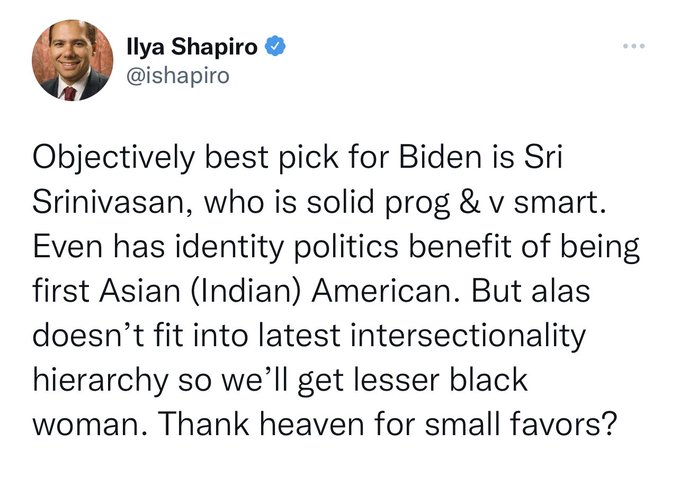
So… a little background.  Shapiro had been recently hired as senior lecturer and executive director at the law school’s Center for the Constitution.  In January, with the announcement of the imminent retirement of Justice Breyer, Shapiro criticized President Biden for signaling his intention to keep his campaign promise to nominate a black woman for any SCOTUS opening.

Shapiro’s admittedly inelegant tweet has been taken down, but there are lots of screenshots, etc., out there:  

OK, so there’s much to unpack here, not least of which is wondering what the hell Georgetown thought they were getting when they offered a senior position to someone who’d put in over a decade at the Cato Institute.  Moreover, Biden’s campaign promise was stupid, pandering, and politically naïve.  Who, exactly, was going to change their vote from Donald Trump to Joe Biden on the basis of that pledge?  And whereas politicians in general (and Biden appears to be no better or worse than most) casually forget what they said in the campaign by, well, the day after the election, Biden picked this vow as one to keep.

Moreover, the stated reason for the exclusion from consideration of anyone except black women, diversity, is rather strained.  True, there’s a long history of white men on the court, due in large part to the fact that for a good deal of American history, they were indeed the only ones qualified.  The eight returning members of SCOTUS after Breyer’s retirement include a black man and three women (one of them “of color”), just not a black woman.  

Plus, of course, Shapiro is right that Judge Srinivasan, as an Asian-American, would also represent a first for SCOTUS.  Equally importantly, let’s look at religion, certainly a category that might shape a justice’s perspective, perhaps to roughly the same degree as race or gender.  According to a Pew Research Center report from a few years ago, Protestants outnumber Catholics in this country by more than a 2:1 ratio, and Jews by nearly 25:1.   Yet even after Justice Jackson replaces Justice Breyer, there will still be six Catholics and a Jew on the Court, as opposed to two Protestants.  If we lump together “atheist,” “agnostic,” and “nothing in particular: religion not important,” we get a figure more than eight times greater than the Jewish population, yet since 1916 there have been two or more Jewish Justices more often than there have been none; there has never been a Justice (or as far as Curmie can tell, a nominee) from that “unaffiliated” group.

Does this make the court “less like America”?  Perhaps.  But Curmie believes in meritocracies.  The NBA sure has a lot fewer white or Asian players than their populations would suggest.  So what?  The goal is to win basketball games, and if the best players available to help the team win are black, so be it.  Same with SCOTUS.  No, I’m not suggesting that every SCOTUS choice was divinely inspired—few of us will have abundant respect for both Clarence Thomas and Sonia Sotomayor—but drafting Sam Bowie before Michael Jordan might not have been the brightest move ever, either.

Shapiro is correct, too, in another tweet in which he suggests that the nominee, who turned out to be Ketanji Brown Jackson, would be regarded as an “affirmative action” choice.  The wording might be a little harsh, but it’s not inaccurate.  One could argue with some justification that the two Justices just mentioned, Thomas and Sotomayor, may also have been chosen for their demographic profiles.  But Jackson was considered the best option not merely from a specifically and intentionally delimited field, but from a delimited field that had been publicly trumpeted by the administration.  The fact that she’s at least as qualified as any of President Trump’s nominees fades to the background: she will be perceived by many people not as the best choice for the job, but as the best available black woman.  And that does add what Shapiro calls an asterisk to her status.

Obviously, though, it’s the penultimate sentence, especially its last three words, in Shapiro’s tweet that has garnered all the attention.  More on that in a moment.  But let’s talk for a moment about what everyone else seems to overlook: that first word.  This guy is a high-ranking administrator at a prestigious law school and he tosses out his opinion as “objective”?  Precision in writing ought to be very high on his list of priorities.  The “lesser black woman” phrasing was inelegant, but any objective observer (see what I did there) reading those words in the context of the rest of the tweet knows what he meant, and it wasn’t racist.  On the other hand, suggesting that objectivity in deciding the “best pick” is even possible, let alone that he alone can recognize that fact is an expression of both delusion and arrogance.

But, let’s return to that phrase that caused all the furor: “lesser black woman.”  Taken in context, all Shapiro is saying is that if Srinivasan is the best available candidate, then literally anyone else is “lesser.”  It was, after all, President Biden, not Shapiro, who limited the field to black women.  The phrasing was, as Shapiro was to admit, “inartful”—“a less qualified black woman” would make the point clearer and less problematically—and yes, he should have known better.  Still, if we were to fire everyone who ever said, “inartfully,” something that wasn’t intended to be offensive but could be interpreted that way, the unemployment rate in the country would be pretty damned close to 100%.

Georgetown, of course, suspended Shapiro almost immediately, with law school dean William Treanor writing that “The tweets’ suggestion that the best Supreme Court nominee could not be a Black woman and their use of demeaning language are appalling.”  Let’s look at the two halves of that statement.  The first part is technically true: if Shapiro thinks the best candidate is an Asian-American man, that pretty much means anyone else—black woman, white man, even a different Asian-American man, is “lesser.”  But “demeaning language”?  Clumsy, sure, but demeaning?  Only if he meant it to be.  (Curmie clings to the vestiges of modernism.)  

Lost in the furor, of course, is the fact that Shapiro’s comments about an “intersectionality hierarchy” are, alas, pretty accurate.  There are those, traditionally disenfranchised, whose omission in the past must be compensated for in the present… and those who, irrespective of skills and qualifications, we in our Wokeness can still cheerfully ignore.

It’s important to note here that the central issue here is not constitutionality: as a private university, Georgetown is not required to allow freedom of expression.  Rather, the question is whether they uphold their own proclamations—that, for example, “To forbid or limit discourse contradicts everything the university stands for.”  To say that Georgetown failed to abide by their own pieties is to err rather more on the side of understatement than of hyperbole.

Anyway, after innumerable headlines, tweets, memes, and other forms of pseudo-argumentation, Shapiro was re-instated… but on a technicality.  He wasn’t actually working at Georgetown yet, you see, when he had an original thought defied Woke orthodoxy tweeted something that should be protected by the university’s claim to academic freedom expressed his heinous opinion.  Therefore, he couldn’t really be terminated.  Sure.  

It is a decision born of cowardice, stupidity, ideological tunnel vision, and a willingness to make up some implausible rationale to avoid (the university hoped) an inevitable lawsuit… people who can be offered leadership positions at Georgetown Law tend to be aware of legal remedies to problems, after all. 

Of course, less than a week after the suspension was lifted, Shapiro quit.  Of course, he didn’t just resign: he sent a four-page, single-spaced letter to the dean and—oh, yeah—made sure to send a copy to FIRE (at the time, the acronym stood for the Federation for Individual Rights in Education; it’s now the Federation for Individual Rights and Expression, expanding the organization’s scope beyond the boundaries of academe).  

That letter is quite a read, with passages like “the IDEAA [Office of Institutional Diversity, Equity, and Affirmative Action] Report—and your own statements to the Law Center community—implicitly repealed Georgetown’s vaunted Speech and Expression Policy and set me up for discipline the next time I transgress progressive orthodoxy” and “no reasonable person acting in good faith could construe what I tweeted to be ‘objectively offensive.’” 

What’s really problematic is that he’s right, even about condoning even more “objectively offensive” tweets by liberal faculty: it’s difficult to find Shapiro’s tweet more problematic than this one from Christine Fair about the Kavanaugh hearings: “Look at this chorus of entitled white men justifying a serial rapist’s arrogated entitlement. All of them deserve miserable deaths while feminists laugh as they take their last gasps. Bonus: we castrate their corpses and feed them to swine? Yes.”  Yet Georgetown invoked their “free expression” policy for that one (as they should have, as both Ilya Shapiro and Curmie agree).

Of course, Shapiro promptly got another gig; he was hired as Director of Constitutional Studies at the Manhattan Institute less than a week after his grand-standing departure from Georgetown.  Someone of cynical disposition might suspect that this change of employment was a). precipitated precisely by the Georgetown kerfuffle and b). in the works long before his suspension at Georgetown was announced.  One suspects that the move, described by one libertarian columnist as “failing upwards,” will provide Shapiro with enough income that he can supersize his #3 combo meal from time to time.

Of course, conservative writers pounced all over this incident, claiming it demonstrates the chilling of free expression on university campuses.  And they’re right… sort of.  Curmie would refine that critique a little, to suggest that university administrators are increasingly narcissistic and hypocritical: anyone who disagrees with their divinely inspired religio-political beliefs is disruptive, and therefore subject to disciplinary action, irrespective of pesky little obstructions like the US Constitution or official university policies.  

Whereas many, probably most, of these incidents involve censorious asshats on the left imposing their will on those of the right (Curmie does recommend a piece written by FIRE intern William Harris for a well-written, interesting, and important overview of the historical relationship between free speech concerns and progressive politics), the converse is also true, as a glance at FIRE’s “recent cases” list demonstrates.  

There, we see attempts to suppress dissent from the left or to withhold support from organizations reasonably linked to liberal ideologies: politics and sexual identity at Hood College, criticism of alleged anti-Semitism at San Diego Community College, complaints about including works by BIPOC and queer authors at Soka University of America, revoking sponsorship of a popular student drag show at Texas A&M... and that’s just in the last six weeks or so.

But there’s another take-away that gets lost in the partisan finger-pointing, a variation on a theme Curmie wrote about over a decade ago in discussing the cases of University of Wisconsin-Stout professor James Miller and Nacogdoches (TX) high school soccer coach Farshid Nourimand.  Both were disciplined by idiot administrators after having done literally nothing wrong.  Both were eventually restored to their positions.  But both had an advantage: not only fans of the short-lived but much-beloved TV series “Firefly” and two of its stars—Nathan Fillion and Adam Baldwin—but also a good many of the 1.6 million Twitter followers of popular novelist Neil Gaiman rallied behind Miller.  Similarly, Clint Dempsey, surely one of the half dozen or so greatest American-born soccer players of all time, made a trans-Atlantic phone call in support of Nourimand. 

Ilya Shapiro has already landed on his feet.  But he was already a big deal, and his case got a lot of press in national media.  But if you’re merely very good at what you do and your case doesn’t get national attention except in places like the Chronicle of Higher Education or Inside Higher Ed, if you’re just someone who criticizes your school’s COVID policy or dares to suggest that the DEI folks are over-reacting to a stimulus that isn’t really even there at all (Curmie wrote about both these stories last October), then you might be in real trouble.  

Not so long ago—well into Curmie’s career, in fact—the presumption was that faculty had the same rights to freedom of expression as everyone else, provided that they didn’t masquerade their opinions as facts and expect their students to agree with them.  Curmie remembers the Political Science department at a place he once taught.  One professor was the county chair of the Republican Party; another successfully ran for Congress as a Democrat.  As far as Curmie could tell, they liked each other, and both were apparently great in the classroom.  That’s what is supposed to happen.

But we have now entered the age of the Infallible Administrator (just ask them), and of imposed orthodoxy and homogeneity.  That’s not good for universities, and it’s certainly not good for the country.  Curmie misses his students, but is kinda glad to no longer be working full-time in a profession that has so demonstrably lost its way.

Sunday, June 5, 2022

The More You Pay, The More It's Worth

There are indeed no fewer than four stories concerning the art world buzzing around Curmie’s brain-box at the moment: the cake-flinging incident involving the Mona Lisa, the millions of dollars of damage at the Dallas Museum of Art caused by a young man “mad at his girl,” and the remarkably amateurish and possibly mischievous restoration of Prague’s Orloj Clock. Curmie has little to add about this last item, and may or may not get to talking about the first two. All of which leaves this item for today’s piece:

An under-appreciated Don McLean song, “The More You Pay, The More It’s Worth,” popped into Curmie’s head unbidden this month. One reason, I suspect, is that a little under three weeks ago, Sotheby’s, the New York-based auction house specializing in high-end artworks and similar items, had a little sale. “Little,” of course, is a fungible term, in this case suggesting that a mere $408 million (well, OK, a little more than that) changed hands in a single evening. 

Picasso’s “Femme Nue couchée”
Leading the way was a Picasso painting, “Femme nue couchée,” in which the famous cubist imagined his lover, Marie-Thérèse Walter, as what the Guardian described as “a multi-limbed sea creature.” That seems pretty accurate, although the prose of Sotheby’s blurb is somewhat purpler:
A crowning achievement of painterly verve, energy and manipulation of the human form, the present work succinctly synthesizes the artist’s groundbreaking achievements of the late 1920s and early 1930s into one colorful, dynamic canvas. Here, in the seclusion of his new country home in Boisgeloup, the nude figure of Marie-Thérèse reclines in a highly abstracted space, her biomorphic figure imbued with fertility, sexuality and grace.
Well, OK, then.

Anyway, people seem to think it’s a pretty impressive painting. Curmie’s not here to disagree with that assessment. Indeed, were you to move the decimal point on the sale price of $67,500,000 a few places to the left, and Curmie might be interested. Indeed, Curmie really likes Monet’s “Le Grand Canal et Santa Maria della Salute,” which sold on the same night, but not, perhaps, to the tune of $56,600,000. In all, some ten paintings sold for $10,000,000 or more apiece, just that one night.

Of course, the Picasso wasn’t even close to being the highest-priced artwork to be sold this month. Andy Warhol’s “Shot Sage Blue Marilyn,” went for almost three times as much at a Christie’s sale only eight days earlier. Yes, really: $195,000,000.

What would possess someone—anyone—to spend that kind of money on a single painting? The most obvious answer is conspicuous consumption: you spend millions of dollars on an artwork to show the world that you can. Another possibility is as an investment: what you can buy for a mere $195 million today might double in value, even relative to inflation, in just a few months. Of course, it might not, but if you’ve got that kind of money to spend on a painting, you can afford to take a gamble. Occasionally, the buyer is a museum rather than an “individual collector.” As a regular person with an interest in art, you like these folks. You might need to travel to Paris or London or New York, but you can actually see that masterpiece.

Of course, a lot of people go to those museums to say they’ve been there. Curmie remembers two trips to London’s Tate Modern: one in December of 2010, one in May of 2019. The special exhibitions on those two visits were of, respectively, Paul Gauguin and Dorothea Tanning. The former was, as might be expected, more expensive, ridiculously crowded, and peopled by a lot of folks who gave every impression of not wanting to be there. To some extent, Curmie was one of them: he likes Gauguin, but isn’t a huge fan, and the exhibition wasn’t of (Curmie’s personal opinion of) the artist’s best work.  Curmie’s claustrophobia didn’t help, either.

Tanning’s most famous painting,
“Birthday”
By contrast, Curmie could show up at the ticket booth for the Tanning exhibition, buy a ticket at a reasonable price, and walk right in, instead of having to wait for two hours. There were other patrons there, but there was room to move around, and everyone was actually engaging with the art, stopping to examine this painting, stepping back to get a different perspective on that one, actually reading the posted descriptions. Curmie confesses he’d barely heard of Tanning prior to seeing that exhibition; a couple of the pictures in the promotional materials looked interesting, so he gave it a try. Curmie is now a fan. That’s what is supposed to happen: you check something out, and you like it. (Or it’s not to your liking; that’s OK, too.)

The point is that people swarmed the Gauguin exhibition not because they’re Gauguin fans, but because Gauguin is famous. And there’s no absolute guarantee that you’re looking at an authentic Gauguin, anyway, as a couple of stories from the last couple of years demonstrate. Here’s one about alleged Gauguins at the Getty Museum (this piece is now admitted to be a fake), the National Gallery in Washington, DC, and the Museum of Fine Arts, Boston. And here’s one about a fake in the Tate’s own permanent collection.

Curmie’s suspicion is two-fold: that the average person (Curmie included) couldn’t tell the difference, and either liked or didn’t like these works based on personal, idiosyncratic taste, independent of issues of authenticity; and that such an average person would be less likely to visit a museum or pay extra for a special exhibition if one or more artworks were believed to be forgeries or even (honestly) misattributed.

This might be the time to remind you, Gentle Reader, of the now-famous episode of world-famous violinist Joshua Bell putting on a baseball cap and a t-shirt and busking in a Washington, DC, subway station, playing a multi-million-dollar Stradivarius. Virtually no one paid any attention, and he made a total of $32, over half of it from a single contributor who actually recognized him from having paid a lot more than that to see him perform a night or two earlier. As blogger Harvey Reid puts it, “It’s hard for people to believe there is something amazing going on when there is no crowd, and nothing telling you to pay attention. There is a lot of context and provenance involved.”

Also of interest is the rationale for the Toledo Museum of Art’s sale of Cézanne’s “Clairière” (“the Glade”): “to establish an endowment to fund art acquisitions.” The painting sold for $41.7 million, so their endowment is off to a good start. More to the point, the management in Toledo seems to think that owning 400 paintings worth $100,000 apiece might be better than having one painting worth $40 million. Curmie nods in agreement.

Of course, the visual arts aren’t alone in this. COVID—both the pandemic itself and the still-extant regulations regarding mask-wearing (a restriction that has passed its sell-by date for most people) have actually made live theatre much more affordable. I just checked: I could get a ticket for Hamilton, once in the $600 range, on Tuesday night for less than $150 on Broadway, or for about $60 in the West End. The play I’d most like to see in either of those cities, Girl on an Altar, has good seats available all this week for £20, or about $25.

Theatre prices will skyrocket again once the industry finds its footing again.  (There was a brouhaha in London recently when tickets to Cock hit £460, or about $575, counting absurdly high processing fees.) Curmie has seen a lot of commentary from friends based in New York that it is becoming increasingly difficult to get New Yorkers to come to the theatre,  Tourists make up well over half of Broadway audiences already, and that percentage seems to be growing.  If Broadway is to ever again be a place where something other than already-established musicals can thrive, it will have to be the locals that make it so.  And that means prices that middle-class New Yorkers can afford.

But live music has gone in the opposite direction. An “Open Letter to Paul McCartney Regarding Ticket Prices” by Ryan Ritchie was published in Los Angeles Magazine a few weeks ago. A sample: “Call me naïve, but I don’t think any three people should have to pay $700 to attend any concert that doesn’t include Elvis walking onto the stage and confirming he faked his 1977 death. That is worth $700.”

It gets worse. Curmie follows the “Spring-Nuts” (Bruce Springsteen fans) Facebook page. The Boss, once the voice of the working class, recently released the European dates for a tour that won’t start until nearly a year from now. Many of those venues are already sold out, with tickets for even standing room running into the hundreds of dollars apiece, and that’s before the scalpers get in on the action. And a LOT of American fans are flying to Dublin or Amsterdam or wherever to see a concert. Curmie and Beloved Spouse would probably spend $500 or so, total, to see Springsteen live… but not round-trip airfare for two to Europe, several nights in hotel rooms (and meals in restaurants), and $400+ per ticket for standing room. Who will be at those concerts? Some die-hard fans, willing to drain their life savings to see their hero… and a bunch of rich people.

This isn’t good for the industry, or, more importantly, for the culture. If people are denied the opportunity to hear live music, or to see the detail of a great painting or sculpture, they’ll never understand that the actual art object is always superior in manifold ways to reproductions—recordings, photographs, whatever.  And they’ll either lose interest in the transcendence of great art, because they’ve never experienced it (notice that neither image included with this post does justice to the original painting), or, as in Plato’s cave allegory, they’ll try to convince themselves that the shadows are the real thing. Curmie isn’t sure which is worse, but he does know this: either way, we all lose.

Saturday, June 4, 2022

These Are Our Protectors. Alas.

Three stories from the past few weeks about the people who are allegedly protecting us.  No, this isn’t about the sorry excuse for law enforcement in Uvalde: everyone already knows about that gaggle of craven incompetents.  More to the point, we can at least understand their inaction, which seems to have been motivated by little else than garden-variety cowardice.  No matter how well you’re trained, no matter how much body armor you’re wearing, that guy in there has a semi-automatic rifle and an apparent desire to kill people: choosing not to be his next target is understandable.  We might hope for more from our police, but we shouldn’t be surprised at what we got.

Today, Curmie writes about different, less comprehensible, forms of unfitness for the job.  Sometimes it’s just people who are temperamentally ill-suited to perform the functions of the job.  Sometimes it’s a system ripe for corruption and a police force more than ready to exploit those opportunities.  And sometimes, well, we’re talking about a significant error of judgment.  It’s probably not true that the cop in question would come in third in a battle of wits with a dead chipmunk and an anvil, but one particular decision was, shall we say, particularly ill-advised.  

As usual in such posts, Curmie takes them in the order they crossed his path.  We begin, then, in Buffalo, NY, site of the last big mass shooting before Uvalde.  Notice the key word, “big.”  There were in fact 15 mass shootings (at least four people killed or injured, not counting the shooter) in this country, accounting for 12 deaths and 72 injuries between Buffalo and Uvalde.  There have been 22 mass shootings (that’s two per day), with 19 dead and 102 injured in the 11 days since Uvalde.  It’s almost as if there was an ongoing problem here.

Latisha Rogers

Eh bien, revenons à nos moutons: One of the survivors of the Buffalo attack was Latisha Rogers, whose misfortune it was to experience her second such shooting incident: the first cost her brother’s life.  This time, Rogers was working at the customer service desk in that Tops supermarket in Buffalo when the shooting started.  She took cover behind the counter, hoping not to be seen.  She took out her phone and called 911, whispering to the dispatcher that there was an active shooter in the store.

The response?  “What? I can't hear you. Why are you whispering? You don't have to whisper, they can't hear you.”  Right, because you can intuitively determine where the shooter is relative to Rogers’s location.  Then, in Rogers’s words, “She got mad at me, hung up in my face.”  OK: not being able to make out what is being said over the telephone by someone who is whispering—that’s completely understandable.  But you’re a freaking 911 operator, and it’s part of your training to understand that if someone is speaking very quietly, there’s probably a reason. What you don’t do is have a snit fit and end the call.

County Executive Mark Poloncarz described the 911 operator’s performance as “inappropriate” and “completely unacceptable.”  Ya think?  Of course, a different county mouthpiece said the law enforcement response time was not affected by the handling of Rogers’s call.  He might even be telling the truth, but Curmie wouldn’t bet the price of a small pizza, let alone the ranch, on the veracity of that statement.  Doing what you can to keep the county from getting sued is likely to trump integrity in situations like this.

The only good news to come out of this is that the still unidentified dispatcher was indeed fired, which is about all one can hope for.  There was no apparent malice, and nothing illegal about her actions.  But people like that ought to find alternative employment.  That’s obviously going to happen.  Curmie hopes so, at least, since he doesn’t want to spend a lot of taxpayers’ money on unemployment compensation.

Our second story suggests that not all cops are good guys.  Who knew, right?  Anyway… In Polish immigrants Justyna and MattKozbial bought a building, formerly a church, in small-town Highland Park, an enclave within the city of Detroit.  After securing some 13 separate licenses, they converted the space into a facility to grow medical marijuana.  Sometime later, on Christmas Eve of 2020, Mayor Hubert Yopp and Police Chief Kevin Coney showed up for a “fire inspection.”  Fire inspections, of course, should be conducted by jamokes like these two instead of… you know… people with relevant credentials, like, I don’t know… maybe someone in the fire department?

Upon entering the building, what to their wondering eyes did appear (Christmas Eve, remember?) but a bunch of marijuana plants?  Naturally, despite the baker’s dozen licenses, the (ahem) fire inspectors declared the site an “illegal narcotics operation” and seized the building under the state’s arcane forfeiture laws. 

Stupid laws like these allow corrupt cops and politicians (there’s another kind?) to exploit the system for literally millions of dollars of cash and material goods.  There are some (not enough) safeguards, such as the one which requires that such seizures be reported immediately to county prosecutors.  Guess who says they were never contacted…  But also guess who did nothing about it when they were, at least until the story went public.

It should be noted here that the Kozbials have not only never been convicted of any offense, they’ve never even been actually charged with a crime, making the seizure of their property even more outrageous.  And yet, things manage to get even worse. 

The city tried what the Kozbials’ lawyer rightfully calls a “shakedown with a badge and a lawyer.”  Highland Park officials actually told the Kozbials that they could get their property back in exchange for two police cars valued at nearly $70,000.  Really, it’s apparently right there in the city records.  In a just universe, Yopp, Coney, and City Attorney William R. “Terry” Ford would now be doing hard time with roommates named Mad Dog, El Diablo, and the Butcher.  Does this look like a just universe to you, Gentle Reader?

There are folks interested in reform of the system—the Mackinac Center, for example—but it’s a long and winding road ahead.  What passes for good news here is that the city conceded shortly after TV coverage from the Detroit ABC affiliate.  Of course, the shakedown artists at the center of the escapade are still in positions of responsibility and more than likely to try again. 

Marc Deldin, the Kozbial’s attorney, makes the cynical but accurate observation that “There’s clearly no respect of the constitution or people’s rights. But there appears to be a fear of the media, because it took a call from you and a story for them to do the right thing….  That should have been done 17 months ago.” 

Curmie is no fan of the media in general terms, but sometimes they do some good.  This would be one of those times.

Finally, we move on to a different kind of incident at a Texas elementary school: a career day.  The day after the Uvalde shootings, a Tarrant County Deputy appeared at a career day at E.M. Daggett Elementary School in Fort Worth.  After the formal presentation, a student asked the deputy what kinds of weapons his vest protected him against.  The deputy then did a Google search, thereby projecting images of AR-15 rifles onto the classroom screen.

Even if, as is likely the case, this was just a moment of not paying attention to the circumstances, it’s a little strange to want to show kids pictures of any kind of guns in answer to that question, irrespective of the timing.  When we add in the fact that those kids are the same age as those killed by essentially that weapon, in that state, the day before… well, that’s a remarkably stupid thing to do. 

But for the brighter kids in the class, the lesson is even more traumatic.  They’ll put things together: “yes, my vest will protect me from the very weapon that killed 19 kids your age yesterday, but the police there didn’t do anything to rescue those children.  These vests are to protect us, not you.  If the same thing happens in this classroom, don’t expect any help from us.”  OK, that’s a little harsh, but you see what I mean, yes? 

The Uvalde police had riot gear, but did nothing for what must have seemed an eternity for those still alive.  Could moving faster have saved one or more of the victims?  Maybe.  But whether it would have made a difference is pure moral luck.  The lives of schoolchildren in Uvalde were deemed insufficiently important to demand an immediate intervention by police. 

There were probably fewer students in class in elementary schools across the country, let alone in Texas, the day after Uvalde: one of Curmie’s Facebook friends, a teacher in Texas, reported that only about a third of her students were physically present that day.  And then to remind the ones who were there that even Kevlar-protected cops wouldn’t necessarily come to the rescue—this may be an appropriate lesson for junior high kids. But for elementary students, the Sheriff’s Office apology that described the incident as “insensitive and a profound momentary lack of judgment” leans more to the side of understatement than of hyperbole.

The good news here was that the reports Curmie saw that the Deputy had brought an actual AR-15 to the school were false.  That’s something, although it also highlights how easily false information can spread.

So there you have it, three stories about people who are supposed to keep us safe: a 911 dispatcher ill-suited for the job; a conspiracy of cops and other city officials to screw over private citizens who had done nothing wrong, and a moment of extreme if unintentional callousness.  All in all, not a good look.


Friday, June 3, 2022

Ceci n'est pas un poisson.

Not a fish.
This will be a considerably shorter post than usual for Curmie, but I can’t just let this go.

The Sacramento Bee (who else?) reports that the state of California has determined that bees qualify as fish. 

This all stems from a series of bills designed to protect endangered species.  So far, so good, right?  Well, the legislation specifies “a native species or subspecies of a bird, mammal, fish, amphibian, reptile or plant.”  Notice that bumblebees, or indeed insects in general, don’t qualify under that rubric.  But, given the need to protect pollinators and the disastrous effect some pesticides have had on bee populations in general, it appears to have been someone’s bright idea to allow for their protection by including not merely snails and similar creatures, but bees, under the category of “fish,” since they are invertebrates (!).

Of course, as anyone who passed high school biology (or, probably, 4th grade science) knows, fish aren’t invertebrates.  Curmie can’t tell whether the California officials are that ignorant or simply convinced that people will decide that since their deception is for a good cause, no one will care.  The obvious solution—getting the legislature to include insects and other invertebrates in the wording of the act in question—never seems to have occurred to anyone.

California has long been the bête noire of the American right, who often make themselves look foolish in the process.  This is not one of these times.  Calling bees fish because it is convenient to do so is stupid.  And little Johnny, not the brightest star in the firmament, is already appealing his Biology grade.

Sigh.


SCOTUS Won't Protect the Innocent

Barry Jones

The SCOTUS “ruling” that’s gotten all the press over the last few weeks isn’t really a ruling at all, at least yet.  Lost in the controversy surrounding what appears to be the imminent reversal of Roe v. Wade is the case of Shinn v. Ramirez, which may have the most horrific consequences of any decision in recent history.  We can disagree about RvW, but there are competing claims there, centered, as Curmie recently argued, on when in the progression from fertilized egg to childbirth a collection of cells becomes a human with rights equal to the mother’s.  And whereas Curmie has argued for some significant limitations on the availability of semi-automatic weapons (for example), at least the Bill of Rights does guarantee the right to bear arms.   

Curmie concentrates here on the case of Barry Jones (whose case was lumped in together with that of David Martinez Ramirez, accounting for the title of the case).  It’s not news that the Supreme Court is more interested in legal niceties than in actual justice (see, for example, Curmie’s commentary on Walmart v. Dukes some eleven years ago).  But usually this manifests in preventing a group of people from filing a class-action suit instead of individual suits, procedural stuff like that.  But SCOTUS sees no legal impediment to allowing the state of Arizona to execute Mr. Jones despite the fact that he is almost certainly innocent.  Yes, really.

The central issue here pertains to the 6th Amendment guarantee of “the Assistance of Counsel,” a phrase that has always been interpreted by the courts as effective counsel. It doesn’t count if your weird Uncle Howard sits by your side and offers advice.  It doesn’t even count if Curmie, who is perhaps only marginally less weird, but a good deal better educated, than Uncle Howard does so: Curmie’s knowledge of criminal law consists of a one-day stint as a juror and considerable experience watching TV courtroom dramas (many of which were set in England).  No, you need an actual lawyer who does his/her damned job.

Jones was convicted of the 1994 murder of his girlfriend’s 4-year-old daughter, Rachel Gray.  As Justice Sotomayor argues in her dissent,

The State argued that Rachel died as a result of an injury she sustained while in Jones’ care. Jones’ trial counsel failed to undertake even a cursory investigation and, as a result, did not uncover readily available medical evidence that could have shown that Rachel sustained her injuries when she was not in Jones’ care. Having heard none of this evidence, the jury convicted Jones and the trial judge sentenced him to death.

Jones’s appeal was similarly mishandled, so he was again denied his 6th Amendment right to effective legal counsel.  Indeed, quoting Sotomayor again, “Arizona state law sets minimum qualifications that attorneys must meet to be appointed in capital cases like Jones’, but the Arizona Supreme Court waived those requirements in Jones’ case, and the state court appointed postconviction counsel who lacked those qualifications.” Holy Star Chamber, Batman!

Some would argue, as Ian Millhiser does on Vox, that SCOTUS is ignoring its own precedents.  Still, it may be true that in purely legal terms the SCOTUS ruling in Shinn v. Ramirez not to allow a federal lower court to initiate an evidentiary hearing is the correct one.  Nevertheless, such a decision cannot be abided in terms of justice.  There is no judicial equivalent to the Hippocratic oath’s admonition to “first, do no harm.”  Were such a stricture in place, we wouldn’t have the usual suspects on the Supreme Court of the United States calmly wiping away any impediments to the execution of Barry Jones.

When the stakes are this high—not merely for Mr. Jones and his friends and family, but for the very significant collateral damage to the citizenry’s perception of justice in this country—the Supreme Court needs to exercise leadership, to pay heed to Ben Franklin’s famous line (possibly riffing off Voltaire and/or Sir William Blackstone) “That it is better 100 guilty Persons should escape than that one innocent Person should suffer, is a Maxim that has been long and generally approved.”

This notion, which dates back centuries, has long been touted as one of the bedrock principles of American jurisprudence—Curmie remembers hearing about it in elementary school in the 1960s, and has taken it as an article of faith ever since.  Those who disagree with this idea tend to be authoritarian rulers like Otto von Bismarck or revolutionaries like Che Guevara—neither of them heroes to the average American. 

That said, one of the more chilling aspects of Curmie found while doing a little research for this essay was a poll conducted by the Cato Institute in 2016, which shows that only 60% of Americans think it’s worse to punish the innocent than to let the guilty go free… not in the 100:1 ratio invoked by Franklin, but in even numbers.  Yes, 40% of Americans, and an even more terrifying 52% of Donald Trump’s “early core supporters” responded to the question of which is worse, “having 20,000 people in prison who are actually innocent; or, having 20,000 people not in prison who are actually guilty” by selecting the latter.  Whereas Democrats were slightly more likely than Republicans to protect the innocent rather than punish the guilty, the real difference is between the authoritarian and the libertarian.  Still, only 75% even of Bernie Sanders’s supporters chose to keep the innocent out of prison even at the expense of failing to incarcerate the guilty.

So Curmie’s initial response that the American people would be outraged at the callousness of the SCOTUS ruling seems to have been misplaced.  This observation would seem to support the commentary of H.L. Mencken about nobody going broke underestimating the intelligence of the “great masses of the plain people.”

But the phrase that haunts Curmie the most is the smug assertion by the insufferable Justice Antonin Scalia, surely the most over-rated jurist in a very long time indeed, that “actual innocence” (his quotation marks) is not grounds for even re-opening a case. Curmie remembers writing somewhere (perhaps on the Facebook page?) that Dickens’s Mr. Bumble may or may not be correct that “the law is an ass,” but that Antonin Scalia certainly is. 

Scalia’s infamous line appears in his dissent in the case of Troy Davis.  SCOTUS ordered a federal court Georgia to consider whether new evidence would clear Davis of a murder charge.  For good or ill, the original verdict was upheld.  Curmie wrote about that case on the eve of Davis’s execution.

What’s different here, however, is that whereas Davis was quite likely innocent, Jones certainly was innocent: the fatal injuries inflicted on Rachel Gray could not, according to three independent experts, have occurred when Jones was even in proximity to the girl.  It’s reasonable that the burden of proof shifts after a verdict: a defendant is not guilty until proven otherwise beyond the proverbial “reasonable doubt.”  Once convicted, however, that person now must prove innocence: not merely that it can’t be proved he did it, but that he can prove he didn’t.  But to shut down the possibility of appeal when there’s evidence not of “probable innocence,” but of “actual innocence,” corrupts the system beyond recognition.

There’s one more thing.  Curmie suspects that he has certain advantages over Barry Jones: he’s almost certainly better educated, very likely more intelligent, and probably in a better financial situation.  Yet Curmie has hired two lawyers ever: one didn’t do something he should have been certain to do, and the other committed an act of colossal stupidity.  With luck, these errors, one of omission and one of commission, will cost Curmie only a few dollars.  At worst, it could be more than a few dollars, but they certainly won’t cost his life.  But if Curmie can hire not one but two lawyers who didn’t get the job done, he finds it difficult to blame Barry Jones for doing the same.

Of course, however much we might like to blame SCOTUS for the brouhaha, there’s at least an argument that they’re just enforcing pre-existing rules.  (We’ll casually avoid mentioning that decisions like Plessy v. Ferguson were once considered inviolable.)  The real blame here falls directly on the Arizona authorities who, presented with real, documentable evidence of both Jones’s “actual innocence” and the incompetence of his defense team, doubled down on their own laziness, corruption, and dereliction of responsibility.  

Curmie was just hoping, rather forlornly, that SCOTUS would protect the innocent instead of the obviously guilty.  No, huh?